Friday Sep 18, 2026
Friday Sep 18, 2026
Monday, 22 December 2025 03:18 - - {{hitsCtrl.values.hits}}
 Conclusions made by Wijesinghe in his research have been revealing. As the main supportive growth contribution, the Government that introduced the open economy system in 1977 had produced a public investment program or PIP to identify in which areas the Government capital expenditure should be spent during 1979-84. In my view, this is a hastily developed document to attract foreign official and non-official investment flows to the country. This weakness of the program has also been found by Wijesinghe. He says that PIP in question has been prepared on a judgmental and informal basis without specifying the needed relationships for estimating production, income, and demand
 On the side of the annual general meetings of the IMF and the World Bank in Prague, Czech Republic in 2000, I had a private conversation with the then World Bank’s Chief Economist Nicholas Stern, now Lord Stern. When he learned that I was from the Central Bank of Sri Lanka, he told me that his best doctoral student at the University of Warwick happened to be an officer of that Central Bank.
He said that the Warwick University had offered him a Postdoctoral Fellowship to continue his research, but his employer, the Central Bank, had not approved of that unique distinction afforded to one of its officers. So, his best Doctoral student as well as the Central Bank lost a golden opportunity to make themselves known in the global arena of economists.
Stern was talking about my late colleague Dr. D. S. Wijesinghe, who was a Head of Department at that time but later retired as Deputy Governor of the Central Bank. Wijesinghe had joined the Central Bank as a probationary staff officer in 1974 with a First-class Honours Degree in Economics from the then University of Ceylon, Colombo. While being at the Central Bank, Wijesinghe had earned a Postgraduate Degree titled Bachelor of Philosophy or BPhil Degree in Economics. Wijesinghe had had a polio attack during his childhood, and therefore, his physical fitness was a little weaker than others in the university or the Central Bank. But his brainpower was far superior to anyone of them.
Though I was senior to him by one year at the Central Bank, he was a very close friend, associate, Guru, mentor, and sometimes a protégé of mine. Every time, we met we talked about books, movies, economics, politics, history, and so on. His knowledge base was so wide, that he could talk on any topic for hours with ease. Though his school education had been purely in the arts stream – Sinhala, Pali, History, and Government for Advanced Level – his quantitative orientation had been just like someone who had been in that area throughout his learning.
|
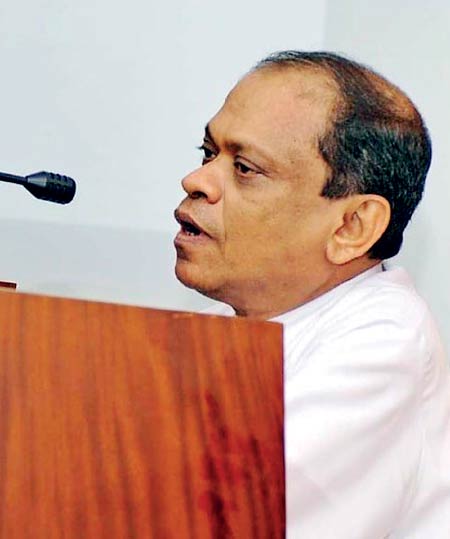
Dr. D. S. Wijesinghe addressing a Central Bank seminar
|
Because of the chronic and acute foreign exchange shortage faced by Sri Lanka in the 1970s, the Central Bank had to depend on foreign scholarships to train its officers. It had got three scholarships from the British Government under the Colombo Plan, and there were more than 20 aspirants to get one of these placements. The bank had a very stringent selection process and finally zeroed on Wijesinghe, Zuhair, and me as the three scholars to undertake postgraduate studies in the United Kingdom.
Wijesinghe went to Warwick, Zuhair to Manchester, and me to York to do our postgraduate degrees. After doing his Master’s Degree in Quantitative Economics at Warwick, Wijesinghe returned to the bank, worked for some time in the Economic Research Department, as well as the South-East Asian Central Bank or SEACEN Research and Training Centre in Kuala Lumpur, Malaysia, and proceeded to Warwick again to complete his Doctorate. It is during this period that he had met Stern.
When Stern talked highly of the academic excellence of Wijesinghe, it did not surprise me. We had frequent discussion on the progress he was making in his Doctoral research that finally culminated in the submission of a thesis titled ‘Some Experiments with a Multisectoral Intertemporal Optimisation Model for Sri Lanka’ for the PhD of the University of Warwick in 1983.1 This thesis was supervised by a team of academics from Warwick headed by J. I. Round. The other two were Nicholas Stern and S.K. Nath.
Strangely, simultaneously with Wijesinghe, another central banker, A. G. Karunasena, did research on the same lines on Sri Lanka at the MacMaster University in Canada and his thesis titled ‘A Macroeconometric Model for Sri Lanka’ was also submitted in 1983.2 Both had tested a general equilibrium economic model for Sri Lanka using advanced econometric tools available at that time. The Central Bank’s macroeconometric analysis capabilities were greatly strengthened when these two economists returned to the bank after obtaining high academic qualifications from two prestigious universities on either side of the Atlantic.
As I had explained earlier3, on the direction of Governor Warnasena Rasaputra, an economist of econometric orientation himself, Wijesinghe was posted to the specially created macroplanning division in the Economic Research Department to work with the other economist there, A. G. Karunasena. The duo was required to jointly prepare a macroeconomic plan for Sri Lanka, train the junior officers in the art and science of macroplanning, and analyse numerous policy proposals that were being considered by the Government at that time from a macroeconomic point. Their joint work resulted in the submission of internal policy papers to the Central Bank management which are not available to the public even today. I am personally aware of how Governor Rasaputra and the senior management of the bank valued those policy papers in terms of their content, profundity, and professional approach.
Wijesinghe’s thesis was submitted at a crucial point in Sri Lanka’s economic history when the country was struggling to move from a closed economy to an open economy. Hence, the past economic policy stances were not appropriate for the new economic policy regime being established in the country. This was aptly identified by Wijesinghe in his research. Noting that Sri Lanka had numerous attempts at macroeconomic planning since Independence, Wijesinghe says that the basic fault in all those plans was that they were based on the then popular Harrod-Domar growth model which placed exclusive emphasis on the level of investment as the prime driver of economic growth.4
However, says Wijesinghe, economic development depends not only on the volume of investment, but also on its efficient allocation. This crucial ingredient in economic development had not been accommodated even in the open economy policy implemented after 1977. Recognising the private sector as the engine of economic growth, the policy pursued by the new Government – all Governments since then, including the present one led by President Anura Kumara Dissanayake – had chosen simply to be only the facilitator without moving into a comprehensive macro plan.
Wijesinghe criticises this policy in his thesis as follows: “(The) Government believes that it could provide the necessary motivation for growth, but to which sectors is the Government going to provide incentives? Which sectors are to be given relatively more emphasis? To answer these questions, we should study the optimal development path of the economy. It cannot be done systematically without using an optimisation model.”5 Hene the necessity for an economy-wide development planning model.
Wijesinghe has presented such a model in his pathbreaking research study. He has conducted several experiments to gain insight into the structure of the economy and to understand the binding constraints for development. The areas he had investigated and experimented are the importance of savings for economic development, and when savings fall below investments, how to solicit stable foreign assistance flows to the country, the implications of the Government’s capital expenditure programs for sustaining long-term economic growth, and how to make economic growth inclusive by ensuring proper distribution of the economic fruits. These are economic issues which even the present Government is faced with.
The model used by Wijesinghe, as well as that of Karunasena, is a general equilibrium model which reaches its optimum level when the system is in equilibrium from all sides. However, when you test that model for Sri Lanka’s data prior to 1977, you run into the problem of distorted market prices which had been subject to strictest controls by the Government. In other words, you do not get market clearing prices to find whether your model is at equilibrium.
Wijesinghe also had run into this problem and due to time limitation, he had used the existing data with modification suitably to represent the current status of the economy. Economists call the modification of these data as using ‘shadow prices’ which are calculated by using the best judgment of the researchers. Because of this reason, the shadow prices computed by one researcher may differ from those calculated by another. Hence, it is a perennial problem and subject to debate. Though Wijesinghe has used a modified Social Account Matrix to calculate the relationship and growth coefficients for the main sectors of the economy, he admits that his research conclusions based on them should be interpreted with caution.6 What this means is that future researchers on the Sri Lankan economy should strive to build up such a corrected historical data base. Unfortunately, neither Karunasena nor Wijesinghe had attempted to do this.
Conclusions made by Wijesinghe in his research have been revealing. As the main supportive growth contribution, the Government that introduced the open economy system in 1977 had produced a public investment program or PIP to identify in which areas the Government capital expenditure should be spent during 1979-84. In my view, this is a hastily developed document to attract foreign official and non-official investment flows to the country. This weakness of the program has also been found by Wijesinghe. He says that PIP in question has been prepared on a judgmental and informal basis without specifying the needed relationships for estimating production, income, and demand.7 Therefore, when the econometric model which he had developed is used for testing the goals of PIP, it has been found that its goals have been overestimated and there are reasonable doubts about the feasibility of attaining its targets. This has even been realised by those who produced PIP after it was put into operation.
The paucity of domestic savings and the need for obtaining high foreign exchange flows to fill the saving investment gap have been the key bottlenecks which Sri Lankan planners may face when they attempt at a high economic growth for the country. Wijesinghe’s research has found that both are binding constraints for effective Government planning in the country. Sufficiently high foreign exchange flows are needed to finance investment as well as to sustain the import demand
Accordingly, Wijesinghe notes that in late 1980, some of the public expenditure plans have been scaled down to make them more realistic. Thus, Wijesinghe has concluded that due to the infeasible goals in the Government’s capital expenditure program, there will be pressure to attract more foreign funding, and if those funding requirements are not met, domestic credit creation will be needed to finance it. He has very correctly concluded that the country will end up in a high inflation regime exacerbated by a foreign exchange crisis. Sri Lanka’s inflation and balance of payments record in the first five years of 1980s has proved Wijesinghe correct.
The paucity of domestic savings and the need for obtaining high foreign exchange flows to fill the saving investment gap have been the key bottlenecks which Sri Lankan planners may face when they attempt at a high economic growth for the country. Wijesinghe’s research has found that both are binding constraints for effective Government planning in the country. Sufficiently high foreign exchange flows are needed to finance investment as well as to sustain the import demand. In this respect, concludes Wijesinghe: “If no foreign financial assistance is not forthcoming, economic growth is not sustainable even without incurring any expenditure on public overhead expenditure.”8 His research has found that given the low savings made by the poor, the rich and formal institutions, it is not possible to increase them to the required levels in the short run. Hence, it is crucial for Sri Lanka to attract additional foreign exchange assistance put the country onto a sustainable growth path. This conclusion is valid even for today.
When a country is faced with the problem of inadequate foreign exchange inflows to meet its investment and import requirements, the usual solution made is moving into import substitution. The rationale of this strategy is that the country by saving its foreign exchange expenditures could fill the gap in its balance of payments, on one side, and boost the local production thereby giving new incomes to local producers, especially those engaged in agriculture. This was the policy adopted prior to 1977 and the policy advocated by some in the present period.
Import substitution prior to 1977 happened to be dictated by political authorities without considering the competitive edges of producers. In this respect, Wijesinghe’s research has revealed: “The results obtained through these two different sets of non-competitive import coefficients revealed that the import substitution has been only marginally effective, enabling the economy to achieve slightly higher levels of overall consumption and incomes. It appears that to accelerate economic development, import substitution alone is not a sufficient policy unless perhaps it could be implemented on a very high scale.”9
A weakness in Wijesinghe’s study, in my view, has been the disregard of the role of export promotion, both merchandise and services, as a powerful source of foreign exchange for the country. The long-term economic development of Sri Lanka depends on its ability to promote both these sources as a permanent solution to its chronic as well as acute foreign exchange problem. I have argued in a previous article in this series that Sri Lanka should promote exports to deliver wealth and prosperity to its people on a sustainable basis.10
Wijesinghe rose in the hierarchy of the Central Bank gradually and steadily. By the time he retired in 2010, he was Deputy Governor. In my view, his destiny would have been changed had the bank allowed him to accept the Postdoctoral Fellowship offered to him by Warwick. Had he continued his research on economic policies using advanced econometric tools, he would have risen to a very high position among the global economists’ community. But he did not have any ill-will for those who denied him of that opportunity.
He continued to do research using advanced econometrics, published them in Central Bank’s Staff Studies, supported his colleagues to undertake research, and was a leading figure among the economists within the bank. Ten years have now elapsed since he had left us. Till his untimely death, he was supporting his colleagues in the bank in numerous advisory capacities. Those who have worked with him know the brilliance he carried within his fragile physical stature.
Wijesinghe is surely an unsung hero of the Central Bank.
(The writer, a former Deputy Governor of the Central Bank of Sri Lanka, can be reached at [email protected] )
Endnote)
1 Wijesinghe, D S, 1986, Some Experiments with a Multisectoral Intertemporal Optimisation Model for Sri Lanka, Central Bank of Sri Lanka, Colombo; out of stock now, but interested readers can download from: https://wrap.warwick.ac.uk/id/eprint/111326/1/WRAP_Theses_Wijesinghe_1983.pdf
2 See: https://www.ft.lk/columns/Unsung-heroes-of-the-Central-Bank-1-Dr-A-G-Karunasena/4-785342
3 Ibid.
4 Wijesinghe, op.cit, p 8.
5 Ibid, p 9.
6 Ibid, p 109.
7 Ibid, p 239.
8 Ibid, p 241.
9 Ibid, p 244.
10 See: https://www.ft.lk/columns/Navigating-the-economic-reawakening-and-sustainable-growth/4-758814