Friday Sep 18, 2026
Friday Sep 18, 2026
Monday, 26 January 2026 03:50 - - {{hitsCtrl.values.hits}}
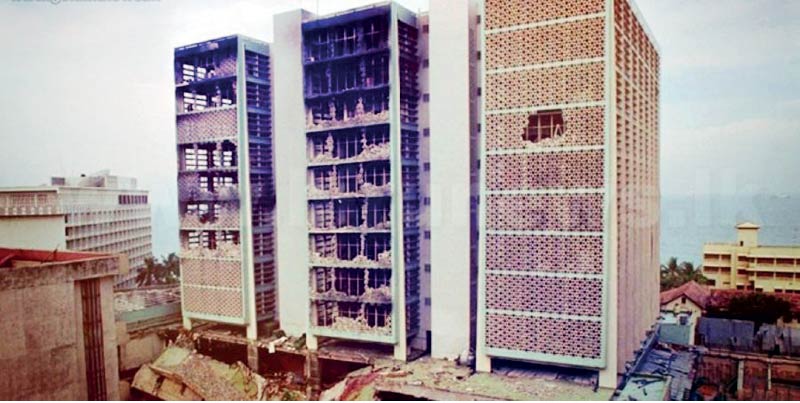
The gutted Central Bank building after the bomb attack
 The bomb explosion was sudden and unexpected. As desired by the LTTE, it created the maximum impact on human lives and physical property. 41 Central Bankers perished on the spot or after being transported to hospitals. More than that number of people died in surrounding institutions. About 1,200 Central Bank officers were seriously injured. Two wings of the Central Bank building, an icon in the city, had been gutted by fire. The bank as well as the other institutions in the area surrounding the Janadhipathi Mawatha, the epicentre of the bomb explosion, instantly became non-functional
 Gruesome attack on Central Bank by LTTE
The Central Bank every year beginning from 1997 conducts a remembrance service in the morning of 31 January to tell the new Central Bankers of the gruesome attack by the LTTE on the country’s key financial institution, the Central Bank, on that day in 1996. The objective of the LTTE was to destroy the bank, create mayhem in the financial system, weaken the economy, and thwart the Government’s efforts to fight the LTTE which had been conducting a bloody campaign for a separate state.
To destroy the Central Bank, the LTTE rammed a lorry packed with a powerful bomb into the bank’s premises, used its foot soldiers to give cover to the lorry and annihilate the surviving Central Bank officers with machine gun fire, and complete the job which the bomb could not do by overrunning the bank. They could not have chosen a better day for the attack since the security measures in the city of Colombo had been eased that day because the top brass of the Government, including the President, had not been in the city. They all had travelled to Anuradhapura to open the new Rajarata University there and most of the security contingents had been transferred to provide extra security to them. Hence, it was a field day for the LTTE in Colombo.
Worse, none of the private sector or Government institutions in the perimeter of the target had pre-training for their staffs as to how they should respond to such an unexpected catastrophe. There was no system of warning either to the commuting public or the officers working in those institutions about an oncoming attack and take cover until it was safe for them to move out. They were all sitting ducks to the LTTE which wanted nothing but to create the maximum terror in the city of Colombo. In the Central Bank, business was as usual, and everybody had gone about their daily routines without the slightest fear of an attack that was to unfold on them that fateful morning.
This writer who was the Director of Rural Credit of the Central Bank whose office was situated on level 6 of the Cargo Boat Development Building opposite the Central Bank and had just finished a meeting with some outside parties and attending to his daily work. Governor A. S. Jayawardena was having an important meeting with some officials when the attack was carried out.
|
The Central Bank’s unsung heroes rising to the occasion
|
Many casualties
The bomb explosion was sudden and unexpected. As desired by the LTTE, it created the maximum impact on human lives and physical property. Forty-one Central Bankers perished on the spot or after being transported to hospitals. More than that number of people died in surrounding institutions. About 1,200 central bank officers were seriously injured.
Two wings of the Central Bank building, an icon in the city, had been gutted by fire. The bank as well as the other institutions in the area surrounding the Janadhipathi Mawatha, the epicentre of the bomb explosion, instantly became non-functional and showed signs of becoming ghost institutions. It was total chaos of the highest magnitude, as if an earthquake had struck. For moment, it seemed the terrorists had attained their goal.
Display of unparalleled bravery and heroism
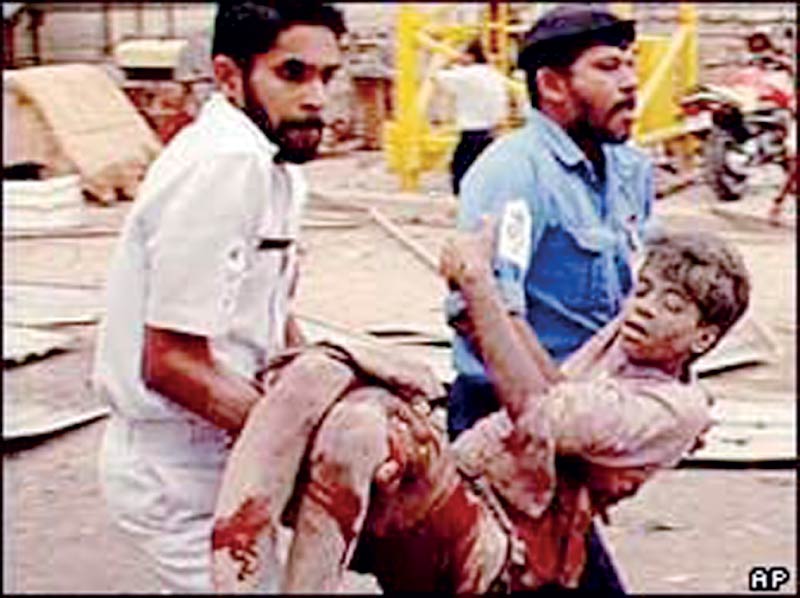
But that was not to be the case. The uninjured or not seriously injured Central Bank officers rose to the occasion like spring-held machines. They started rescuing those who had been injured or trapped in the debris, daring the deadly-scorching flames of a major fire that was ominously engulfing the skeletal bank building. With no electricity, it was dark inside the building. With no elevators, the injured were carried on shoulders using the staircase at the back of the building that had been dedicated as a fire-escape.
There were demonstrations of sympathy and empathy at the highest level and the usual camaraderie among fellow workers. Everyone worked as a team and that was shown by the Governor at the top and the lowest level of employee at the bottom. It had been unplanned, but they worked together like a team unconsciously coordinating the rescue operations. They all are unsung heroes of the Central Bank.
Governor Jayawardena used the metaphor of the Greek mythical story about the Phoenix rising from the ashes and declared boldly to a foreign news media agency: “This is the most heinous cowardice on the part of the terrorists, but they will not win here. We will rise from the ashes like the Phoenix in the mythical Greek story”. That was the slogan used by the Central Bank in its rescue, rehabilitation, renovation, reinvention, and redevelopment of the bank in the coming few years. That is a separate story that will be told later. This article will highlight some unsung heroes from that fateful day and the days immediately after.
Sugathadasa's wisdom overtaking intelligence of the educated
One such hero was Sugathadasa who had been attached to the Rural Credit Department or RCD. He had joined the bank as a labourer in mid 1960s and regraded as a clerical officer but performing the same function as a minor employee. That was because he did not have the skills to perform as a clerk.
On this fateful day, at around 10.45 am, I heard the sounds like firecrackers outside. I did not pay any attention to it because that was a normal event in that area. But when I turned and looked back at the glass windows in the adjoining room facing the Janadhipathi Mawatha, almost all officers attached to RCD were looking down with animated gestures at the street below through the glass window. Compelled by curiosity, I too joined them and what I saw down there could be seen only in a thriller movie. Having failed to break through the iron barrier guarding the entrance to the foyer of the bank building, the lorry was reversing to make a final assault to break through it.
That barrier had been nicknamed the Karunatilake Barrier because it had been constructed by ex-Governor Neville Karunatilake to protect the bank from a possible terrorist attack. There were some dead bodies lying here and there in the street. It had been completely deserted except the attackers who had been armed with RPGs and AK 47machine guns. With eyes glued to the unfolding panorama below, we were watching the scenario excitedly without any feeling about the risk we were taking. At that time, I heard Sugathadasa shouting authoritatively back from behind asking us to retreat immediately to the centre of the office warning that the building was going to be blown up.
We had about 10 seconds to run back and take cover under the office desks as commanded by him. The bomb went off destroying the whole floor from one end to the other. The ceiling fell but we were safe because we had been safely packed under the desks. Later we found that the flying glass pieces had dug holes of about an inch deep on the walls and had we been standing, they would have gone through our bodies like bullets instantly killing or disabling us.
None in RCD got injured because of the timely warning given by Sugathadasa with good intentions and in all sincerity. He may not have been an educated person by the standards of the contemporary society, but his wisdom and the exercise of that wisdom in that critical moment were far superior to the so-called educated people like us. We all had intelligence, but not wisdom.
Security Officer Wijayawardhana’s act of bravery
Then, there was the Security Officer Wijayawardhana who had crawled to the iron door to the building and locked it to prevent the attackers from entering the area. If those suicide attackers had entered the building, the hundreds of people who had come to the bank that day to do business would have been an easy target. If it had happened, the death-toll would have risen to many hundreds. He took an enormous risk in performing this heroic act and saving the lives of many hundreds. Therefore, he was another unsung hero.
There was Winifreda Fernando, a poet, who died in the bomb attack. When her desk was examined later, as if by premonition, she had penned a poem a few days before her death which could be translated into English as follows: “Thousands of mouths might shout that you are dead; but out beating those voices, I say you are not dead and still living with us”. This poem was used as the epitaph of the memorial statue erected to remember those heroes who left us that fateful day
Dedicated loyalty of currency officers
The officers of the Currency Department led by its workaholic Superintendent Captain R. G. Jayaratne were real heroes. The Currency Department is in the basement of the bank premises and once electricity is out, it is a dark cave lighted by some emergency lights dimly illuminating the exit points. The currency officers operate in this ‘dark cave’ as well as in the Banking Floor on the ground floor.
The team working on the Banking Floor had taken out some Rs. 900 million for the day’s operations. When the bomb exploded in front of the bank building, they were the first casualties since they were directly exposed to the bomb. It was a gruesome scene with debris scattered everywhere, dead bodies of fellow workers as well as customers piled up one over the other, and the flames of the fire reaching down threatening to scorch them to a painful death. The currency officers could have easily walked out of the building with bundles of currency notes they had taken out for business unnoticed. There could have been other intruders who also could have done the same. Though they had been very badly injured, they had protected the money as a snake-spirit would buried treasure, put the money back to trunks, and carried those trunks on their shoulders down to the dark cave where the bank’s vaults had been setup. In candlelight, they had redeposited moneys in the vaults, kept records, locked them up, and walked out of the bank building only after the work was over.
With the soot of the fire all over their bodies, they had looked exactly like some walking ghosts coming out of a hole in the earth. But that was the integrity, dedication, commitment, and love for the bank they had displayed on that fateful day. The gutted bank premises were no longer usable. But these heroic officers were ready to conduct currency operations as they had done before with a hitherto unused vault at the Treasury building and through the branches of the Bank of Ceylon.
A driver rescues many injured officers
There was a driver attached to the Small Farmers and Landless Credit Project, known in vernacular as the Isuru Project, who was a first respondent rescuer after the bomb blast. His name was Wijerama. This sternly built young man had carried many injured officers on his shoulders through the bank’s fire-escape to the waiting ambulances and other vehicles. He braved the spreading fire and examined every corner of the building for injured officers waiting helplessly until the needed help arrived. In his shuttling exercises between the bank building and the waiting ambulances, he had rescued dozens of people.
Here, I will mention about two important cases. One was the rescue of Dr. D. S. Wijesinghe. The other was the rescue of Dr. Leslie Gunaratne. Both could not move on their own or even crawl for safety because both legs had fractured due to the fall of heavy wooden cupboards. Dr. Wijesinghe who had a fragile physique due to a polio attack during childhood had been lying on the floor semi-unconscious when Wijerama had come to the floor to make one last look for any remaining victims in need of help. Since he could not see anyone, he had turned back to leave. At that time, he had heard a soft moaning coming from a dark corner of the floor. When he looked for the source, he had found Dr. Wijesinghe lying on the floor trapped under a cupboard that had fallen on his legs. With enormous physical might, he had moved the cupboard aside, lifted Dr. Wijesinghe as if he had been carrying a child and brought him to safety on his shoulders.
Dr. Gunaratne’s case was a little different. At the time of the blast, he had been in the bank’s library looking for a book standing in front of a heavy teak bookshelf. The blast had thrown Dr. Gunaratne to the floor and brought down a heavy shelf on his legs. With the consequential fracture in both legs, he could not move. It was at that time that Wijerama had appeared like a miracle and rescued him to a waiting ambulance. Both these officers would have succumbed to their injuries had Wijerama not rescued them. Because of Wijerama, both had got an extension to life and prospered in the bank. Later, after leaving the bank, Dr. Gunaratne became a professor of economics at the University of Brunei, while Dr. Wijesinghe retired from the bank as its Deputy Governor.
Almost all the Central Bank officers functioned as rescuers that day. They are all unsung heroes worthy of appreciation. After 30 years, my understanding is that they all have retired from the bank and are presently living on meagre pensions fighting against the elevated cost of living
Winifreda’s premonition
There was Winifreda Fernando, a poet, who died in the bomb attack. When her desk was examined later, as if by premonition, she had penned a poem a few days before her death which could be translated into English as follows: “Thousands of mouths might shout that you are dead; but out beating those voices, I say you are not dead and still living with us”. This poem was used as the epitaph of the memorial statue erected to remember those heroes who left us that fateful day.
How the bank had won loyalty of officers
I have mentioned only a few prominent cases here. Almost all the Central Bank officers functioned as rescuers that day. They are all unsung heroes worthy of appreciation. After 30 years, my understanding is that they all have retired from the bank and are presently living on meagre pensions fighting against the elevated cost of living.
When some of them were retired under an early retirement scheme in 2002, Governor A. S. Jayawardena gave them a solemn promise that they would in future be afforded the same facilities as those serving in the bank. In the past, the bank had kept this promise by duly recognising their service and granting a pension rise whenever a salary increase was accorded to serving bank officers. The objective was to look after them till their death, a principle which had been incorporated to all the welfare services that had been afforded to them when they were recruited to the bank. That was how their uncompromised loyalty was won by the bank.
Two years ago, there had been a thumping salary adjustment to those serving the bank. The pensioners had been ignored in this salary revision, and they are still waiting for a positive response to their repeated requests from the bank’s present management.
The story of how the Phoenix rose from the ashes later.
(The writer, a former Deputy Governor of the Central Bank of Sri Lanka, can be reached at [email protected].)