Sunday Sep 13, 2026
Sunday Sep 13, 2026
Saturday, 18 July 2026 05:05 - - {{hitsCtrl.values.hits}}
“Whoever controls the volume of money in any country is absolute master of all industry and
commerce” - 20th US President James Garfield in 1881
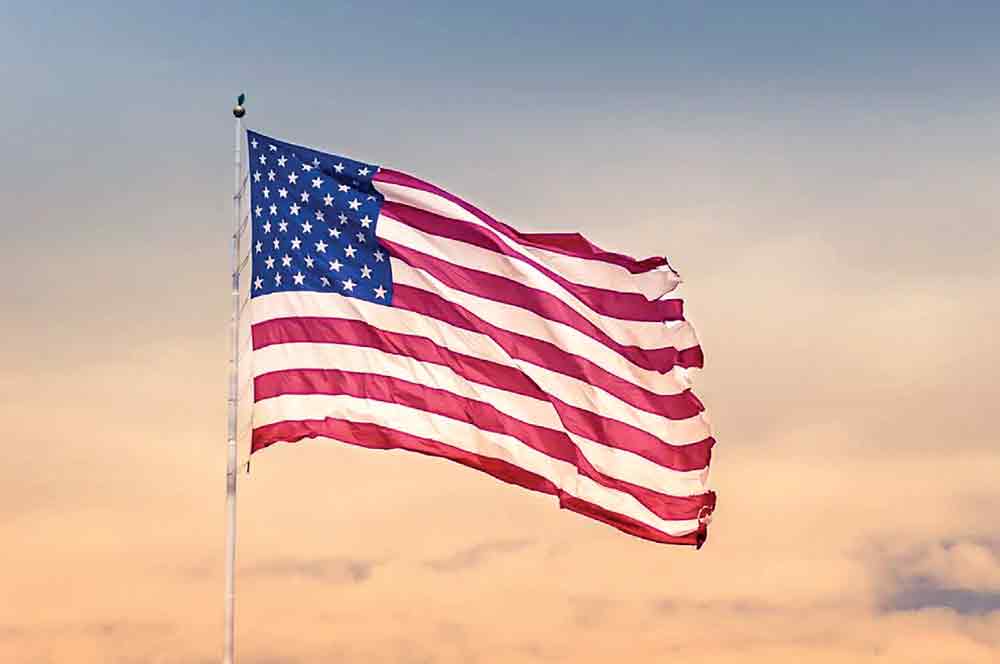
Historical trajectory of the rise of US and statecraft since the revolution
 The global power, might and super-power status the US experiences and enjoys today, since the end of the WW I in 1918, were not fortuitous nor serendipitous by any stretch of imagination. They were extremely and punctiliously strategised and crafted national and international courses of action executed and prosecuted with efficacy, sagacity and potency. As the US commemorated the momentous and iconic 250th year of Independence on the first week of July 2026, author wishes to place on record, unequivocally, that the ascendency and supremacy of US were political, economic, diplomatic, military, technological, cultural and innovative statecraft and not stagecraft.
It may be felicitous and pertinent to place on record that the US, relatively a young nation or probably an “infant” compared to the civilisations of China, Egypt, Japan, Iran, Greece or India which have documented histories well over four to six millennia. Since the then Kingdom of England arrived in Jamestown, Virginia in 1607 and settled, thus recognising the immense potential in all spheres of the vast land of the US. Then they continued, the much-known sequence of British Empire, to explore, expand and exploit reaching 13 states till 1770s. In 1770s, the US Revolution took place and the Declaration of Independence, with the primary author Thomas Jefferson, was signed. This document is, arguably being considered as one of the greatest documents ever drafted, thus birthing a new nation known as the US.
The US was fundamentally a less developed nation compared to the other nations during that era. The US needed to acquire and expand its geographic and territorial dimension and was believed to be the objective of the Founding Fathers of the US. President Thomas Jefferson was instrumental in initiating the Louisiana Purchase Treaty with Napolean Bonaparte in 1803. This real estate purchase was often considered as one of the greatest purchases the world has ever known. The cost was $15 million consisting of land larger than Indonesia or 2/3 the geographic size of India. In today’s value, the cost per acre was $0.84 cents or $538 per square mile.
After the American-Mexican war of 1840s, US purchased the State of Texas for a total amount of $25 million, thus expanding the geography of the US. The scale of Texas was larger than France and UK combined. Then the US in 1867, purchased State of Alaska from Russia for $7.2 million or in today’s value, $0.37 per acre. This piece of real estate was equivalent to the combined geographic size of Pakistan, Thailand and Bangladesh. One could comprehend the manner in which the US leaders, approximately 200 years ago, purchased land for expansion and used it for agriculture, livestock, industry, manufacturing and infrastructure since the 19th Century. It is frequently being stated that the US is by far the greatest and the most ‘paragon’ piece of real-estate in the world. It has two major oceans i.e. Pacific and Atlantic, and in military terminology known as ‘moats’, where ground or any invasion becomes almost impossible. These acquisitions, indeed, enabled US to attain “Strategic Depth” as no other nation.
Challenges, impediments and travails US were compelled to confront and opportunities
The US underwent one of the most diabolical and fiendish civil wars the world has ever witnessed from 1861 to 1865 between the Union and Confederate States. This was premised mostly on slavery, westward expansion of the new states and election of President Lincoln. The Civil War killed nearly a million soldiers and civilians and almost rived the Union.
In the beginning of the 1900s, the US was a highly indebted country, mostly to the European powers. In 1898, the Spanish-American war led to the decline of Spanish Empire, which had colonised nations for many centuries including Sri Lanka. According to historians, the Spanish-American war, which enabled US to defeat Spain, catapulted US as a potent military power to be reckoned.
With the break-out of the WW I in 1914, had many European Empires as Britain, France, Germany, Austria-Hungary and Ottoman enmeshed but the US was not involved. The US got involved only in 1917, marginally, since Germany convinced Mexico to join Germany in the war against the US, according to infamous “Zimmerman Telegram”. However, the WWI was opportune and providential to the US as it enabled US to shift from a debtor nation to a creditor nation.
Since European powers needed funds for the war, the US provided the funds. By 1920s, after WWI, US demanded the Europe to pay the debt in full whilst minimising imports to the US from Europe. Further, US raised tariffs, the highest ever known as “Smoot-Harley Tariff Act”. Eventually, this led to the Great Depression as global trade diminished by approximately 60%.
After the WW I, similar to many other nations, US was confronted with one of the deadliest pandemics known as “Spanish Flu”. This killed nearly 700,00 Americans. It is strongly presumed that the Great Depression, which transcended to the entire world mostly to Europe, led to the WW II. Again, during the WW II the US got embroiled only after the attack on Pearl Harbor in 1941. But yet again, this too was a uniquely fortuitous to the US, which enabled the US to supply armament and material in scale to Europe and USSR. It is being stated that this, particular, event fueled unprecedented industrial revolution and evolution of the US industrial base as never before.
On a separate note, the unparalleled rise of US was neither linear nor reposeful as US had to address, shape and fashion the global order and re-build the war devastated economies with iconic Marshal Plan, prevent and stymie the spread of Communism and Socialism in many parts of the world with engrossment on Korean War in 1950s and Vietnam War in 1960s/1970s, address the convolutions of Cold War, amongst others.
How US became the dominant power
It should be stated that regardless of the sentiments of the global community, the US, today, is an unmatched, unrivaled and unparalleled economic, political, and philanthropic power-house with unchallenged global soft power and reach. Most may not be aware that the Mississippi River Basin played a seminal and transformative role in the economic and commercial metamorphosing of the US from a developing economy to a dynamic economy with its 14,500-mile navigable waterways for purposes of most efficacious transportation within the country.
By the end of WWII, the US had already emerged as the predominant power replacing the UK, France and Germany. Also, the US Dollar had replaced the British Sterling as the most transacted currency, thus it had emerged as the Global Reserve Currency. By the 1920s, the US share of global GDP was hovering between 15% to 20%. After WWII, US share of global GDP soared to over 40% since all other major economies were devastated i.e. UK, France, Germany, Russia and Japan, and also had the largest Navy, amongst others.
Whilst in 1944, as the world was in the midst of WWII, in Bretton Woods in the US, top most bankers and technocrats were in the midst to establish a feasible global monetary order. The US position was that since the US possessed over 80% of reserve gold, the US Dollar would be backed by gold, or each ounce of gold would be priced at $35. Instantaneously, the US Dollar became the Official Reserve Currency of the world. All other currencies had to be pegged to the USD. This gave the US gargantuan and unparalleled stature in international commerce and finance.
Many economists used to argue that the standing of reserve currency would last 80 to 100 years, only, since the beginning of the year 1400 AD. In 1450 AD, it was Portugal, then Spain, Netherlands, France and Britain, which ended its reserve currency status in 1920. Today, $has surpassed over 100 years and still maintains 58% of all official reserves. It is unlikely the $would be replaced by the Euro, which consists of 20% of reserves, in the foreseeable future. None of the BRICS currencies, known as 5-R, is convertible. They are Real (Brazil), Ruble (Russia), Rupee (India), Renminbi (China) and Rand (South Africa). The BRICS currencies may transact bilaterally but cannot replace the USD, whatsoever.
On 15 August 1971, the Nixon Administration, arbitrarily, dismantled the Bretton Wood System by suspending the $convertibility into gold. This was known as “Nixon Shock”. The $became a fiat currency and backed by “full faith and credit” of the US Government. Since energy and oil prices spiked dramatically and eroded the value of $with Yom Kippur war of 1973 coupled with stagflation and Vietnam War, the US succeeded in securing an agreement with Saudi Arabia to price oil exclusively in USD, thus buttressing global demand for the US Dollar. Since Saudi Arabia was the largest producer and exporter of oil as well as the anchor of OPEC, other oil producing countries followed suit. These were ingenious economic and political statecraft executed and acquitted in the most efficacious manner by the US in order to maintain the global supremacy.
Global predominance of US economy and polity
In the 1950s, the global population was around 2.5 billion and the US population was around 150 million. The US share of global GDP was hovering around 40% while the US share of global population was only 6%. Today, the global population is around 8.2 billion whilst the US is around 350 million. The global GDP is $126 trillion and the US is around $32 trillion. Author wishes to expatiate that with a US share of global population of only 4.2%, the US share of global GDP is around 25%, if one does simple math. The US has been maintaining, consistently and unwaveringly, the share of global GDP of 25% or higher since the end of WWII. These records, manifestly, validate the omnipotence and dexterity of the US economy in all spheres.
In order to make comparisons with some of the leading economies such as China, which is the second largest economy, the share of global GDP of China is around 15% with a share of a global population of 17%. With regard to Germany, the share of global GDP is around 4.2% with a share of global population of around 1% and with regard to India, share of global GDP is around 3.3% with share of global population of 17.8% respectively. These figures of three of the largest economies i.e. China, Germany and India, would reflect the unparalleled lead or vantage the US has in the economic dimension.
The US is the largest importer of goods and services in the world accounting for around 13% and second largest exporter, behind China, with around 10%, with an estimated global trade of $36 trillion in 2025. The US is well-endowed with coal, iron, oil and gas and other natural resources as well as the largest arable land in the world. The US is the largest producer of crude oil in the world today, surpassing both Russia and Saudi Arabia, accounting for over 13 million bpd, which is around 15% of global oil production. Its defense spending is over $one trillion whilst the next largest is China, which is around $370 billion according to the World Bank. The global spending of defense is around $2.9 trillion and the US spends over 1/3. The US operates an estimated 750 to 800 overseas military bases in around 75 countries. In comparison, the overseas military bases of all other countries combined in the world would not be less than 50 bases. These establish the unmatched and supreme military métier and might of the US.
Corporates and influence of US on global scale
In the beginning of the 1900s, nobody paid much heed to the US equity market index known world over as Dow Jones Industrial Average (DJIA). Today, the global equity markets, either directly or indirectly, correlate to the US equity market, which is over 60% of the global market cap. of equity markets. The market cap of US equity is around $78 trillion or 225% of its GDP. The so-called “Magnificent-7” corporates have a total market cap. of $23 trillion and are highly focused on AI, ML, Quantum Computing and most advanced technologies, thus embracing the 5th Industrial Revolution. This figure is still greater than the entire GDP of China or the country with the second largest stock market cap., which is also China, around $17.5 trillion. Here the author is focusing on just seven trillion-dollar market cap. corporates ranging from NVDIA to Tesla. The NVIDIA too recorded the highest ever market cap. of $five trillion in June 2026, exceeding the annual GDP of Japan, India or UK. Of course, the market cap. and GDPs of nations cannot be compared since the sources are disparate but readers would get a perspective of the depth and breadth of the equity market and strategic depth economy of the US.
In 1901, US chronicled the first ever billion-dollar corporate i.e. US Steel, and in 2017 chronicled the first ever trillion-dollar corporate i.e. Apple. Also, the US produced the first billionaire in 1916 and the first trillionaire in 2026 respectively. With a share of global population of merely 4.2%, the US consistently boasts and dominates the top most universities and largest corporates in the world as no other nation.
The impact of the US financial and banking realm is a force to be reckoned with. When the Federal Reserve Bank (Fed) appointed Kevin Warsh in May 2026 as the new Chair of Fed, the entire world was fixated on his monetary policy whether its hawkish or dovish. All electronic and print media extended coverage of this crucial appointment. Similarly, when the Central Bank of China, PBOC, appointed the Governor Pan Gongsheng in July 2023 and Reserve Bank of India (RBI) appointed the Governor Sanjay Malhotra in December 2024, the world as well as Asia did not pay much attention.
As the 41st President George H. W. Bush quote “If anyone tells you that America’s best days are behind her, they’re looking the wrong way” unquote. These were echoed well over three decades ago. The author wishes to enunciate that this article was drafted not to determine or assess whether the domestic or foreign policy of America were moral, ethical or justifiable but to, unequivocally, establish the uninterrupted and unprecedented trajectory of prowess, impact and influence of the US since the beginning of 20th Century.
I like to conclude with the sapient words of President Dwight Eisenhower quote “America is best described by one word, Freedom.”
(The author is former career Ambassador and Professor and Examiner of International Economics with PhD from IIT Delhi and a Senior Fellow at Harvard. He could be reached on [email protected])




