Friday Oct 16, 2026
Friday Oct 16, 2026
Friday, 21 August 2026 00:28 - - {{hitsCtrl.values.hits}}
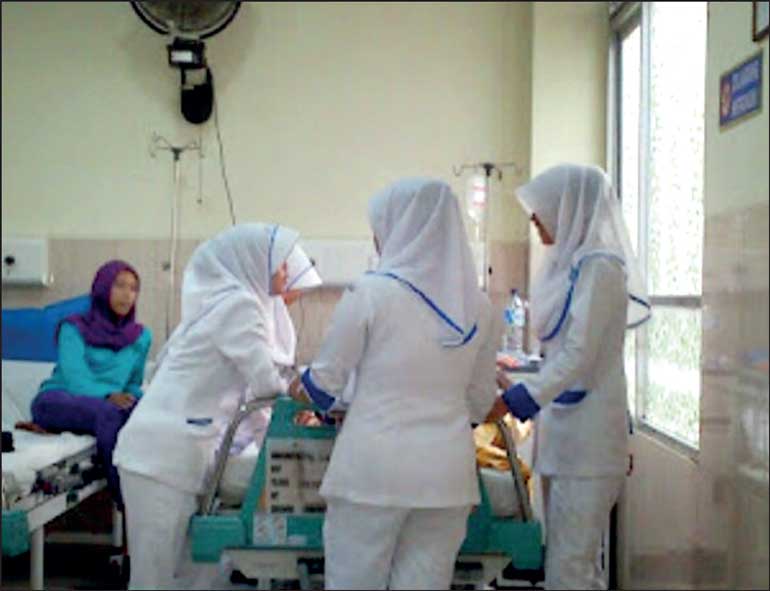
In August 2021, the then Singapore Prime Minister Lee Hsien Loong officially announced the permissibility of wearing the Hijab for Singaporean Muslim women in the healthcare sector
 More than a dispute over a uniform
The controversy surrounding the dress of Muslim female junior health workers appointed to the Kalmunai North Base Hospital should not be allowed to become another communal dispute. Nor should it be dismissed merely as an administrative disagreement over a uniform.
At the heart of the controversy is the desire of Muslim female junior health workers to observe their religious requirements of modest dress, particularly by covering the head and legs, while wearing the prescribed uniform and performing their professional duties. Contrary to reports in some sections of the media, the issue was not about health workers reporting for duty in abayas or seeking to substitute religious attire for the official uniform. Rather, it concerned whether reasonable modifications could be accommodated within the prescribed uniform to enable them to meet their religious obligations without compromising professional standards, hygiene, safety or patient care.
The Government appears to have found an immediate solution by transferring the affected workers to Ashraff Memorial Hospital, while reports suggest that the relevant circular governing their uniform may now be reconsidered.
If so, that reconsideration should be welcomed.
The issue should not be portrayed as the State making a concession to one religious community. It raises a broader constitutional and administrative question: can Sri Lanka accommodate legitimate religious observance while preserving uniformity, hygiene, infection control, patient safety and professional standards in the public health service?
The experience of other multicultural societies demonstrates that it can.
The Constitutional question
Sri Lanka’s Constitution provides the starting point.
Article 10 guarantees every person freedom of thought, conscience and religion. Article 12(1) guarantees equality before the law and equal protection of the law, while Article 12(2) specifically prohibits discrimination against citizens on grounds including religion and sex.
Most directly relevant is Article 14(1)(e), which protects the freedom of every citizen, individually or with others, publicly or privately, to manifest religion or belief in worship, observance, practice and teaching.
Significantly, even Article 9, which gives Buddhism the foremost place, expressly requires the State to assure to all religions the rights granted by Articles 10 and 14(1)(e).
These protections are not absolute in every circumstance. The Constitution itself permits certain restrictions on fundamental rights, including restrictions prescribed by law in the interests of public health and other legitimate purposes.
A hospital is therefore entitled—and indeed obliged—to maintain rigorous standards relating to infection control, hygiene, occupational safety, professional identification and patient care.The argument should not be that religious requirements automatically override professional standards.
Rather, the question is one of necessity, reasonableness and proportionality.
If a religiously appropriate head covering or fuller clothing can be designed and worn in a manner that satisfies clinical and safety requirements, what legitimate objective is achieved by prohibiting it altogether?
An administrative circular is intended to facilitate public administration. It cannot override constitutional guarantees. Where its requirements unnecessarily interfere with the manifestation of religion or produce unequal consequences for employees of a particular faith, there is at least a serious constitutional question that warrants reconsideration.
Transfer resolves the incident, not the issue
Transferring the affected health workers to Ashraff Memorial Hospital may have been useful in defusing an immediate confrontation.
But it cannot be the permanent solution.
Indeed, the transfer raises an obvious question. If the health workers can perform precisely the same public duties at another government hospital while observing their religious dress requirements, why should such accommodation be inherently impossible at Kalmunai North Base Hospital?
The answer cannot be to identify hospitals where Muslim health workers can wear religiously appropriate clothing and transfer them there. That risks creating an unintended form of segregation within the public health service.
A citizen should not, where reasonable accommodation is possible, have to choose between public employment, the place where she serves and the observance of her religion.
The appropriate solution is therefore not merely to change the employees’ workplace, but to examine whether the rule itself needs changing.
Singapore: Change the policy, not the employee
Singapore offers a particularly instructive example.
Like Sri Lanka, Singapore is an Asian, multi-religious and multi-ethnic society. It also attaches considerable importance to discipline and uniformity within public institutions.
For many years, restrictions existed on the wearing of the tudung by uniformed Muslim women in parts of the public service. Singapore eventually reconsidered the policy.
From 1 November 2021, Singapore’s Ministry of Health permitted female Muslim uniformed staff in the public healthcare sector to wear the tudung as an addition to their uniform. Importantly, the change was not confined to nurses; it applied to more than 7,000 female Muslim uniformed staff across the public healthcare sector.
What is particularly relevant to Sri Lanka is how Singapore managed the change.
It did not abandon uniform standards or compromise infection control. The Ministry developed clinical and implementation guidelines following extensive consultations involving infectious-disease experts, healthcare workers, nursing leaders, trade unions, Muslim community representatives and the Islamic Religious Council of Singapore.
The guidelines sought to accommodate the religious wishes of Muslim health workers while safeguarding occupational safety, patient-care standards and infection-control requirements.
The experience after implementation is equally noteworthy. Singapore’s Ministry of Health subsequently reported that hospitals had implemented clinical safeguards, including refitting N95 masks where necessary for employees wearing the tudung, and that feedback from Muslim and non-Muslim staff was generally positive.
Singapore therefore did not choose between religious freedom and healthcare standards. It found a practical way of protecting both.
The British experience: Accommodation within standards
The United Kingdom provides another useful comparison.
NHS England’s guidance on uniforms and workwear specifically addresses the interaction between infection-control requirements and the needs of different faith groups. Its approach covers the broader healthcare workforce, including medical, nursing, midwifery and allied health professions.
Religious headwear—including headscarves, turbans and other religious coverings—is permitted provided that patient care, health and safety, infection control and security are not compromised.
The guidance even addresses the more difficult issue of covering the forearms. Where employees wish to cover their arms for religious reasons, practical accommodation is possible, while the forearms must still be exposed when required for hand hygiene and direct patient care. Current NHS infection-control guidance also makes specific provision for disposable over-sleeves worn for religious reasons, subject to strict hand-hygiene requirements.
The principle is simple: accommodate religious practice wherever reasonably possible, but never at the expense of patient safety.
Having served in both the United Kingdom and Singapore during my diplomatic career, I have seen how plural societies continuously seek to reconcile institutional requirements with religious and cultural diversity. Their systems are not identical to ours, and Sri Lanka need not copy them. But their experience demonstrates that professional discipline and religious accommodation need not be mutually exclusive.
Uniformity does not mean identicality
This controversy also requires us to reconsider what we mean by a “uniform”.
Uniformity should ensure professional identity, discipline and recognisable standards. It need not necessarily mean that every item of clothing worn by every employee must be identical regardless of legitimate religious requirements.
A revised Sri Lankan circular could specify an approved head covering of prescribed colour, material and design; require it to be securely fitted; permit appropriate fuller-length clothing; maintain visible professional identification; and prescribe circumstances in which garments must be adjusted for infection-control purposes.
The UK experience demonstrates precisely this approach. Headscarves must be secured appropriately, while clinical requirements remain paramount. Singapore similarly incorporated the tudung into the official uniform framework rather than treating it as an unrestricted personal addition.
Thus, reasonable accommodation does not destroy uniformity. It incorporates diversity within uniformity.
Not a Muslim exemption, but a common principle
The Government should also avoid framing any amendment as a special concession exclusively for Muslims.
A revised circular should establish a general principle of reasonable religious accommodation applicable to all health workers.
Where a sincerely held religious requirement affects dress, accommodation should be permitted provided that it does not compromise hygiene, infection control, occupational safety, professional identification, security or the employee’s ability to perform his or her duties.
Such an approach would transform the present controversy from a communal issue into a question of equal citizenship.
It would also reassure other communities that no group is receiving privileges unavailable to others. The same constitutional principle would apply equally to everyone.
Better to change now than later
If the Government is already considering amending the circular, it should do so after proper consultation and without hesitation. Changing an administrative rule when experience reveals a legitimate problem is not weakness. It is good governance.
The Ministry could consult health administrators, infection-control specialists, professional bodies, health workers, constitutional experts and representatives of relevant religious communities before adopting a nationally applicable standard.
That is surely preferable to waiting until an affected public servant invokes the fundamental-rights jurisdiction of the Supreme Court and asks whether the restriction is compatible with Articles 10, 12 and 14(1)(e).
Sri Lanka does not need litigation to resolve something that consultation, comparative experience and common sense can address today.
Professional discipline matters. Uniformity matters. Infection control and patient safety must remain paramount.
But constitutional freedoms matter too.
Singapore has shown that an existing uniform policy can be changed without weakening healthcare standards. Britain demonstrates that religious dress can coexist with rigorous infection-control requirements.
Sri Lanka can find its own balance.
The temporary transfer of the affected health workers may have provided breathing space. The Government should now use that opportunity to address the underlying issue.
If an administrative circular can be revised to protect both professional standards and constitutional freedoms, it is better to amend it through enlightened administration today than to be compelled to change it through constitutional litigation tomorrow. 
(The author is a former Sri Lankan Ambassador to the European Union, Belgium, Türkiye, Ukraine and Saudi Arabia. He also served in UK as Acting High Commissioner and Deputy Head of Mission in Singapore)




