Wednesday Oct 21, 2026
Wednesday Oct 21, 2026
Thursday, 2 April 2026 02:19 - - {{hitsCtrl.values.hits}}
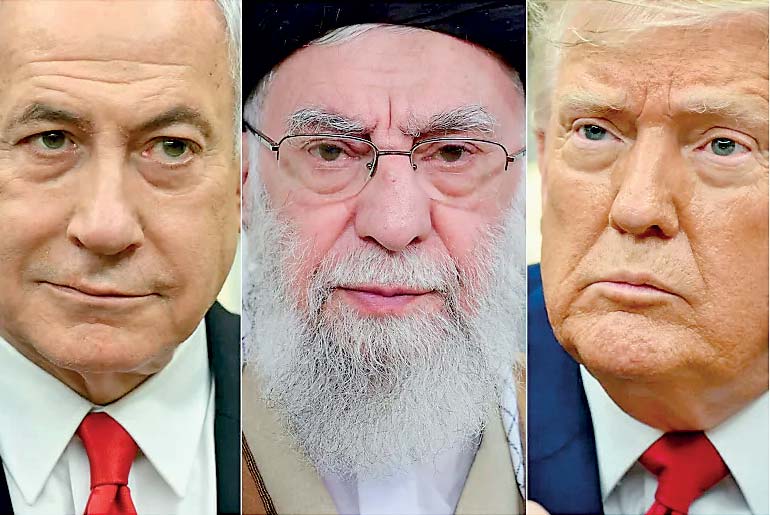
From left, Israeli Prime Minister Benjamin Netanyahu, Iran’s former Supreme Leader Ayatollah Ali Khamenei, and US President Donald Trump
 The NPP administration’s courageous and principled declaration of neutrality rejected military requests from both sides -the US and Iran- while offering humanitarian assistance to all, and declining to support a resolution at the UNGA condemning Iran, which it viewed as unbalanced. One cannot help but reflect on how different the country’s position might have been under a different leadership than Anura Kumara Dissanayake
 The success or failure of any action is ultimately measured by the extent to which its objectives are achieved. Against this backdrop, military aggression was launched on 28th February 2026 by the self-declared global policeman cum sole superpower, US, in collaboration with the regional power, Israel, targeting Iran.
If the objective of the war had been the killing of innocent civilians, including school children, the targeted assassinations of political leaders and scholars, and the destruction of schools, universities, and other civilian infrastructure, then the US–Israel coalition would have definitely and undoubtedly won the war.
However, the stated objectives of this military action differed in emphasis as per the both powers. For the US, the goal was to prevent Iran from acquiring the capability to develop nuclear weapons. For Israel, the objective was to change Iran’s current Ayatollah-led political system.
This convergence may also be viewed through the lens of strategic and ideological narratives. The doctrine of “America First,” associated with the US, and the conviction of a divinely “Chosen Nation” and the concept of “Greater Israel” attributed to Jewish Israel, have, among other factors, contributed to aligning their positions in favour of military aggression.
This unprovoked war was waged under the cover of multilateral negotiations among the concerned parties that were ongoing in Geneva, raising serious concerns about the honesty and bona fides of the US in particular. These concerns are further reinforced by the fact that a similar unprovoked military action was carried out against Iran in June last year under the cover of negotiations, casting doubt on the credibility and sincerity of such diplomatic engagements.
“Unprovoked war” and “Self-defense”
An unprovoked war is when one country attacks another without a valid reason. It happens when there is no real threat, no prior attack, and no need for self-defense. Under the rules of the UN Charter, countries are not allowed to use military force unless they are defending themselves or have approval from the UN Security Council. When a country ignores these rules and starts a war on its own, it is considered unprovoked and unlawful aggression, which weakens global peace and shows a disregard for fairness, law, and respect between nations.
Article 51 of the UN Charter allows the victim country of unprovoked war to defend itself against such unlawful aggression.
“Nothing in the present Charter shall impair the inherent right of individual or collective self-defense if an armed attack occurs against a Member of the United Nations, until the United Nations Security Council has taken measures necessary to maintain international peace and security”. The greatest tragedy, however, is not merely the breach of international law—but that the breach is committed by those who introduced that law and swore to uphold it.
It is common sense—not rocket science—to recognise that Iran is the underdog in this well-coordinated war waged jointly by two nuclear-armed countries: the US and Israel
The advent of Trump and the making of an international pariah
The slogan “America First” has long influenced US foreign policy. However, most previous presidents balanced it with diplomatic pragmatism. In contrast, the current leadership under Donald Trump—a businessman accustomed to quick profits, now marked by impaired judgment in advanced age—has often failed to articulate strategies that balance national interests with international norms.
Actions such as unilateral tariffs, the kidnapping of Venezuelan President Nicolás Maduro, and the attempted acquisition of Greenland (firmly rejected by Denmark and Europe) have isolated the US from its EU and NATO allies. As a result, the US became an international pariah. Meanwhile, Israel—seeking to advance its regional hegemony—sought to capitalise on this isolation and Trump’s diminished acuity. Hence, the military aggression against Iran began on 28th February 2026, in clear violation of international law.
The Underdog: Weakened but unbroken
It is common sense—not rocket science—to recognise that Iran is the underdog in this well-coordinated war waged jointly by two nuclear-armed countries: the US and Israel.
Iran’s contemporary geopolitical position cannot be understood in isolation without reference to its modern history. Since the 1979 revolution, which led to the overthrow of Mohammad Reza Shah Pahlavi, who was the loyal servant of the USA, Iran has faced sustained political, economic, and military pressures. These pressures have exhibited in various forms, including diplomatic isolation, security threats, and persistent disinformation and narratives that have shaped global perceptions of Iran.
Over the decades, the US and its allies have sought to challenge the Iranian regime through multiple avenues—ranging from political and economic pressure to indirect military engagements. One notable example is the Iran–Iraq War, widely regarded as a prolonged and devastating conflict in which the USA and other external influences had played a significant role.
In parallel, Iran has endured wide-ranging economic sanctions imposed primarily by the US for nearly five decades. These measures have had far-reaching humanitarian and economic consequences, significantly constraining Iran’s global economic engagement. Even major global powers such as China and Russia have often found their ability to counterbalance these sanctions limited in the face of the US’ dominant position in the global financial and political system.
The doctrine of “America First,” associated with the US, and the conviction of a divinely “Chosen Nation” and the concept of “Greater Israel” attributed to Jewish Israel, have, among other factors, contributed to aligning their positions in favour of military aggression
Biting the dust as the war objectives fade
The US–Israeli war against Iran, initiated more than a month ago with assurances that it would conclude within days—if not weeks—has now entered its second month. What was projected as a swift and decisive campaign has instead evolved into a protracted and uncertain conflict.
However, the stated objectives of the war campaign were far more strategic: to prevent Iran from advancing its nuclear weapons capability and to bring about regime change. On these critical fronts, neither the US nor Israel has demonstrated any clear success. On the contrary, there are increasing indications that the US has, through various channels, sought to reopen negotiations with Iran.
Recent public statements and press briefings by Trump suggest that the initial underestimation of Iran’s resilience and strategic capacity may have backfired. Moreover, signs of internal discord have begun to surface within the upper echelons of the administration, reflecting a lack of consensus on both the conduct and the consequences of the war.
Notably, President Donald Trump has appeared to distance himself from the decision to initiate the war, attributing responsibility to his Secretary of Defense, Pete Hegseth. This internal fracture was made undeniable on March 17, 2026, with the high-profile resignation of Joe Kent, Director of the National Counterterrorism Center. Citing his “good conscience,” Kent argued that Iran posed no imminent threat to American soil and issued a blistering critique of the “external lobbies” dictating U.S. foreign policy.
When we look back at this conflict, one key truth becomes clear: winning a war is not about who is the top dog or the underdog, but about the objectives. By that standard, the joint actions of the US and Israel can be seen as a strategic failure. The nuclear-armed U.S. unilaterally wants to stop Iran from allegedly becoming a nuclear power, but the attack itself made that goal more complicated by removing any reason or hurdle for Iran to hold back.
Israel, whose prime minister is facing criminal lawsuits locally and an international warrant for war crimes, wants regime change in Iran, but the objective has obviously failed, as the country’s political system remains intact. Far from dividing Iranian society, the apparent injustice of the aggression has, in many respects, promoted internal unity while also generating global sympathy among the oppressed and fair-minded in support of the underdog, Iran.
The world’s reluctant gratitude
The world—and especially the European Union—should be grateful to Iran. If not for the Iranian resistance, the US might have continued its military aggression beyond Iran, after having kidnapped and detained Venezuelan President Nicolás Maduro. This could have extended to Greenland (which is under Danish rule) and Canada as well.
Trump is naïve to think that his NATO allies and other countries will help him conquer Iran—especially when it comes to keeping a safe sea route for ships and oil tankers passing through the Strait of Hormuz.
Even though many NATO countries have strained relations with Iran, most of them would rather see the US-Israel coalition lose this war. Not necessarily because the war is illegal, but because if the US wins, it would encourage Trump to carry out more aggressive actions in the future.
Israel, whose prime minister is facing criminal lawsuits locally and an international warrant for war crimes, wants regime change in Iran, but the objective has obviously failed, as the country’s political system remains intact. Far from dividing Iranian society, the apparent injustice of the aggression has, in many respects, promoted internal unity while also generating global sympathy among the oppressed and fair-minded in support of the underdog, Iran
Injustice anywhere is a threat to justice everywhere
Ultimately, the world is learning that “right is might”—not the other way around. When a self-styled “global policeman” turns inward with an “America First” approach, and a regional power tries to exploit the perceived decline in that leader’s cognitive and strategic focus to advance its own military ambitions, both overlook a simple truth: no nation can crush another that is determined to stand firm.
In this context, the insight of Martin Luther King Jr.—“Injustice anywhere is a threat to justice everywhere”—assumes critical importance. Acts of aggression, the selective application of international law, and the erosion of sovereign equality do not remain confined to a single conflict or region. Rather, they create precedents that weaken the entire framework of global governance. When powerful states act outside the bounds of accepted norms, they inadvertently legitimise similar conduct by others, thereby accelerating the breakdown of a rules-based international order.
Equally concerning is the role of silence and inaction. When the international community fails to respond decisively to clear instances of injustice—whether due to strategic calculation or political convenience—it contributes to the gradual normalisation of such conduct. This passive acceptance not only emboldens those who rely on bullying but also undermines confidence in international institutions designed to uphold peace and justice. Over time, the cumulative effect is the erosion of trust, the weakening of legal principles, and the transformation of global order into a system driven less by law and more by power.
Magnanimous stand of the SL Government
My article would be incomplete without acknowledging the magnanimous stand taken by the present Government. The NPP administration’s courageous and principled declaration of neutrality rejected military requests from both sides -the US and Iran- while offering humanitarian assistance to all, and declining to support a resolution at the UNGA condemning Iran, which it viewed as unbalanced.
One cannot help but reflect on how different the country’s position might have been under a different leadership than Anura Kumara Dissanayake. At the same time, it is worth noting—cautiously—that such independent positioning may attract closer attention from major powers, particularly the US Department of War, which is notorious for its intolerance of dissenting stand and stance.
In a broader sense, the unprovoked war waged by the US and Israel against Iran may well signal a turning point—perhaps even the beginning of the end of unquestioned global hegemony.
“The world will not be destroyed by those who do evil, but by those who watch them without doing anything.” - Albert Einstein-
Even though many NATO countries have strained relations with Iran, most of them would rather see the US-Israel coalition lose this war. Not necessarily because the war is illegal, but because if the US wins, it would encourage Trump to carry out more aggressive actions in the future
(The author is a Retired Deputy Commissioner General , Inland Revenue Department and could be reached via email at [email protected])




