Thursday Sep 17, 2026
Thursday Sep 17, 2026
Thursday, 17 September 2026 04:54 - - {{hitsCtrl.values.hits}}
The real prize is not simply obtaining a lower tariff today. It is securing a framework that gives exporters the confidence to invest, expand capacity and enter into long-term commercial commitments
Sri Lanka has stabilised its economy; the next challenge is to generate sustainable growth. The US relationship can play a major role in that transition. The opportunity before Sri Lanka is to leverage the current US goodwill into long-term economic certainty—and turn that certainty into exports, investment, jobs and growth, while maintaining our longstanding relationship
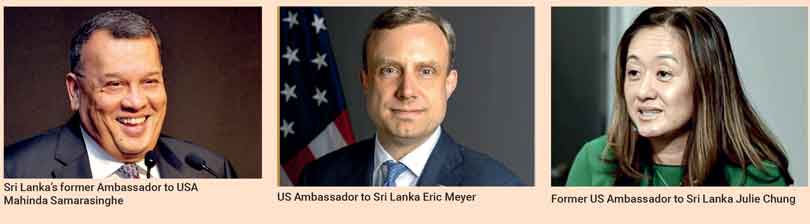
 The US commitment to Sri Lanka is at its highest level in recent times, and Sri Lanka now has a narrow but important opportunity to convert that goodwill into a more durable economic partnership with Washington. That was the central message from former Sri Lankan Ambassador to the United States Mahinda Samarasinghe, who called for the early conclusion of the bilateral agreement on the new US tariff regime, warning that Sri Lanka must secure certainty for its exporters and investors. (Daily FT)
Delivering the keynote at the Sri Lanka Institute of Directors (SLID) Annual Members Meeting and 25th Anniversary celebration at Cinnamon Grand Colombo, Samarasinghe placed the relationship in the context of Sri Lanka’s economic recovery.
“If not for the United States, the IMF deal would never have been done,” he said.
The remark goes to the heart of Sri Lanka’s relationship with Washington. The US has not merely been an important trading partner; it has also been an important economic and diplomatic partner at a critical moment in Sri Lanka’s history. The challenge now is to ensure that this relationship delivers a stronger economic dividend over the next decade.
The US market cannot be taken for granted
The US accounts for around 25% of Sri Lanka’s exports. For an economy that needs to generate foreign exchange, preserve export employment and attract new investment, continued access to the US market is strategically important. (Daily FT). This is why the tariff negotiations matter far beyond the immediate percentage being discussed. Samarasinghe said negotiations and US goodwill had helped reduce the originally proposed tariff from 44% to 33% and subsequently to 10%. (Daily FT) That is a substantial improvement. But the real prize is not simply obtaining a lower tariff today. It is securing a framework that gives exporters the confidence to invest, expand capacity and enter into long-term commercial commitments. Julie Chung, who made her presence felt during her tenure in Colombo, has now left, with her successor, US Ambassador Eric Meyer, taking over at an important juncture to further strengthen the longstanding US-Sri Lanka relationship.
Policy consistency
Businesses cannot plan effectively when market access remains uncertain. A manufacturer deciding whether to invest millions of dollars in a new production line needs confidence about the tariff environment several years ahead. International investors similarly require predictable rules. This is why Samarasinghe’s call to “lock in” the favourable tariff rate deserves particular attention.
“I have recommended very strongly to the Government that we need to conclude the agreement so that we can lock in the very favourable tariff rate that Sri Lanka has got up to now,” he said. (Daily FT)
Samarasinghe said around 90% of the agreement’s content had been completed, with the remaining work involving agreement in principle, domestic procedures and the necessary legal processes before signing and implementation. (Daily FT).Sri Lanka has often paid a high price for policy uncertainty and delays. Investors do not wait indefinitely, and export orders can move to competing countries when the commercial environment becomes less attractive.The Government therefore needs to recognise that certainty itself is an economic asset.
Give and take
There is, however, no such thing as a one-sided trade agreement. Samarasinghe pointed out that countries concluding agreements with the US have generally had to provide complete or near-complete duty-free access for American exports. (Daily FT). This is where the negotiations become more difficult—and more important. Sri Lanka must determine what it is prepared to offer in return for preferential access to the US market. Opening the domestic market can create opportunities through greater competition, lower costs and technology transfer, but it can also expose less competitive industries to pressure. The answer should not be blanket protection. Sri Lanka’s objective should be a framework that encourages competitiveness and investment while allowing sufficient time for sectors requiring adjustment. The agreement should also form part of a broader export strategy rather than remain an isolated tariff arrangement.
The investment opportunity
Perhaps the biggest opportunity is not the exports Sri Lanka has today, but the investment it could attract tomorrow. A predictable US trade framework could strengthen Sri Lanka’s proposition to international investors. If investors know that Sri Lanka offers reliable access to a major market, the country becomes more attractive as a production and services base. But tariffs alone will not bring that investment because the sub region has got the same. Sri Lanka must also address issues that repeatedly concern investors: policy consistency, taxation, regulation, infrastructure, skills, energy costs, logistics and the efficiency of public institutions. The trade agreement can therefore become a catalyst for broader economic reform.
From friendship to economic partnership
Samarasinghe emphasised that the US has been a longstanding friend of Sri Lanka and that its support has been “unconditional and genuine”. (Daily FT) That relationship now has an opportunity to evolve into a deeper economic partnership. The next phase should focus on trade and investment, technology, education, skills development, supply-chain integration and economic resilience. For Sri Lanka, the objective should therefore be clear: to leverage the goodwill built with Washington.
The longer-term objective must be to use that agreement as a platform for attracting investment, diversifying exports and embedding Sri Lanka more firmly in global supply chains. Sri Lanka has stabilised its economy; the next challenge is to generate sustainable growth. The US relationship can play a major role in that transition. The opportunity before Sri Lanka is to leverage the current US goodwill into long-term economic certainty—and turn that certainty into exports, investment, jobs and growth, while maintaining our longstanding relationship.
References
https://www.magzter.com/stories/newspaper/Daily-FT/JULIE-CHUNG-MADE-DIPLOMACY-MEANINGFUL-839410?srsltid=AU7gw4VdvgxJDYa875mXAYZ18yHsqg7HGIbWfPOiPjY2vA_i5ozcMqJ5
https://www.ft.lk/front-page/Ex-envoy-Mahinda-urges-speedier-finalisation-of-new-tariff-deal-with-US-by-Sri-Lanka/44-797261
https://www.ft.lk/front-page/Ex-envoy-Mahinda-urges-speedier-finalisation-of-new-tariff-deal-with-US-by-Sri-Lanka/44-797261




