Tuesday Sep 29, 2026
Tuesday Sep 29, 2026
Tuesday, 29 September 2026 00:00 - - {{hitsCtrl.values.hits}}
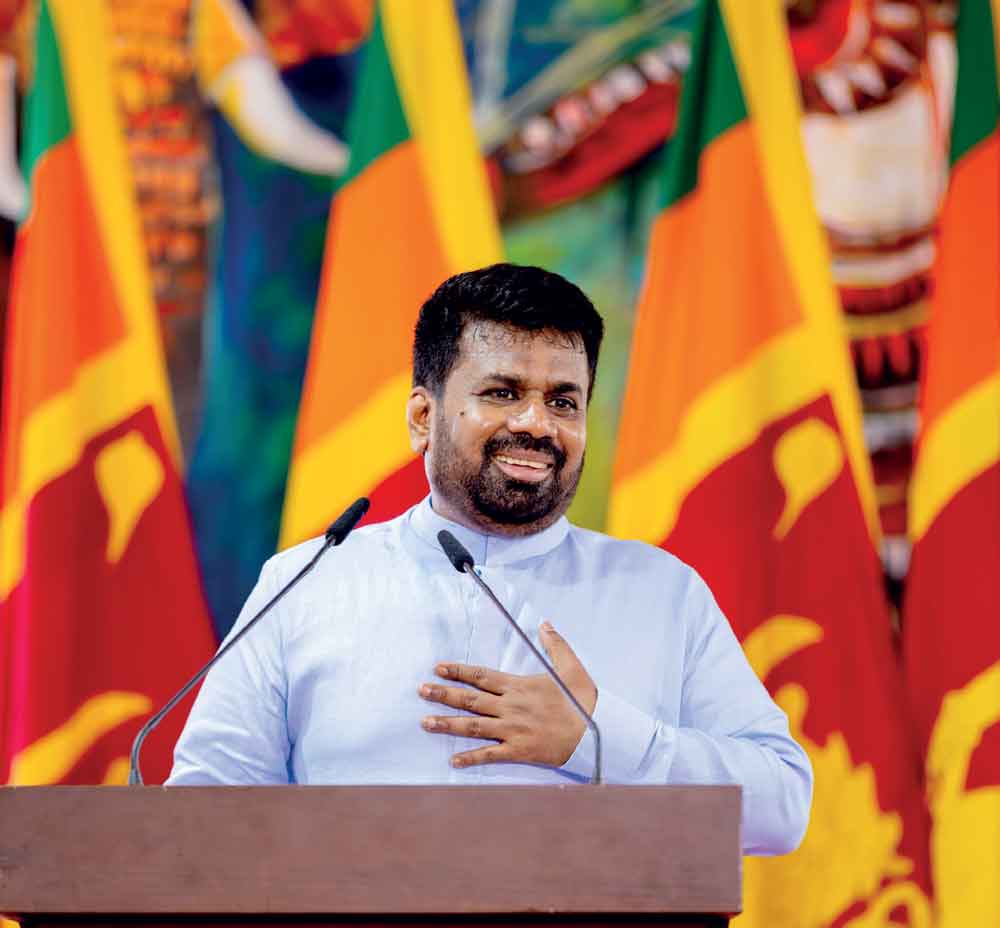
President Anura Kumara Dissanayake
 Sri Lanka’s 2024 Presidential election took place as the country was beginning to recover from a severe economic crisis. But the return of economic growth had not yet eased the pressures many households faced. Two years later, this article looks at what has changed. It uses 2024 as the starting point and compares that situation with the latest evidence available in 2026.
The aim is to assess both the economy and the promises made to voters. Has greater stability led to better living conditions? Have employment, household incomes and the cost of essentials improved? And where promises remain unfulfilled, what has prevented progress? These questions matter because economic recovery is not complete when growth returns. It must also improve people’s lives.
The economic starting point: 2024
Sri Lanka’s economy contracted by 7.3% in 2022 and a further 2.3% in 2023. In 2024, it grew by 5%. This was a significant recovery, supported by a strong rebound in industry, including construction, and growth in tourism-related services. However, one year of growth could not undo the losses of the previous two years. Household incomes, savings, job security and purchasing power had not fully recovered.
This distinction is central to the assessment. GDP growth shows how the economy is changing overall; it does not show how evenly the benefits are shared or how quickly families recover. In 2024, many people were still dealing with poverty, high prices, lower real wages and the effects of reduced public spending.
The cost of recovery for households
Poverty remained one of the clearest signs that economic recovery had not yet reached many households. The World Bank estimated that 24.5% of Sri Lankans lived below its poverty line in 2024, nearly twice the 2019 level. Although the poverty rate fell by an estimated 2.7 percentage points during 2024, the World Bank cautioned that the recovery had not brought broad improvements in household welfare. This estimate uses the international poverty line of $ 3.65 per person per day, measured in 2021 purchasing-power-parity terms.
The labour market also needs to be examined beyond the unemployment rate. In 2024, annual unemployment was 4.4%, while labour-force participation was 47.4%. Female participation remained particularly low. The World Bank also reported that the employment-to-population ratio fell from 46% in the second quarter of 2023 to 45.5% in the second quarter of 2024. A low unemployment rate alone does not show whether people have stopped looking for work, whether available jobs are secure, or whether wages are sufficient.
Real wages show the pressure on workers’ purchasing power. Between 2021 and 2024, real wages fell by 16.9% in the private sector and 22% in the public sector, according to the World Bank. In other words, the issue was not only how many rupees people earned, but how much those rupees could buy. Real wages in 2024 also remained below their 2019 levels. Promises to raise wages and ease pressure on household budgets therefore addressed immediate concerns for many voters.
 A promise is more than an expression of intent. To assess whether it can be delivered, voters need to know how it will be financed, when it will be implemented, who will benefit and who will bear the cost. This is especially important for promises involving salary increases, subsidies, lower tariffs or tax reductions, because these affect public revenue, government spending, state-enterprise finances and debt. A promise should not be judged simply as “fulfilled” or “not fulfilled.” A fair assessment asks whether the policy was implemented, who benefited, what it cost and whether it produced measurable improvements. The latest available evidence points to progress in some areas, alongside continuing pressures in others
Inflation had fallen sharply from its crisis peak, which was a major improvement. But a lower inflation rate means that prices are rising more slowly; it does not mean that prices have returned to their earlier levels. Food prices more than doubled between 2021 and 2024. Families were still paying substantially more for food and other essentials, including transport and electricity. For many, the easing of inflation had not yet made daily life feel more affordable.
The constraints behind election promises
By 2024, Sri Lanka was working to restore fiscal stability by increasing Government revenue, controlling expenditure and recovering costs in state-owned enterprises. These measures supported economic adjustment but also placed pressure on households and businesses through taxes and charges. The Government faced tight financial limits: the World Bank estimated public and publicly guaranteed debt at 102.4% of GDP at the end of 2024.
Against this background, it was understandable that many prominent election promises focused on electricity bills, food prices, wages, employment, corruption and equality before the law. These were not abstract campaign issues; they reflected pressures people were experiencing in their daily lives.
But a promise is more than an expression of intent. To assess whether it can be delivered, voters need to know how it will be financed, when it will be implemented, who will benefit and who will bear the cost. This is especially important for promises involving salary increases, subsidies, lower tariffs or tax reductions, because these affect public revenue, Government spending, state-enterprise finances and debt.
What has changed since 2024?
The latest available evidence points to progress in some areas, alongside continuing pressures in others. Sri Lanka’s economy grew by 5% in 2025, maintaining the 2024 rate. The Department of Census and Statistics estimated growth of 4.2% in the second quarter of 2026. The IMF, however, projected full-year growth of about 3%, reflecting a more difficult external outlook. The challenge has shifted from restarting growth to sustaining it while ensuring that more people benefit.
 Employment: improvement, with more to examine
Labour-market indicators improved in 2025. The Department of Census and Statistics reported a labour-force participation rate of 49.4% and unemployment of 3.9% for the year, compared with 47.4% and 4.4% respectively in 2024. These figures point to improvement. They do not, by themselves, show whether new jobs are secure, whether real wages have recovered, or whether more women are entering and remaining in the workforce. Those questions remain important in assessing whether the gains are reaching households.
Poverty and household welfare: recovery remains incomplete
There is no new household-survey-based poverty estimate for 2026 that can be directly compared with the World Bank’s 2024 figure. It would therefore be premature to make a precise claim about how much poverty has changed. What can be said is that renewed economic growth alone does not prove that household welfare has fully recovered. Poverty, real incomes and the affordability of essential goods and services remain important measures of progress.
Inflation and the cost of living: prices are rising again
Inflation fell during 2024 and 2025, but rose again in 2026. Colombo’s headline consumer-price inflation increased to 8% year-on-year in August, from 7.3% in July. The Central Bank attributed the increase primarily to the statistical base effect in food inflation; food inflation itself rose to 8.5%. This is different from saying that August’s increase was caused by a global oil-price shock. External tensions have, however, contributed to wider economic pressures, including higher fuel import costs and risks to tourism earnings.
The cost of living cannot be judged by inflation alone. Even when inflation falls, families may continue to face high prices if the cost of essential goods remains well above what it was before the crisis. This pressure is especially difficult for low- and middle-income households, which spend a large share of their income on essentials.
Business conditions and investment
Business sentiment improved during 2024. The Central Bank’s Business Outlook Survey recorded its Business Condition Index rising from 99 in the first quarter to 128 in the fourth quarter. This is a useful indication of improving business conditions, but it is not a complete measure of investor confidence. Business surveys, bank lending, foreign direct investment and private investment each measure different aspects of economic activity.
By 2026, businesses faced renewed uncertainty, including the effects of events in the Middle East on energy prices and external demand. Durable confidence will depend on whether businesses see stable policies, effective institutions and credible opportunities to invest and expand.
External stability: stronger reserves, continuing vulnerabilities
Sri Lanka’s foreign-exchange position is more stable than it was during the crisis. The Central Bank reported gross official reserves of $6.6 billion at the end of July 2026, including the swap facility with the People’s Bank of China. However, the merchandise trade deficit widened to $ 6.5 billion in the first seven months of 2026, from $ 3.9 billion in the same period a year earlier. Tourism earnings fell by 11.5% over that period, while workers’ remittances rose to $ 5.4 billion and provided an important source of foreign exchange. The external position has strengthened since the crisis, but it remains sensitive to energy prices, tourism, remittances, global demand and geopolitical developments.
Debt and the room for policy
The IMF projected public debt at about 100.1% of GDP in 2026. The burden is expected to ease, but it remains heavy and continues to limit what the Government can spend on salaries, subsidies, electricity tariffs, tax reductions and public services. This constraint does not determine whether a particular promise was justified or well designed. It does make transparency about its cost and financing essential.
How should promises be assessed?
A promise should not be judged simply as “fulfilled” or “not fulfilled.” A fair assessment asks whether the policy was implemented, who benefited, what it cost and whether it produced measurable improvements.
For electricity tariffs, this means examining both the relief consumers received and the financial position of the electricity sector. For salaries, the key question is whether workers’ purchasing power improved, not only whether their nominal pay increased. For food prices, household expenditure and the availability of supplies matter more than an announcement of price controls.
Promises about corruption and equality before the law also require careful assessment. The number of investigations or arrests is not enough. Institutional independence, due process, fair trials and equal treatment under the law are essential to determining whether these commitments are being honoured.
The recovery is not complete. Poverty remains a serious concern, and the latest comparable household poverty estimate is still high. Household welfare has not fully recovered; inflation has risen again; public debt remains burdensome; and the outlook for trade, tourism and investment remains exposed to external shocks. Macroeconomic stability and household wellbeing are connected, but they are not the same. Stability creates conditions for recovery; it does not guarantee that the benefits will reach households quickly or fairly
The Anura Meter, maintained by Manthri.lk, tracked 30 selected promises from the 2024 presidential manifesto. In its assessment for November 2025, it classified 10 as fulfilled, 10 as in progress, nine as showing no progress and one as unsuccessful. This provides a snapshot of a selected group of promises at a particular time. It is not a complete assessment of every commitment or of the Government’s overall performance.
Two years on: progress and unfinished work
The comparison between 2024 and the latest evidence available in 2026 shows clear progress. Economic growth has returned and continued through 2025. Labour-force participation rose and unemployment fell. Reserves are stronger than during the crisis, and business conditions improved from their early-2024 position. These gains deserve recognition.
But the recovery is not complete. Poverty remains a serious concern, and the latest comparable household poverty estimate is still high. Household welfare has not fully recovered; inflation has risen again; public debt remains burdensome; and the outlook for trade, tourism and investment remains exposed to external shocks.
Macroeconomic stability and household wellbeing are connected, but they are not the same. Stability creates conditions for recovery; it does not guarantee that the benefits will reach households quickly or fairly.
In 2024, Sri Lanka was emerging from a severe crisis, but many households had yet to feel the benefits of recovery. By 2026, the country had made real progress in several areas. The next test is whether that progress leads to lower poverty, stronger real incomes, better employment, more affordable essentials and greater confidence among households and businesses.
GDP growth, reserves and inflation are essential indicators, but they cannot by themselves describe people’s economic experience. The ultimate test of political promises is whether they have been turned into credible policies and measurable results that improve daily life.
A promise made in 2024 should be judged in 2026 by what has been implemented, what it has achieved and whether people can feel the difference.
(The author is Emeritus Professor of Economics, University of Colombo)




