Monday Oct 12, 2026
Monday Oct 12, 2026
Saturday, 25 April 2026 00:25 - - {{hitsCtrl.values.hits}}
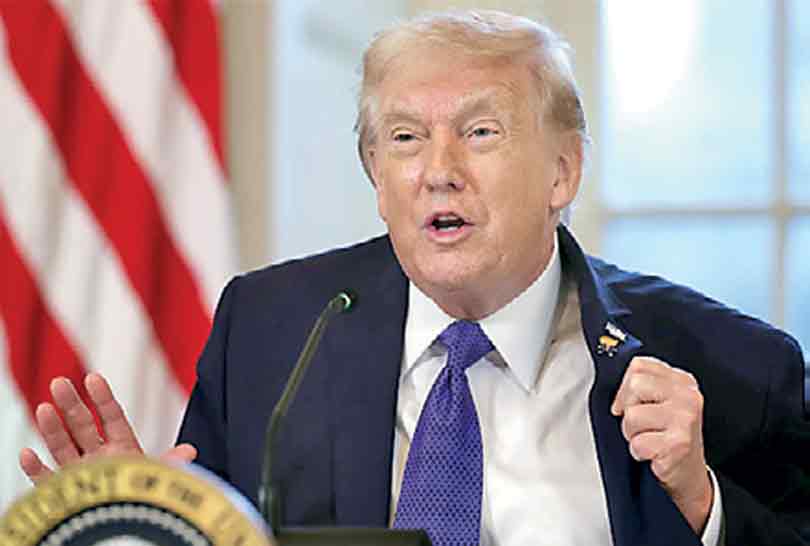
US President Donald Trump
 Trumpflation has two components, inflation and stagflation, which ultimately lead to recession. It is a negative shock to the world economy.
Following the closure of the Strait of Hormuz, IMF’s Chief Economist Pierre-Olivier Gourinchas has warned that the world economy would be facing an inflation rate of over 5% and that global economic growth would dip to 2% by the end of this year. This inflation and the prospect of a recession is a gift from the US pseudo-Jesus incarnate Donald Trump and his White House sycophants.
However, a wave of cost-push inflation had already started when the war in Ukraine broke out in 2022, followed by Israel’s invasion of and genocide in Gaza a year later. The current wars in Iran and Lebanon have made the situation worse.
The supply constraints these events generated ultimately resulted in increasing the cost of living for hundreds of millions of ordinary households all over the world, and Donald Trump casually dismissed that increase as a small price necessary to bear in order to achieve the long-term benefit of a secure world.
To fight against Trumpflation and recession, central banks are resorting, as usual, to their conventional monetary tool of raising interest rates. That would negatively impact private sector investment, which means an increase in unemployment.
Ultimately, what the world is confronting by the end of this year is economic contraction caused by stagflation, a situation that led to the collapse of Keynesian economics in the 1970s and the rise of supply-siders.
Trumpflation is undermining the supply side. It was the rise in the price of oil that caused stagflation then, and it is the same that is causing the current one. But there is a difference between then and now. Earlier, oil prices increased because of OPEC, formed by countries that owned that natural resource to stop multinational intermediaries headquartered mostly in the West from exploiting the legitimate owners.
But now it is the unprovoked war on Iran by a psychotic US President, in alliance with an internationally convicted war criminal Netanyahu, both backed by a powerful Zionist US lobby, all aiming to prevent Iran emerging as a potential military threat to Israel’s territorial expansion and regional supremacy in the Middle East, which has set the stage for another wave of stagflation and recession. Iran is a country that sits on 12% of the world’s oil resources and 4% of the world’s oil supply, and more importantly, it is strategically placed to watch over the passage of nearly 20 million barrels of oil passing through the Strait of Hormuz daily.
This war could have been stopped without a shot being fired had the oil-producing Gulf countries—Saudi Arabia, UAE, Kuwait, Oman, Qatar and Bahrain—kept their promise not to allow the US to fire its missiles from American bases in that region. As one UAE academic, Abdul Khaleq Abdulla, had noted, the American base in the UAE has become a “burden” and not a “strategic asset”. That is true of all American bases in the Gulf region.
Once Iran was attacked by the US, it had no alternative but to retaliate and convert it into a regional war. As a result, Gulf oil producers have suffered significantly, and they made it worse by encouraging the US to punish Iran even more. The fact that Iran’s main objective in strengthening its military capabilities is not to attack the US but to build up its own defence against Israel’s existential threat is something that every Arab country in the region cannot afford to ignore.
In short, by not supporting Iran in this war, Arab countries in the region are set to pay a heavy price for their original sin of depending on Western powers like Britain before, and the US after World War II, for their defence and security needs, when Israel decides to extend the boundaries of Greater Israel, as it has done in Gaza and the West Bank already and is doing so now in southern Lebanon.
The severity of the recession would increase and last longer if the current stalemate in negotiations between the US and Iran in Islamabad ends in the resumption of war.
The US, as one of its historians, Timothy Snyder, points out, would be committing “superpower suicide”, with declining support at home and abroad. Trump seems to be more interested, according to Snyder, in the personal enrichment of himself, his family and cronies than in enhancing the country’s economic strength and people’s welfare. Already, his unilateral hike in tariffs has hit the pockets of ordinary US citizens, and all constitutional constraints on the President’s power have been ignored. His reliance on oil and gas has already surrendered clean energy leadership to China. The US, in essence, is a waning superpower.
The resumption of war would close not only the Strait of Hormuz but, more damagingly, Bab el-Mandeb (Strait of Tears), which connects the Red Sea to the Gulf of Aden and the Indian Ocean, and through which 4 million barrels of oil and 6% of global trade per day pass.
The Houthis from Yemen, a member of Iran’s axis of resistance, would be called upon to get directly involved in implementing the closure of this strait. That would be a double jeopardy to the world economy, and the recession would last longer and recovery more difficult. In the post-OPEC stagflation, economic recovery was relatively smoother and quicker because of open economy policies, the revolution in information technology and globalisation, which made factor mobility across nations smoother.
Now, with robotics and AI, unemployment would persist and could cause labour unrest.
Optimistically, Trumpflation may be a blessing in disguise in the sense that the severity of the economic recession could cause the demise of the post-World War economic order controlled by the Global North and led by the US.




