Monday Sep 14, 2026
Monday Sep 14, 2026
Saturday, 23 May 2026 04:14 - - {{hitsCtrl.values.hits}}
 He belonged to an earlier era of American politics when individual legislators could exercise considerable independent influence over foreign assistance and appropriations. That space has narrowed significantly today. Wilson himself was far from a conventional politician, and aspects of his legacy will always be debated. But for Sri Lanka, at a difficult moment, he was a well-placed friend who made a difference
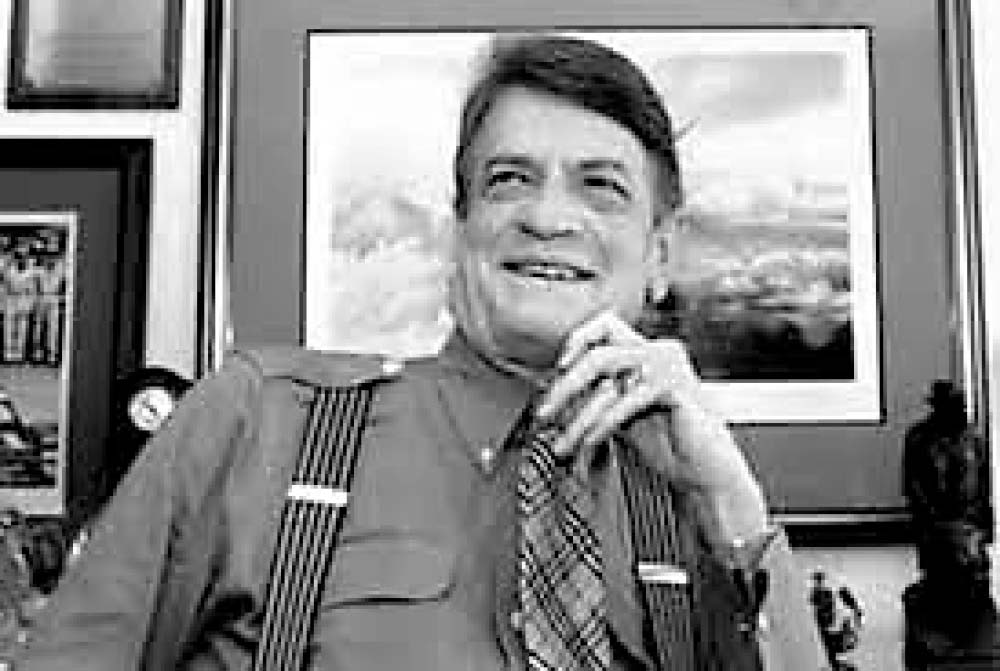
 It was in the early 1990s, during one of the most difficult periods in Sri Lanka’s post-independence history, that I came to know an unusual and unforgettable figure in Washington — Congressman Charlie Wilson.
At the time, I was associated with the Government of President Ranasinghe Premadasa as Special Representative of the Government of Sri Lanka. My responsibilities included handling aspects of Sri Lanka’s relationship with the United States, as well as troubleshooting and coordinating aspects of external economic cooperation, including engagement with the World Bank and the International Monetary Fund. In that context, the US Congress — particularly the foreign operations subcommittee of the Appropriations Committee — would have an important bearing on Sri Lanka’s economic position.
Most influential voices on foreign assistance
Congressman Charlie Wilson was a powerful member of that subcommittee and one of its most influential voices on foreign assistance.
He was already a legend on Capitol Hill: a flamboyant East Texas Democrat, politically powerful, with a rough-edged charm and highly effective at the often obscure but decisive business of congressional appropriations. Wilson did not resemble the typical American legislator. Yet beneath the eccentricity lay a sharp political instinct, a practical understanding of power, and a strong grasp of international affairs.
I still vividly remember one of my early meetings with him in his congressional office. He was famously fond of cats, several of which roamed freely through his office. As I was about to take a seat on his sofa, he remarked dryly, “You are welcome to sit there, but you are likely to leave a hell of a mess.” Only then did I notice one of his cats asleep there.
A story circulated in Washington that one of Wilson’s cats would often appear in congressional hearing rooms shortly before Wilson himself entered — as though announcing his arrival.
Such anecdotes formed part of his legend. But his outward unorthodoxy was deceptive. He understood the quiet instruments through which much of Washington actually works: procedure, relationships, timing, and leverage.
Wilson was widely credited with helping secure American support for the Afghan resistance during the Soviet occupation of Afghanistan, a role later popularised in the Hollywood film Charlie Wilson’s War, starring Tom Hanks and Julia Roberts. For Sri Lanka, Wilson mattered because he could help sway decisions on foreign assistance that affected us directly.
President Premadasa had taken office during a period of severe political and economic strain. Sri Lanka faced internal conflict, economic instability, and a serious balance-of-payments crisis. External assistance was therefore critically important.
At the time, the United States was providing Sri Lanka with assistance in a number of areas, including the Public Law 480 program, popularly known as PL 480, which provided American wheat and financial aid to Sri Lanka on concessional terms. While allocations under such programs were proposed by the executive branch, congressional committees had to approve them and could shape them. It was within this process that Wilson’s influence could come into play.
On several occasions, through his intervention in the committee process, Sri Lanka was able to secure increased allocations and other forms of assistance. At that time, such support had real economic importance for the country.
Although Sri Lanka was of limited strategic consequence to a congressman of his stature and influence, Charlie Wilson was always accessible and consistently willing to help whenever we approached him.
|
Charlie Wilson
|
Clinton Vs Bush and disparaging reference to Sri Lanka
One such occasion occurred during the 1992 US presidential campaign. In his widely televised acceptance speech at the Democratic Convention, then-presidential candidate Bill Clinton, in an effort to criticise President George H. W. Bush, made a passing but disparaging reference to Sri Lanka, stating that the American economy had fallen to a level “somewhere between Germany and Sri Lanka.” The reference to Sri Lanka was clearly meant as shorthand for economic decline. To make matters worse, a few weeks later, at the Republican Convention, which I also attended, President Bush took umbrage at Clinton’s remark, but in doing so he repeated the same unfair comparison.
The remark quickly became a much-replayed soundbite, featured in news reports across the United States and abroad. I felt that this characterisation of Sri Lanka should not be allowed to stand unchallenged, and wrote an op-ed for The Washington Post to present a more accurate picture. I will save the story of how that came about, which involves another Washington legend, for another day. Remarkably, in Washington, where political gestures are often carefully calculated, Charlie Wilson, though a Democrat himself, took the lead by placing my article in the Congressional Record with a supportive introduction. Several other Democratic and Republican senators and representatives then followed suit.
That gesture reflected something important about him. Beneath the flamboyance was a strong sense of personal fairness and independence. He was willing to act on conviction, even when it cut across partisan lines.
Over time, there were several other occasions on which he extended assistance and goodwill towards Sri Lanka. Much of diplomacy, particularly in Washington, depends not only on formal state relations but also on personal relationships and individual channels of influence. Wilson was one such channel.
He belonged to an earlier era of American politics when individual legislators could exercise considerable independent influence over foreign assistance and appropriations. That space has narrowed significantly today.
Wilson himself was far from a conventional politician, and aspects of his legacy will always be debated. But for Sri Lanka, at a difficult moment, he was a well-placed friend who made a difference.
He passed away in 2010, closing the chapter on one of the more colourful careers in American political life.
Yet what remains with me is not the legend or the film, but the memory of a congressional office, a sleeping cat, and his dry warning: “You are welcome to sit there, but you are likely to leave a hell of a mess.”
(The author is the Founder of the Pathfinder Foundation)