Wednesday Sep 23, 2026
Wednesday Sep 23, 2026
Wednesday, 23 September 2026 03:55 - - {{hitsCtrl.values.hits}}
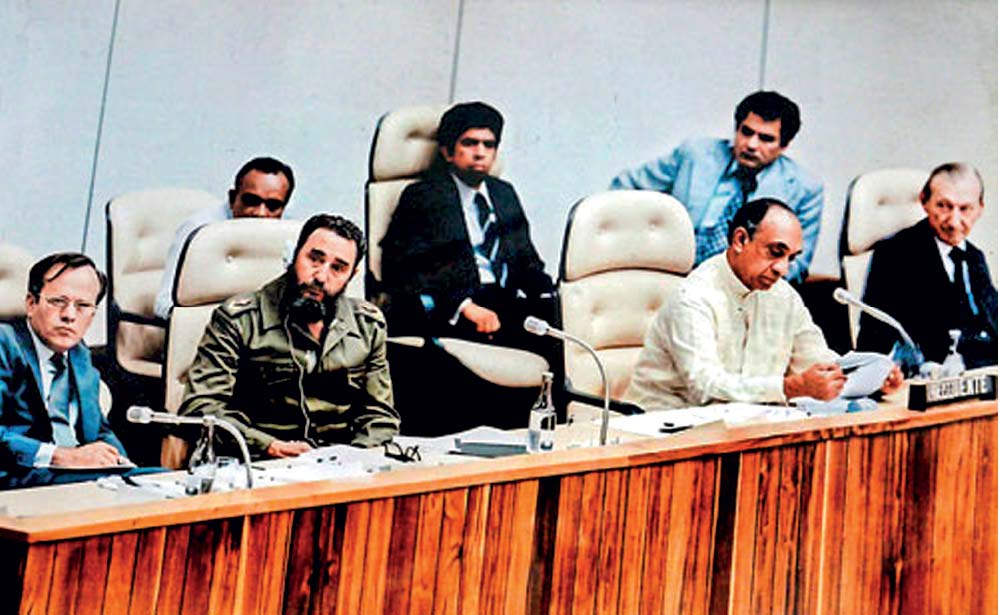
Ambassador Nihal Rodrigo (back row in a black suit) at the 1979 Non‑Aligned Summit in Havana, along with Sri Lanka’s President J.R. Jayewardene, Cuban leader Fidel Castro UN Secretary General Kurt Waldheim
 In many ways my friendship with Nihal went against the current. I was quite a loud-mouthed human rights activist in my youth and I would mumble, grumble and express outrage at Sri Lanka’s human rights violations. When I got carried away Nihal’s humour and innate tolerance would always bring me back to base
 In an era of vicious polarisation my relationship with Nihal and Chitra Rodrigo and their children is unique because it crosses socially imposed boundaries. It is a testament to a friendship that is bonded in a nostalgic Sri Lankan identity before ethnic nationalisms became prominent. Through them I developed a love for Southern cuisine (especially nelun Ala, polos and del), Sarathchandra plays, Chitrasena ballets and Sri Lankan painting. Whenever Sarathchandra plays opened in Colombo I was always taken to the best seats in the house and Chitra would whisper the storyline.
They took me to meet George Keyt. I was young then, starry eyed and Keyt told me I had a face like the full moon. Nihal watching my expression cautioned me by whispering that he says that to everyone! A sketch of Radha Krishna done during that encounter hangs in my house. Nihal himself was a painter whose beautiful women all resembled different versions of his wife Chitra. My relationship with the Rodrigos was close and signified the promise of independence where everything was possible and we dreamed of the beautiful futures so captured by the art of that period.
My experience during the Presidential Commission on Youth made me realise that this delightful world was very privileged and the art of Keyt and Paynter would soon give way to Thenuwara, Anoli Perera, Jagath Weerasinghe and T Sananathan- the art of suffering and struggle. My constant desire to return to the living room of Nihal and Chitra was to escape the latter world and to be reminded of that special time when we felt so secure and life was beautiful.
If Nihal had a public persona and a passion it was as Sri Lanka’s leading advocate for the non- aligned movement
|
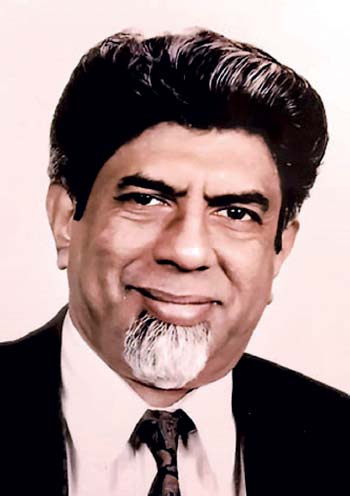
Nihal Rodrigo |
In many ways my friendship with Nihal went against the current. I was quite a loud-mouthed human rights activist in my youth and I would mumble, grumble and express outrage at Sri Lanka’s human rights violations. When I got carried away Nihal’s humour and innate tolerance would always bring me back to base. At that time, I was also constantly attacked in the newspapers. My mother would get agitated and besides family she would call on Neelan and Sithie Tiruchelvam and Nihal and Chitra. They would come immediately. Chitra says Nihal went to advise and calm down my mother while she accompanied him for my mother’s specialty cheese toast .
If Nihal had a public persona and a passion it was as Sri Lanka’s leading advocate for the non- aligned movement. In this we were united. His life and service paralleled the early growth of the movement. He was on Sri Lanka’s delegations at every Non-Aligned Summit since the Colombo Summit in 1976. At that summit Sri Lanka became the chair of the movement. Nihal co-ordinated its UN activities and was elected Chairperson of the Political Committee at the 11th NAM summit.
Nihal was very Sri Lankan but like many in his generation, inspired by the Indian freedom struggle he also had a South Asian identity
Recently there is a great deal of interest in the Bandung Conference that created the non-aligned movement. Non-alignment was not only a negative value- prevent western interference in internal affairs but also a positive people’s movement located in anti-colonial struggles. Vasuki Nesiah and Tony Anghie posit it within third world struggles for global equity and social justice. Recently at a conference held at BCIS commemorating seventy years since Bandung, there was a large turnout of young people. Post Gaza the appeal of a modern non-alignment movement that will help reconfigure the global order is gathering momentum. Nihal would have been very happy.
Nihal was very Sri Lankan but like many in his generation, inspired by the Indian freedom struggle he also had a South Asian identity. He read widely on South Asian history and culture. He had close friendships with so many South Asian diplomats. The aesthetic of his house also shows this bias. Th paintings are Sri Lankan but the statues and artifacts are from all over South Asia. It therefore seems quite natural that he would end his career as the Secretary General of SAARC but with a divided and polarised membership
While geopolitics and foreign policy were Nihal’s public face, he was a very creative person and loved creativity in others
Nihal was also one of the first to realise the importance of our relationship with China while he was ambassador there. We know so little about this great power and Nihal gained encyclopaedic knowledge while he was there that he would share with friends, colleagues and at international conferences. Relations with China would blossom during his time while China itself was undergoing a major transformation from being underdeveloped to a global economic power. Nihal witnessed this transformation taking place and felt there were many lessons for Sri Lanka. Nihal was very much part of the “Asia Rising” school given his passion for the aspirations of both South Asia and China.
In a country undergoing civil strife Nihal had a special sensitivity to the cost of war. He was perhaps the most non-violent of human beings. In Peradeniya while a student he directed Euripides’ Trojan Women in Peradeniya’s famous open- air theatre. His peers still talk about the production. During the 1983 riots Nihal and Chitra sheltered many people. It was a terrible time for my family and the Rodrigos were steadfast in their support. My whole relationship with my country changed for a while as I felt so much grief and anger. There were also amusing anecdotes. My mother felt that if our house was burnt the most important thing to save were all the Kancheevaram sarees she had hand picked through the years. She packed them all in a suitcase and asked me to take it to Chitra. If indeed we went to a refugee camp, we would have emerged from the ashes in all our saree splendour.
Nihal was also a lover of books. He was deeply disturbed by the burning of the Jaffna Library. For him it was a civilisational violation and he became one of the main voices fighting for its restoration. In 1997 a presidentially appointed committee co-chaired by Foreign Minister Lakshman Kadirgamar and Mangala Samaraweera gave Nihal the opportunity and restoration work began in 1997. The foreign Minister held discussions with British Library officials and a film was made to gather assistance for the Jaffna library. Between 2001-2003 it was restored with new structures and books though the precious original manuscripts could never be replaced.
While geopolitics and foreign policy were Nihal’s public face, he was a very creative person and loved creativity in others. He loved music and opera and in his last years music would keep him calm and contented. Nihal’s secret passion were old movies, especially those with Humphrey Bogart as a hero. He must have seen Casablanca a 100 times. He was an unabashed romantic. Nihal and Chitra’s love story with Nihal stealing the Harischandra beauty was also testament to that fact.
It is also satisfying to know that Nihal’s gentleness, integrity and creativeness will live on in his children. They have his values, decency and a rare self-awareness and sensitivity. That in the end will be the most important testament to his life
Chitra, Nihal’s wife was a professional teacher recognised by many. Generations of Ladies College girls greet and meet her all over the world. Their love and respect for her are very obvious. She was also the perfect hostess and trained generations of diplomatic wives to plan and entertain in diplomatic circles. My greatest respect for Chitra was for her role as carer in the last three years of Nihal’s life. It was a very difficult period and she did everything to make him comfortable. Her sacrifice and dedication sometimes broke my heart.
In the end my bond with the Rodrigos is familial. Like Anila Dias Bandaranaike I would escape university life to be spoiled at the Rodrigo apartment in New York while they were serving there. It was a very small apartment so I slept in between the children and managed to charm my way to get Satya’s first marriage proposal at the age of four. Satya has followed in his father’s footsteps and is now Ambassador in Italy. Later on in New York I became very close to daughter Nandi who worked for the New Yorker and now as head of research for the New York Times magazine. With her husband Rafi, a staff writer for the New Yorker and their delightful daughter Anouk I have spent countless hours going to exhibitions and just talking about everything, art, plays, politics, history and just life in general. Even though I am single I have never felt the need for children. My brother’s sons, Neelan and Sithie’s children and Nandi and Satya have filled that void. I am forever grateful. It is also satisfying to know that Nihal’s gentleness, integrity and creativeness will live on in his children. They have his values, decency and a rare self-awareness and sensitivity. That in the end will be the most important testament to his life.
(The author was the former United Nations Under Secretary General and the Special Representative on Children and Armed Conflict)