Saturday Sep 19, 2026
Saturday Sep 19, 2026
Saturday, 19 September 2026 00:10 - - {{hitsCtrl.values.hits}}
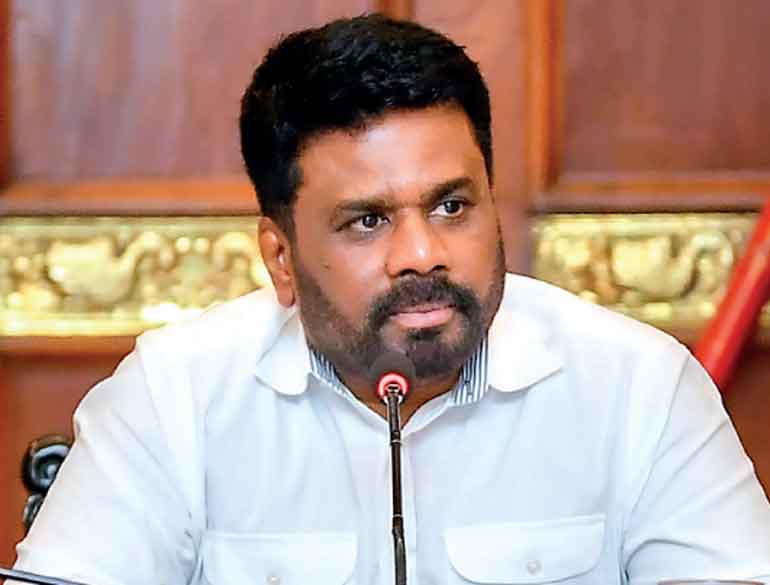
President Anura Kumara Dissanayake
- To inspire change, the NPP must first establish itself as the benchmark for good governance. By temporarily prioritising the design and execution of a robust institutional action plan over immediate political goals, the administration will naturally achieve its long-term political objectives. Currently, a noticeable gap remains between the administration’s operational conduct and the exemplary leadership required to build lasting public confidence
- It is increasingly evident that the NPP requires a comprehensive capacity-building initiative to govern effectively and fulfill its promised agenda
 Public expectations from a national government
Concluding this three-parts article, this segment outlines prevailing public sentiment, balancing popular expectations against the administration’s perceived strengths and weaknesses. The objective is to present a constructive overview for the NPP Government, offering a roadmap to transform public scepticism into confidence. If the Government can prioritise efficiency, professionalism, and decisive governance, they have ample time to prove to the public that their electoral choice was the correct one.
8. National unity, social cohesion, and political stability
Why it matters
No country can develop amid division and instability. Citizens should expect:
I. Policies that promote unity
II. Respect for diversity
III. Stable governance free from political turmoil
Global examples
I. Switzerland: Multi-ethnic, multi-lingual harmony.
II. Singapore: Strong emphasis on social cohesion.
III. Rwanda: National unity as a foundation for development.
Expectation for public
Citizens should expect leaders who unite the nation rather than divide it for political gain.
9. Accountability, transparency, and citizen participation
Why it matters
Democracy thrives when citizens are informed and engaged. Citizens should expect:
I. Transparent decision-making
II. Accessible public information
III. Mechanisms for public consultation
IV. Accountability for misuse of public funds
Global examples
I. Estonia: Digital governance ensures transparency.
II. Sweden: Open-access public records.
III.South Korea: Strong anti-corruption enforcement.
Expectation for public
Citizens should expect a Government that listens, explains, and remains accountable.
 10. Decent and beautiful country attracting tourists
Why it matters
Tourism is one of the fastest ways to generate foreign exchange, create employment, stimulate regional development, and improve the international reputation of a nation. However, tourists are not attracted solely by natural beauty. They seek countries that are clean, safe, organised, culturally vibrant, environmentally sustainable, and welcoming. A beautiful country reflects disciplined governance and a responsible society.
Citizens should expect:
I. Clean, attractive, and well-maintained cities, towns, villages, and public spaces.
II. Safe environments with low crime rates and strong public security.
III. Efficient transport systems, quality tourism infrastructure, and visitor-friendly public services.
IV. A visible and uncompromising zero-tolerance policy, rigorously enforced by law enforcement authorities, against any form of unethical conduct, fraud, harassment, exploitation, or ill-treatment of tourists by service providers or members of the public.
V. Protection and preservation of natural, historical, cultural, and archaeological heritage.
VI. High environmental standards through effective waste management, pollution control, and sustainable development.
VII. Professional tourism promotion supported by a strong national brand.
VIII. A hospitable culture where visitors are treated with respect, warmth, and professionalism.
IX. Public amenities, including roads, toilets, parks, beaches, walking trails, and recreational facilities, maintained to international standards.
X. Policies that encourage eco-tourism, cultural tourism, wellness tourism, adventure tourism, and community-based tourism.
Global examples
I. Singapore: World-renowned for cleanliness, safety, efficient public services, and urban greenery, attracting millions of visitors despite its limited natural resources.
II. New Zealand: Successfully markets its pristine environment, adventure tourism, Māori culture, and sustainable tourism practices.
III. Japan: Combines exceptional public discipline, cultural heritage, modern infrastructure, and hospitality to create one of the world’s most admired tourism destinations.
IV. Switzerland: Demonstrates how environmental conservation, efficient transport, and scenic landscapes can become valuable national economic assets.
V. Rwanda: Once associated with conflict, Rwanda has transformed itself into one of Africa’s cleanest, safest, and best-managed tourist destinations through disciplined governance and environmental stewardship.
Expectation for Government
Citizens should expect a Government that views tourism not merely as an industry but as a national development strategy. This requires coordinated planning across ministries responsible for transport, environment, culture, urban development, public security, heritage conservation, local government, and economic development. National cleanliness, environmental protection, infrastructure development, and public behaviour should become integral components of economic policy rather than isolated initiatives.
A truly beautiful country is not created by periodic clean-up campaigns but through consistent governance, effective law enforcement, civic education, professional urban planning, and a culture where every citizen takes pride in maintaining the nation’s appearance and reputation.
Expectation for public
Citizens should recognise that every individual is an ambassador for the nation. They should maintain cleanliness, protect public property, respect cultural and natural heritage, demonstrate hospitality towards visitors, obey environmental laws, and actively contribute to making their communities attractive places to live and visit. A nation’s beauty is ultimately a reflection of the values and behaviour of its people.
The citizen’s role in the journey to development
While governments carry the primary responsibility for national development, citizens also play a crucial role. They must:
I. Vote responsibly
II. Hold leaders accountable
III. Participate in civic life
IV. Behave as law abiding citizens
V. Respect muti-ethnic, multi-cultural identities
VI. Treat all equally and equitably
VII. Shed political beliefs temporarily until the end of the term of any elected government and support right actions and constructively criticise wrong actions
VIII. Seek facts before comment
IX. Support long-term national goals over short-term populism
Sri Lanka has the potential to become a prosperous, stable, and developed nation. But this transformation requires a Government that is visionary, competent, transparent, and committed to the well-being of all citizens. These expectations are not luxuries. They are the foundations upon which every developed nation has been built.
Evaluating the NPP’s journey so far: Promising indicators with premature triumphs
Strong AntiCorruption drive
I. The NPP entered office on a platform of “system change,” prioritising transparency and accountability.
II. Initiatives like the Clean Sri Lanka (CSL) program demonstrate political will to tackle corruption and improve governance, even if shallow scope and implementation gaps remain.
III. Independent analysts note that the Government has made “important strides in anticorruption,” laying groundwork for longterm institutional reform yet, the progress is slow and the drive is diluted with own political protectionism.
Progress in power sector reforms
I. The Government pushed through major energy-sector restructuring, including unbundling the Ceylon Electricity Board (CEB).
II. These reforms were backed by strong political leadership and technical expertise, helping overcome resistance and protests.
III. The newly formed power sector institutions currently lack a publicised national strategic plan to guide their operations. Without defined strategic directions and supporting business plans, these organisations risk functioning as mere extensions of the former CEB rather than distinct, modernised entities.
Steps toward economic stabilisation
I. Research indicates signs of economic recovery following the 2022 crisis, with improved macroeconomic stability.
II. The NPP’s rise was partly driven by public demand for economic reform, and early measures have helped stabilise key sectors.
III. Yet, a publicised National Economic Plan for the post-IMF transition in 2027 remains absent. This ad-hoc approach is reminiscent of Sri Lanka Cricket team used to prepare for the World Cup tournament at the last minute. Relying on such short-term, reactive planning is a significant national shortcoming that must be addressed.
Breaking the twoparty dominance
I. The NPP’s electoral victories in 2024 marked a historic shift away from Sri Lanka’s longstanding twoparty system.
II. This broadened political representation and created space for alternative policy approaches.
III. The NPP currently holds a historic two-thirds majority, yet it has shown a reluctance to pursue the bold, sustainable reforms required to modernise the state. The administration’s failure to prioritise introduction of a new constitution, the abolition of the PTA, and the dismantling of divisive legal frameworks suggests a preference for maintaining the status quo over fulfilling its mandate for deep institutional transformation.
Identified vulnerabilities: Key areas requiring urgent rectification
Concerns about rule of law and political influence
I. Achieving the equal application of the rule of law across all social strata remains an unfulfilled objective.
II. The systematic postponement of court proceedings pending the conclusion of investigations raises concerns regarding the professionalism of evidence collection, ultimately eroding public confidence in the judicial process.
Slow or stalled education reforms
I. Education reforms have lagged due to weak leadership coordination and bureaucratic resistance.
II. This contrast highlights uneven governance capacity across sectors.
Limited economic relief for citizens
I. Despite macrolevel improvements, poverty remains high and the Government has struggled to deliver meaningful economic relief to the bottom 30% of public.
II. Relying solely on free rations is insufficient to lift impoverished populations out of poverty; sustainable economic mobility requires holistic structural support and capacity building.
Falling short of campaign promises
I. Oneyear assessments note that the NPP has not fully delivered on major pledges such as:
a. Eliminating corruption at all levels
b. Reviving the economy for ordinary citizens
c. Reforming public education
d. Introducing a new constitution with devolved power
e. Repealing harsh antiterrorism laws
These gaps have led to public disappointment.
II. Ideological Compromises in equitable and transparent governance.
a. As the NPP settled into governance, its anticorruption and leftleaning platform increasingly collided with neoliberal economic pressures.
b. This has led to compromises that some supporters view as inconsistent with the party’s original principles.
Concluding observations
It is increasingly evident that the NPP requires a comprehensive capacity-building initiative to govern effectively and fulfill its promised agenda. While cultivating public and civil service support is essential, doing so demands a fundamental shift in both civic and administrative behaviour.
To inspire this change, the NPP must first establish itself as the benchmark for good governance. By temporarily prioritising the design and execution of a robust institutional action plan over immediate political goals, the administration will naturally achieve its long-term political objectives. Currently, a noticeable gap remains between the administration’s operational conduct and the exemplary leadership required to build lasting public confidence.
(The author is an engineer currently working in the Australian NSW Local Government sector. He aims to share his perspectives on various social development issues alongside his professional expertise to inspire others to think critically and differently. He can be reached at [email protected])




