Monday Oct 12, 2026
Monday Oct 12, 2026
Saturday, 11 April 2026 01:00 - - {{hitsCtrl.values.hits}}
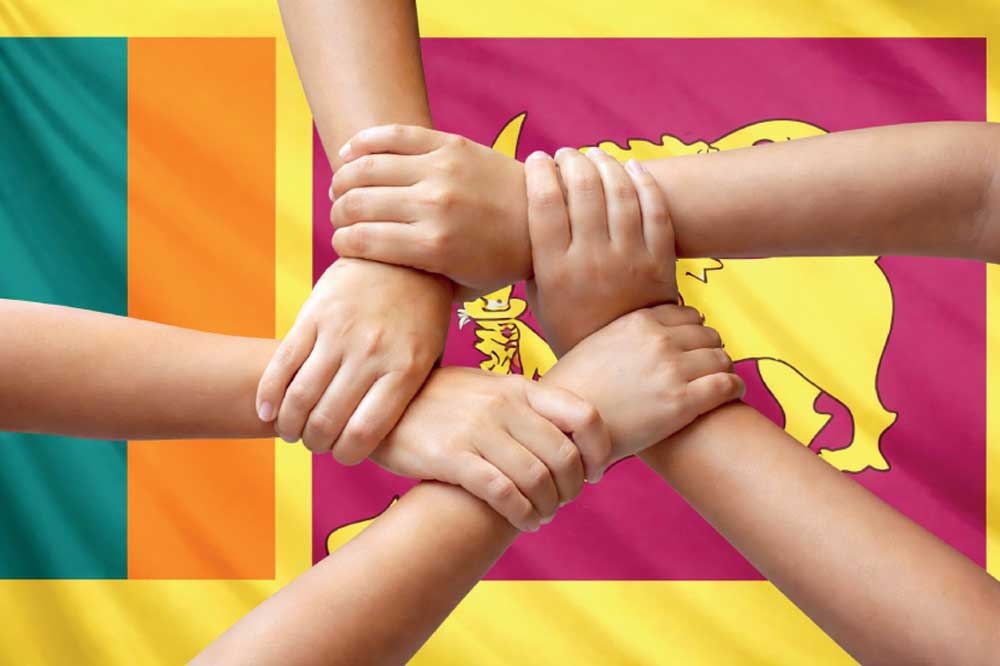
 There had been a close silence on the matter of bringing past miscreants in high places to justice until the renewed demand – and fresh deadline – for a former President to prove his bona fides as regards assets, revenue streams and sources of wealth.
Then suddenly the cacophony of nationalists crying foul on the grounds of ‘anti-patriotic’ elements driving the agenda threatened to drown out all other noise around the vexed issue.
And it reminded me that not only is our sense of nationhood tied to political messiahs of a particular era but almost inextricably linked to notions of race, ethnicity, language and culture.
It is also inevitably the stamping-grounds of war horses trumpeting patriotism and all that stuff.
A time such as this – a traditional new year is ahead for Sri Lankans one and all – is a good time for some reflection. And if rationality speaks louder than our downfall-causing jingoism, it is also an auspicious season for resolutions towards ‘never going there again’ – ‘there’ being wars based on race, a false peace when there is absence of war without justice and equality for all. Or yet another conflict fuelled by ethnic particularism.
So yes: Sri Lanka’s identity politics is less a bug in the system than its default operating software – written over centuries, patched by colonialism, and catastrophically corrupted in the decades before and after independence. To analyse it usefully, we need to hold two truths together: identity politics has both protected communities and poisoned the polity.
The pros Yes: there are some!
For one, there’s cultural preservation and resilience. Identity-based mobilisation has helped safeguard languages, religions and traditions – Sinhala-Buddhist, Tamil-Hindu, Muslim, Malay, and Burgher – against eclipse or erasure. Without such assertion, smaller communities in particular may have been assimilated or marginalised more deeply than some of them have been. For another, there is political representation for minorities. Tamil and Muslim identity politics especially emerged as defensive responses to majoritarian consolidation. They enabled articulation of grievances that might otherwise have been silenced.
And then again – it stimulates social solidarity within groups. Ethnic identity has functioned as a support network – mutual aid, welfare, religious institutions – especially in times of conflict and displacement.
Last not least – identity politics serves as a check on absolute majoritarianism (in theory, at least). Plural identity blocks can – if functioning well – force coalition politics and compromise; although Sri Lanka’s history shows that this potential was abused and compromised, and the many opportunities presented to shape and safeguard the nation’s future were squandered.
The cons
At first (and later) glances, these are far more consequential.
It entrenches an ethos of majoritarianism. Sinhala-Buddhist nationalism, especially post-1956, translated demographic majority into political dominance, and did so often (and usually) at the expense of pluralism.
It provokes reactive ethno-nationalisms. Tamil nationalism in particular hardened in response, culminating in separatism and the long civil war. Muslim identity politics later evolved defensively, amidst mounting majoritarian pressures.
Identity politics cultivates a zero-sum political culture: identity became the primary currency of power. Elections were less about policy and more about ethnic arithmetic.
It militates towards institutional distortion: language policy, education, public sector recruitment, land settlement – all became areas of ethnic contestation. Identity politics often unleashes violence and begets generational trauma. The protracted Sri Lankan civil war remains the most devastating outcome; but anti-Tamil pogroms (1956, 1958, 1977, 1981, and Black July 1983) and anti-Muslim riots (1915, 1976, 2014, 2018, 2019) show recurring patterns.
Significantly, it invites economic underperformance. Identity politics diverted resources from development, deterred investment, and entrenched regional inequality.
And there is most often substantial diaspora polarisation. Diasporic communities often amplify identity politics, sometimes freezing conflict narratives long after underlying realities evolve – and maybe even improve – domestically.
SWOT analysis: ethno-linguistic and cultural diversity
First, to its strengths:
Foremost, perhaps, is civilisational depth. Sinhala, Tamil, Muslim, and Burgher traditions enrich literature, law, cuisine and spirituality, among other spheres.
Next comes strategic multiculturalism. A bridge between South Asia, South-East Asia and the Middle East, not to mention – more distantly – and in different ways, Australia, the UK, and Canada. Third, there is linguistic capital, with bilingual or trilingual populations being an economic asset. Fourth, there is resilience: communities have survived war, colonisation and globalisation.
Next, weaknesses must be admitted...
Sri Lanka has experienced segregated lived realities: parallel societies exist with limited interaction.
In general, mutually exclusive historical narratives – and competing myths of origin and entitlement – drive communities farther apart. Politicised religion has played a diabolical part in dividing island peoples. Sacred identities have been instrumentalised for temporal power so many times that the heavens weep and sundry deities hide their faces. Beneath the surface of a typical islander bonhomie and camaraderie, there lies a trust deficit, a deep suspicion running submarinely across communities.
Of course, opportunities abound...
Sri Lanka is, in a sense, blessed with a post-war generation that is less directly shaped by conflict – and therefore, perhaps, more open to hybrid identities.
A modicum of digital integration is evident in 21st century Sri Lanka, such that shared media spaces can foster valuable cross-cultural exchanges.
And economic necessity – for instance, erstwhile crises such as the country’s unprecedented economic meltdown in 2022 followed by the Aragalaya – have already demonstrated moments (and movements) of cross-ethnic solidarity.
A final point of expedient opportunity is the barometric tourism industry and soft power in showcasing the island nation as a hub of diversity, a winning global brand to beat Bali and beyond.
But there is no denying the existence of threats that lurk...
Here be dragons! Political entrepreneurs, those agents of ethno- and ultra-nationalism, and agents provocateurs against national unity, thrive on division and dissension to the detriment of a united identity. External influences also exert pressure through diaspora funding and fermentation of a fertile seed-bed for contesting nationalisms, as well as geopolitical actors exploiting ethnic fault lines. Another hazard is that when economic shocks come, such crises often ignite scape-goating, sabotaging any good work being done by civil society to mitigate the ‘otherness’ of the others, those alien people among whom we live, clutching their gods while we clutch ours...
More prosaically, there is radicalisation whereby religious extremism can crouch in and spring up from any community.
So how can we boil the pot of a fresh start towards developing a salutary new sense of self, nation-wise?
Pillars of a national strategy
Civic nationalism over ethnic nationalism! Shift identity from ‘who we are’ to ‘what we can share’. Citizenship per se and not idiosyncratic cultural markers must be prioritised as the primary identity.
Radical equality before the state! Ensure language parity (Sinhala and Tamil in everyday practice, not merely the background letter of the law), meritocratic public service, de-politicised policing and judiciary. Integrated educational reform! Implement mandatory bilingual education, a broad-based history curriculum (multi-perspective, not majoritarian) and experiment with student exchanges across the provinces.
Economic interdependence! Establish mixed ethnicity industrial zones, regional development that compels cooperation, and offer incentives for diversity honouring workplaces.
Truth, memory and reconciliation! Undertake an honest reckoning with war-time abuses on all sides, enabling memorialisation that humanises, not weaponises.
Political system reform! Incentivise cross-ethnic parties (through proportional representation tweaks?) and penalise hate speech meaningfully.
Cultural synthesis! Conduct national festivals celebrating all traditions, and impose media quotas for multi-lingual, multi-cultural content.
The keys to a new national identity
A viable identity must be aspirational, non-ethnic, emotionally resonant, economically grounded.
‘Citizen first, culture follows.’ ‘One island: many stories, one strategy.’ ‘Sri Lankan by choice, not circumstance or compulsion.’ ‘Unity without uniformity.’ The most potent, however, may be: ‘We before me – Sri Lanka above, beyond and abolishing labels.’
Likely push-back – from where, why
One must be proactive in anticipating adversarial responses from the religious and sociopolitical elements opposed to any tinkering with the status quo:
Majoritarian hard-liners fearing loss of historical primacy, ethno-nationalist groups, political actors who benefit from ethnic bloc voting...
Minority nationalist elites fearing assimilation disguised as unity, sociopolitical actors whose legitimacy rests on nurturing grievances...
Diasporic exfLikely push-back – from where, why
tremes, and sociopolitical and ideological investment in unresolved conflict narratives...
Religious institutions, concerned over dilution of doctrinal authority...
Counter-measures
Once identified, you must explore strategies to frustrate the rabid reactionaries, as well as any remnant genuinely agnostic to the cause of reshaping hidebound ideas and lame-duck (as well as latently dangerous) ideals.
Reframe – don’t erase – identity. Assure all communities that this is addition, in the national interest, not subtraction by hidden agendas of one bloc or ethnic segment. “You don’t stop being or lose by being Sinhalese, Muslim, Tamil or Burgher by attribute – you gain by being Sri Lankan first, in essence.”
Deliver material benefits early. Nothing kills extremism like shared prosperity. An over-arching national identity wins education, jobs, infrastructure – and fosters growth, development and progress (an all-new GDP) – for all. Engage narrative warfare (the soft power at work again) – state, media and the arts must relentlessly tell shared stories.
Co-opt moderate leaders: build coalitions of religious and community leaders who endorse civic nationalism.
Legal deterrence: firm but fair enforcement against hate speech and incitement. Diaspora engagement strategy: turn potential foes into friends, agitators into investors.
Youth-first approach: if schools, universities and workplaces integrate, overall and eventual national integration will follow naturally. Sri Lanka does not lack unity; it lacks a story of unity than is stronger and more appealing to the national will to win – as in, at cricket, for just a singular example – than its tales of woe and division.
The tragedies of the past – from 1956, through Black July, to anti-Muslim pogroms under recent regimes still threatening resurgence – is that identity was weaponised.
The opportunity of the future is to reimagine identity as architecture rather than ammunition.
The question is not whether Sri Lanka can become one people, but whether it will opt to be one race – a strong, singular, synthesised, culturally rich island race – by design and not by default.
(The writer is Editor-at-large of LMD, and has a Post-graduate Diploma in Politics and Governance)




