Thursday Oct 15, 2026
Thursday Oct 15, 2026
Friday, 31 July 2026 00:24 - - {{hitsCtrl.values.hits}}
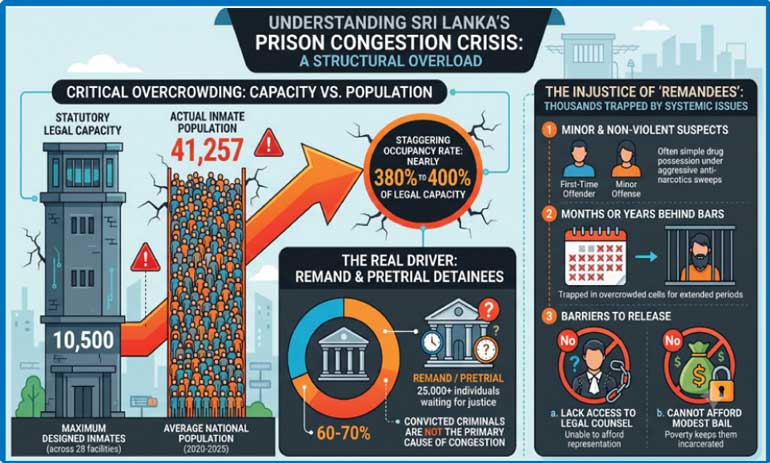
Source: AI generated image based on various editions of Annual Reports of Department of Prisons
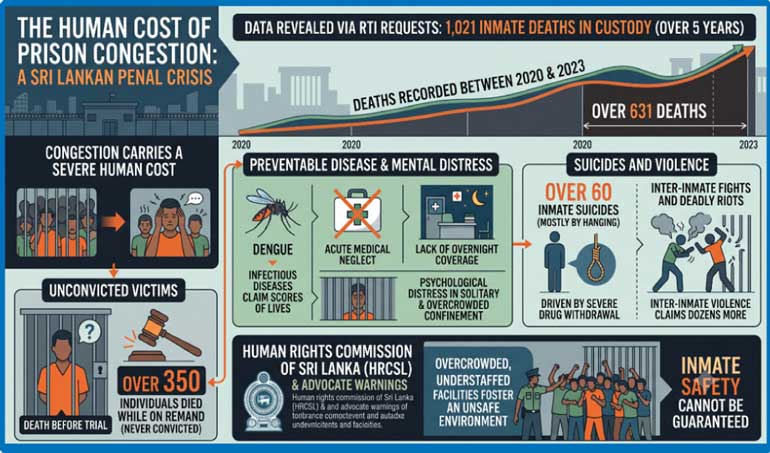
Source: AI generated image based on information on ‘Prison Study by the Human Rights Commission of Sri Lanka (2020/2021)

The riots at Negombo Prison earlier this July had the country in shock. Designed to house a statutory maximum of 650 detainees, Negombo Prison was crammed with nearly 2,600 inmates. Inmates as well as officers who tried to control the situation were seriously injured and some succumbed to injuries.
Justice Ministry officials acknowledged the historic systemic vulnerability of the penal institutions. Yet Negombo crisis will not be the last of its kind, unless action is taken.
The heavily overcrowded prisons of Sri Lanka
Between 60% and 70% of those behind bars are remand prisoners, under-trials awaiting court appearances or toxicological report results during the aggressive narcotic raids from time to time.
Non-violent, first-time suspects remain trapped in overcrowded cells for months, and sometimes years, simply because they lack access to legal counsel or cannot afford modest bail amounts, relatives to bail them out.
Over 1,000 deaths in 5 years within Prison walls
People who are suspects, yet to be convicted are also victims of in-prison deaths. Human rights advocates and the Human Rights Commission of Sri Lanka (HRCSL) have repeatedly highlighted that overcrowded; understaffed facilities foster an environment where inmate safety cannot be guaranteed.
Empowering the Legal Aid Commission
Section 3 of Legal Aid Law No. 27 of 1978 defines the core objectives:
To operate throughout Sri Lanka an efficient Legal Aid Scheme to provide to deserving persons particularly of low income.
Under Section 4, the Act mandates the Commission to establish regional committees and prison legal clinics, conduct legal awareness.
However, the Legal Aid Commission is deterred from acting in full capacity due to following reasons.
1. Widening deficits: In Financial Year 2023, the Commission operated at a net deficit of Rs. 8.8 million, which widened sharply to a deficit of Rs. 30.74 million in Financial Year 2024. Annual operational expenditure rose by Rs. 57.98 million against a revenue increase of only Rs. 36.04 million.
2. Underutilised Legal Aid clinic funds: Audit queries in 2024 noted that while Rs. 66,000 was allocated per legal clinic, which is not at all sufficient.
3. Low salary scale: difficulty retaining experienced staff.
4. Cumbersome panel lawyer payment process: documentation requirements and extensive delays in processing the payments.
5. Outdated means test: the monthly income ceiling of Rs. 15,000 had not been revised, effectively excluding many who genuinely needed legal aid.
6. Budgetary constraints described as actively limiting the provision of legal counselling across Regional Legal Aid Centres (RLACs). In 2026 ‘Support to Justice Project’ (JURE) discussion revealed that copier machines for documentation requirements, vehicles to commute are basic necessities that are acutely scarce in these centres. By 2024, the commission received only Rs. 307 million with 272 staff widely reported as grossly insufficient relative to caseloads, which reached over 127,000 legal consultations in that year alone.
7. IT asset depreciations: Unsettled payables accumulated to Rs. 6.67 million by end-2024, alongside un-revalued IT and office infrastructure valued at over Rs. 103 million, limiting digital case-tracking capabilities.
Legal Aid expansion to reduce prisons costs
Annual Reports of the Legal Aid Commission (2020–2025) show that direct court representation and prison duty-counsel schemes yield immediate system-wide relief:
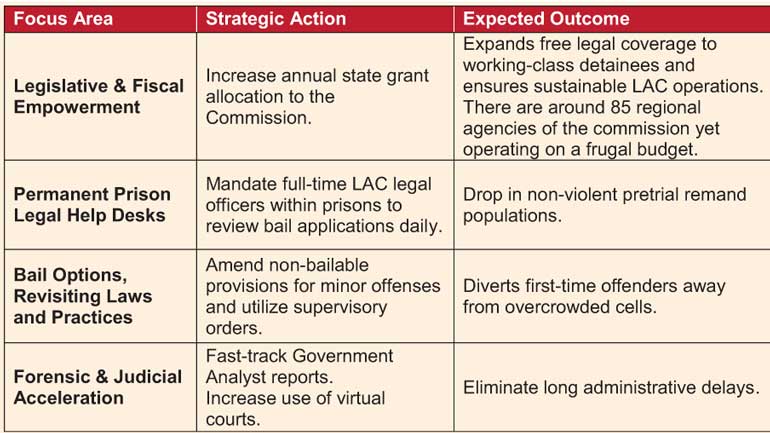
Way forward
The Annual Report 0f the Department of Prisons 2025 states that they are already looking at other custodial methods such as house arrest. Also, Prison Management Systems to manage prisoner data. Also, an important task is awareness on legal matters which are hampered by low funding.
A UNDP study ‘Legal Aid Sector of Sri Lanka Final Report on Stakeholder Mapping with Recommendations: 2023’ notes a network of stakeholders from law students, civil society to private lawyers working on helplines, distributing pamphlets along with more community level engagement.
(The author is an independent policy researcher. None of the views expressed here reflect views of any institution she is affiliated with)
Sources:
1. 1021 inmates died in prison over 5 years, Sri Lanka Mirror, July 25, 2026.https://srilankamirror.com/news/1021-inmates-died-in-prisons-over-five-years/
2. Auditor General’s Reports on the Legal Aid Commission of Sri Lanka – various years
3. Auditor General’s Reports on the Department of Prisons and Prisoners’ Welfare Fund – various years
4. Legal Aid Law No. 27 of 1978.
5. Department of Prisons, Sri Lanka - Annual Performance Reports -various years
6. Prison Study by the Human Rights Commission of Sri Lanka (2020/2021).
7. United Nations Development Programme (UNDP), 2024
https://www.undp.org/sites/g/files/zskgke326/files/2024-03/05._final_legal_stakeholder_mapping_with_recommendations_final_with_logo.pdf
8. United Nations Development Programme. (2026, July 12). Reimagining legal aid in Sri Lanka. UNDP Sri Lanka. https://www.undp.org/srilanka/publications/reimagining-legal-aid-sri-lanka




