Sunday Sep 13, 2026
Sunday Sep 13, 2026
Monday, 20 July 2026 03:28 - - {{hitsCtrl.values.hits}}
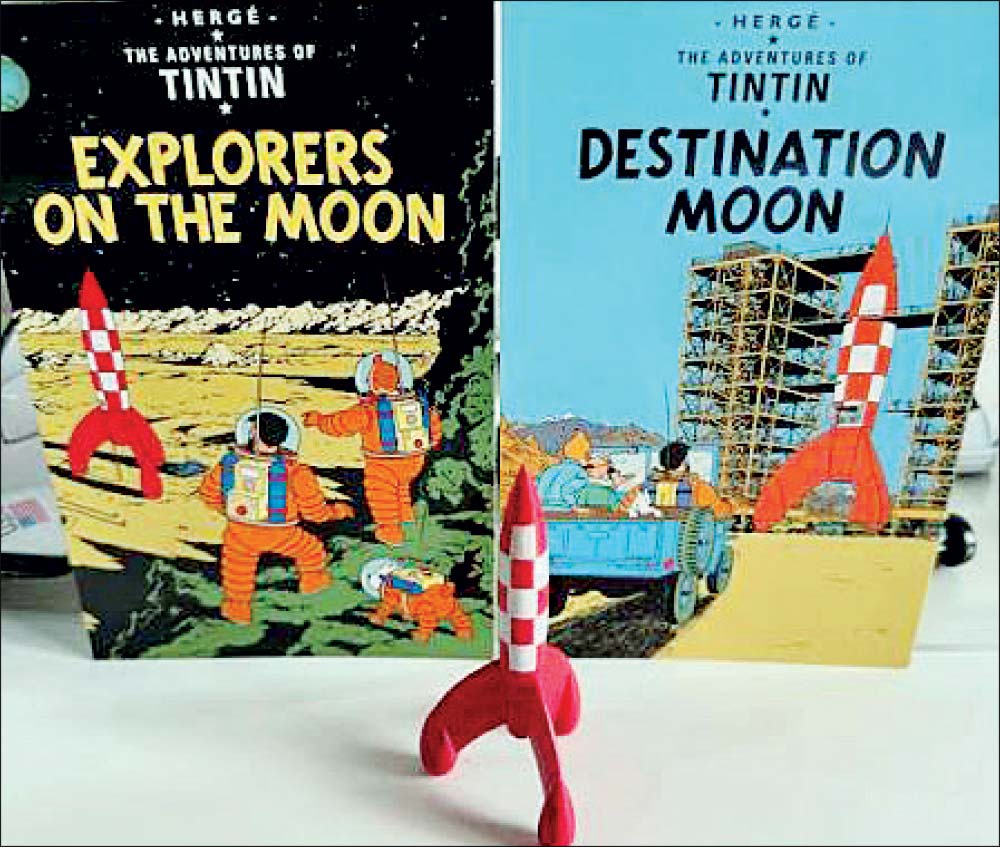
Iconic books: Long before US astronaut Neil Armstrong took “one small step” that became “a giant leap for humankind”, generations of readers had already travelled there in the pages of Hergé’s Destination Moon (1953) and its sequel Explorers on the Moon (1954)
 Perhaps the greatest ramification is philosophical rather than political. Colonisation of the moon should never become an excuse for failing to mitigate the fallout from a rapidly warming planet.
There is no Planet B waiting conveniently overhead, as in sci-fi or fantasy. The moon may help us become an interplanetary civilisation, but it cannot replace the fragile blue world that remains our only true home
 Long before US astronaut Neil Armstrong took “one small step” that became “a giant leap for humankind”, generations of readers had already travelled there in the pages of Hergé’s Destination Moon (1953) and its sequel Explorers on the Moon (1954).
For many children of the Space Age, those graphic novels were their first glimpse of what a lunar expedition might look like: the sleek red-and-white rocket, the cumbersome spacesuits, the eerie silence of the moon, and the thrill of setting foot on Earth’s only natural satellite.
The remarkable thing is not merely that Hergé imagined the journey. It is how astonishingly accurate much of it proved to be. Working with scientific advisers, the Belgian cartoonist depicted weightlessness, working in a vacuum, oxygen supplies, orbital mechanics and lunar geology with uncommon accuracy (as events later transpired).
The persistent claim that Destination Moon became a training manual for NASA astronauts, however, is more myth than history. There is no evidence that the National Aeronautics and Space Administration formally used Hergé’s work as part of the US’s training programs.
Yet numerous astronauts, engineers and space enthusiasts have acknowledged that Tintin inspired their childhood fascination with space. In that sense, the fictional voyage became a very real launching pad.
Lunar milestone
This July marks another milestone. Today, it will be 57 years since a human being first set foot on the moon during the Apollo 11 mission in 1969. The anniversary invites not merely nostalgia, but a fresh look at what has happened since, as well as where humanity may be heading next.
The road to Tranquillity Base was paved by an extraordinary succession of unmanned flights. Before Armstrong’s famous footprint, both the Soviet Union and the United States launched dozens of robotic missions in a frantic Cold War contest. Between 1958 and July 1969, roughly 60 lunar probes were attempted by the two superpowers, with many failures and much spectacular success.
Soviet Luna missions achieved several historic firsts: the first spacecraft to reach the moon, the first impact, the first photographs of the far side, and the first soft landing. America’s Ranger, Surveyor and Lunar Orbiter program, meanwhile, photographed potential landing sites and demonstrated that astronauts could land safely. Apollo itself was preceded by uncrewed Saturn V test flights before carrying astronauts.
Only one nation has actually landed people on the moon: the United States. Between Apollo 11 in July 1969 and Apollo 17 in December 1972, six Apollo missions successfully landed astronauts on those sunlit silvery plains: Apollos 11, 12, 14, 15, 16 and 17. Apollo 13, famously crippled by an onboard explosion, never landed, but remains one of history’s greatest feats of crisis management.
In total, twelve human beings (and all of them Americans) have walked on the moon. No Soviet, Russian, Chinese or European astronaut has yet followed them.
More moon missions
That monopoly, however, is unlikely to last much longer. The state of play today is arguably more exciting than at any point since the early 1970s.
NASA’s Artemis program seeks to return astronauts to the lunar surface, including the first woman and the first person of colour to walk there, while establishing a sustained human presence around the moon through the planned Lunar Gateway space station.
China, meanwhile, has emerged as perhaps America’s principal competitor in the lunar race. Following the success of its Chang’e robotic missions – including returning lunar samples and landing on the moon’s far side – it plans to land astronauts before the end of this decade in partnership with Russia’s proposed International Lunar Research Station.
India has also dramatically altered the landscape. In 2023, Chandrayaan-3 achieved the first successful landing near the moon’s south pole, placing our nearest neighbour among the handful of nations capable of soft lunar landings.
Japan followed with its SLIM precision lander. Private companies are joining the race as well, while Europe contributes through the European Space Agency’s participation in Artemis, spacecraft development and scientific instruments.
Plant the flag
So how many countries have planted their flags on the moon?
The answer depends on what one means by ‘planting flags’. Six American flags were physically planted during the Apollo landings. China has planted its national flag through robotic missions using specially designed unfurling mechanisms. Soviet probes carried the USSR’s iconic hammer and sickle emblem; while India, Japan and others have deposited national symbols aboard their spacecraft. Yet only the Stars and Stripes has been carried there by human hands.
The deeper significance lies not in flags but in capability. Today, the club of nations able to reach the moon extends well beyond ‘the usual suspects’.
The United States, Russia (through Soviet achievements), China, India and Japan have all achieved successful lunar surface missions. Europe, although lacking an independent crewed lunar program, plays a central role through the European Space Agency. South Korea and the United Arab Emirates have successfully operated lunar orbiters, demonstrating that access to cislunar space is widening rapidly.
Beyond destination moon
The moon is no longer merely a destination. It is increasingly viewed as a strategic resource.
Previous explorations have revealed substantial deposits of water (in the form of ice) trapped in permanently shadowed craters near the poles.
Water can be split into hydrogen and oxygen, providing both drinking water and rocket fuel. Lunar regolith also contains oxygen bound within minerals, titanium, aluminium, silicon, rare earth elements and traces of helium-3, a rare isotope often discussed as a possible future fusion fuel, although commercially viable fusion remains elusive.
This prospect transforms the moon into something resembling humanity’s closest “space station” of a sort. Rather than launching every kilogramme from Earth’s deep gravity well, future explorers could manufacture fuel and supplies on the moon before venturing onwards to Mars and beyond.
Such a staging point could significantly reduce the costs of deep-space exploration.
Explorers on the moon and Mars
So could humanity’s escape from a rapidly warming planet (or from other man-made and natural disasters in the offing) one day rely upon this lunar outpost?
Probably not in the sense of mass migration. The moon is a profoundly hostile environment – lacking atmosphere, shielding from radiation and liquid water at the surface. It is unlikely ever to become a refuge for billions. But it could become an indispensable industrial and scientific base that enables our species to expand permanently into the solar system.
Mars remains the obvious long-term destination for human settlement. Beyond Mars, the picture becomes more speculative. Titan, Saturn’s largest moon, possesses a thick nitrogen atmosphere and abundant hydrocarbons, but it is lethally cold. Io, by contrast, is perhaps the least hospitable major world in the Solar System, wracked by constant volcanic eruptions driven by Jupiter’s immense gravity. Europa and Enceladus, whose sub-surface oceans may harbour conditions favourable to life, are generally considered more promising scientific targets than Io. For human habitation, however, none currently rivals Mars.
Geopolitics rising
Yet, the moon raises another question: will geopolitics readily spill over into the lunar race now unfolding between the United States, China and other players? History suggests it almost certainly will.
The Apollo program itself emerged from Cold War rivalry with the Soviet Union. Today’s competition is less ideological than technological, economic and strategic. Access to water, control of infrastructure, communications networks, navigation systems and resource-rich regions around the lunar south pole all carry geopolitical significance. And the emerging competition increasingly resembles the contest for influence in the Arctic or the world’s sea lanes.
Whether that rivalry becomes confrontational depends partly on international law.
The cornerstone remains the 1967 Outer Space Treaty, which declares that the eponymous area (including the moon) cannot become the sovereign territory of any nation. It prohibits weapons of mass destruction in space and commits states to peaceful exploration for the benefit of all humankind.
The 1979 Moon Agreement goes farther in proposing that lunar resources constitute the “common heritage of mankind”; but major space-faring nations including the United States, Russia and China never ratified it.
More recently, the Artemis Accords led by the United States and signed by dozens of countries, establish principles for transparency, inter-operability and the peaceful use of space. China and Russia have instead pursued alternative cooperative frameworks.
Whether these legal instruments are adequate to protect not only national and international but also our species’ best interests remains uncertain. Existing treaties were drafted before commercial mining, permanent lunar settlements and strategic competition became realistic possibilities.
If terrain conflicts were ever to spill over into the near vicinity of the space between Earth and Luna, today’s legal architecture would almost certainly face severe strain.
Smaller blocs of powerful nations, including the European Union and several BRICS members, are already participating in various ways. Europe contributes major hardware, astronauts and scientific expertise to Artemis. India is steadily expanding its ambitions. Brazil, South Africa and others may join through international partnerships. So lunar exploration is becoming less an exclusive club than an increasingly interconnected global enterprise.
Perhaps the greatest ramification is philosophical rather than political. Colonisation of the moon should never become an excuse for failing to mitigate the fallout from a rapidly warming planet.
There is no Planet B waiting conveniently overhead, as in sci-fi or fantasy. The moon may help us become an interplanetary civilisation, but it cannot replace the fragile blue world that remains our only true home.
Fifty-seven years after Armstrong’s first footprint, the moon once again stands at the centre of history. Not simply as an object of scientific curiosity or nationalist prestige, but as the first stepping stone towards a wider human future among the planets. The next “one small step” may lead not only to Mars, but eventually to destinations scarcely imaginable today
The next ‘one small step’
Fifty-seven years after Armstrong’s first footprint, the moon once again stands at the centre of history. Not simply as an object of scientific curiosity or nationalist prestige, but as the first stepping stone towards a wider human future among the planets. The next “one small step” may lead not only to Mars, but eventually to destinations scarcely imaginable today.
One suspects that Hergé would have smiled at the thought. Professor Calculus would already be calculating trajectories with serene confidence. Tintin would be eager to investigate whatever mysteries awaited beyond the next crater. And Captain Haddock, after a characteristically thunderous “billions of blue blistering barnacles!”, would probably still be wondering whether anyone remembered to pack a decent bottle of his favourite hooch for the voyage.
(The writer is the Editor-at-large of LMD and is a senior journalist with a Post-graduate Diploma in Politics and Governance)




