Saturday Oct 03, 2026
Saturday Oct 03, 2026
Friday, 6 March 2026 00:24 - - {{hitsCtrl.values.hits}}
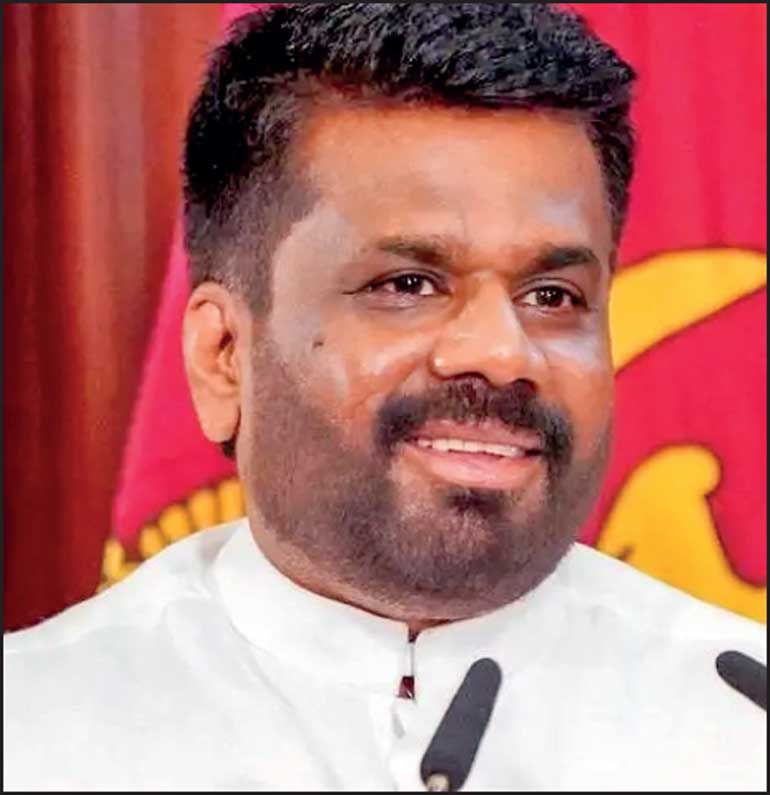
President Anura
Kumara Dissanayake
 Sri Lanka is a nation that remembers vividly — and forgets conveniently.
We remember anniversaries. We remember betrayals. We remember the faces of leaders, the slogans of campaigns, the promises made beneath floodlights and temple flags.
But when it comes to institutional failure, when it comes to corruption allegations that shook the republic, when it comes to public money that evaporated into opaque transactions and grand announcements, our memory becomes selective.
Selective memory is dangerous
The present administration under President Anura Kumara Dissanayake inherited not merely an economy in distress but a political culture fatigued by scandal. The people who voted for change were not only seeking price stability and debt restructuring. They were seeking moral correction. They were demanding that the era of impunity — whether perceived or proven — be confronted with clarity.
It is against that expectation that the present pace of accountability is being quietly measured.
The Central Bank Treasury Bond controversy remains a defining rupture in Sri Lanka’s modern financial history. A Presidential Commission of Inquiry examined it extensively. It issued findings. It recommended action. Numbers were placed before the nation. Yet more than a decade on from the original events, the public still searches for unmistakable closure. Not commentary. Not press conferences. Closure.
Beyond that file lie others — heavier, older, politically complex. The long and costly trajectory of Air Lanka and later SriLankan Airlines; the rise and collapse of Mihin Lanka; ambitious infrastructure projects such as Hambantota Port, Mattala Airport and the Uma Oya scheme; controversial procurement in oil, coal and power generation; vast state lands allocated under development narratives; defence and aviation acquisitions executed under successive administrations.
Not every failed project is corruption. Governance requires risk. Policy involves judgment calls that can age poorly. Infrastructure does not always deliver immediate return.
 But risk must be transparent. Procurement must be clean. Oversight must be real.
When losses become systemic and accountability indistinct, suspicion fills the vacuum.
The concern today is not a partisan accusation. It is institutional anxiety. When investigations move slowly or appear to drift between agencies, when high-profile cases seem to linger without visible prosecutorial momentum, the perception — whether justified or not — is that power still protects itself.
Perception, in governance, matters almost as much as proof. Sri Lanka’s economic collapse was not simply a macroeconomic event. It was a collapse of confidence. Investors fled not only because of fiscal numbers but because of governance uncertainty. Citizens took to the streets not only because of shortages but because of accumulated frustration over how the state had been managed.
Recovery therefore cannot be defined only by stabilised exchange rates or IMF tranches.
It must include institutional integrity.
If credible evidence of wrongdoing exists in any of these historical chapters, it must be tested before a court of law without hesitation or delay. If evidence does not meet prosecutorial thresholds, that conclusion too must be communicated with transparency. Ambiguity is corrosive. It fosters conspiracy. It nurtures cynicism. It conditions the next generation of public officials to believe that time is the greatest defence.
Time is not justice
There is also a strategic dimension to this reckoning. Sri Lanka speaks frequently of transforming into a $ 150 billion economy. That ambition requires sustained foreign direct investment, deepened capital markets and global partnerships. International investors conduct due diligence not only on Balance Sheets but on institutional behaviour. They assess enforcement credibility. They evaluate procurement systems. They study precedent.
An economy seeking to expand cannot afford a governance memory gap.
 It is not about vengeance. It is about precedent.
If the nation signals that large-scale controversies can drift indefinitely without resolution, it inadvertently signals tolerance for repetition. Conversely, if it demonstrates that even politically sensitive matters will be concluded lawfully and transparently, it rebuilds credibility.
The present administration may argue that investigations are complex, that due process takes time, that cases must be airtight before proceeding. That is fair. Justice rushed is justice risked.
But justice indefinitely deferred erodes confidence.
Sri Lanka has paid dearly for governance failure — through debt distress, through migration of talent, through reputational damage that takes years to repair. The public has absorbed that cost in higher taxes, reduced services and diminished opportunity.
To move forward without conclusively addressing the past is to gamble with recurrence.
Forgetting does not require amnesia. It can be achieved through delay. Through fatigue. Through political calculation that assumes the electorate’s attention will shift.
It often does. Until the next crisis.
Those who forget the past may indeed revisit it — not because history is vindictive, but because systems uncorrected tend to reproduce themselves.
The path forward is not sensational prosecution nor selective targeting. It is principled completion. Close the files lawfully. Conclude the investigations. Clarify the outcomes. Strengthen the systems that allowed vulnerabilities to emerge.
 Economic recovery built on unstable institutional foundations will always remain fragile.
Sri Lanka does not need spectacle. It needs resolution.
And resolution, unlike rhetoric, demands endurance.
If the present leadership truly seeks to reshape the republic, it must ensure that yesterday’s shadows do not quietly script tomorrow’s headlines.
Because history in Sri Lanka rarely disappears. It waits.
And when it returns, the price is never small.
(The author is a broadcaster and investigative journalist)



