Saturday Oct 03, 2026
Saturday Oct 03, 2026
Tuesday, 3 March 2026 05:49 - - {{hitsCtrl.values.hits}}
 The illusion of safety
Sri Lanka is not at war.
Our hotels are operating. Our beaches are calm. There is no domestic instability.
Yet within hours of hostilities between Israel, the United States and Iran beginning on 28 February, Sri Lanka’s tourism industry felt the impact.
Sri Lanka is stable. But in tourism, geographic distance from conflict does not mean insulation from its consequences.
This is the illusion of safety in a globally connected industry. You can be far from the battlefield and still economically exposed to it.
What has already happened
In the immediate aftermath of the outbreak, all services from Emirates, Qatar Airways, Etihad, Flydubai, Gulf Air, Air Arabia and Oman Air into Colombo were suspended following blanket Middle East airspace closures.
Based on pre-conflict schedules, the weekly flights grounded were:
Total: 134 weekly flights suspended.
That represents approximately 60–70% of Bandaranaike International Airport’s long-haul capacity.
There were no partial operations during the initial phase. It was a full halt.
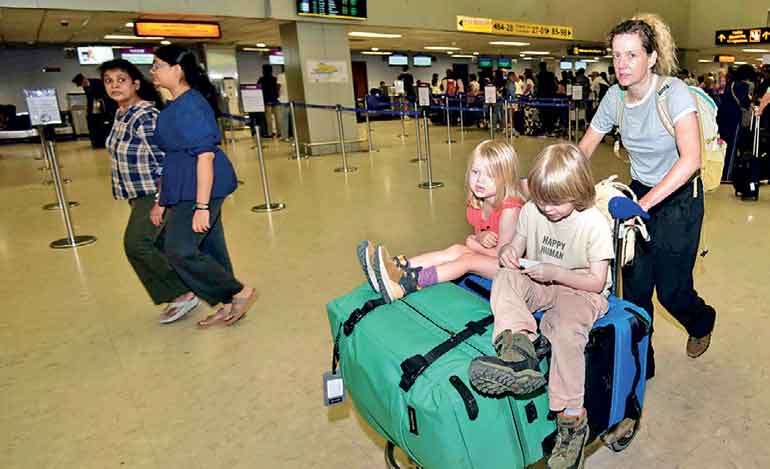
The impact was immediate. Negombo hotels filled quickly as outbound passengers whose flights were cancelled moved closer to the airport awaiting rebooking. These are not additional tourists. They are travellers unable to depart.
At the same time, operators report early hesitation in forward bookings from Europe. Travellers due to arrive in the coming weeks are already enquiring about postponements.
This is where the real vulnerability becomes clear — not on the ground in Sri Lanka, but in the air routes that sustain our tourism economy.
Why the Gulf matters
Direct Middle Eastern arrivals account for only 2–4% of Sri Lanka’s visitor mix.
But the Gulf is not merely a source market. It is the transit backbone of Sri Lanka’s long-haul tourism model.
An estimated 30–40% of arrivals from Europe and Russia connect through Dubai, Doha or Abu Dhabi. The UK, Germany, France, Switzerland, Scandinavia and Russia predominantly route via these hubs. So do Spain, Italy and much of Eastern Europe, where direct connectivity to Colombo does not exist. A meaningful share of North American traffic also relies on Gulf transit because of frequency and pricing.
When those hubs close, Sri Lanka’s effective access to its core long-haul markets contracts immediately.
Seat capacity does not decline gradually. It drops overnight.
Oil, airfares and domestic cost pressure
Following the outbreak of hostilities, Brent crude moved into the high-$90s per barrel. Iran’s Strait of Hormuz closure is now active. That corridor carries roughly 20% of global oil supply and about one-third of global LNG flows.
Escalation could push oil towards $110–120 per barrel.
Higher oil prices affect Sri Lanka on two fronts.
First, through airfares. Fuel is a major airline cost component. Sustained oil increases translate into higher long-haul ticket prices. A 10–20% fare increase can influence discretionary European travel decisions.
Second — and often overlooked — Sri Lanka imports 100% of its petroleum.
Higher global oil prices feed directly into domestic transport costs: airport transfers, tour coaches, safari jeeps, supply logistics and generator usage in hotels. Even food prices are affected because the supply chain runs on diesel. Imported goods, including food and beverages, become more expensive as freight and aviation cargo rates rise.
If Q1 arrivals were to decline by even 10–15% under a prolonged disruption scenario, the foreign exchange impact could reach $100–200 million, based on recent monthly revenue averages.
What happens next
In any boardroom facing an external shock, the first discipline is clarity: what can we control?
We cannot influence events in the Middle East. We can manage exposure.
First, stabilise messaging. Markets must hear clearly that Sri Lanka remains operational and accessible.
Second, maximise unaffected corridors. India — now accounting for roughly 25% of arrivals — remains largely unscathed and offers a near-term stabiliser if activated decisively.
Third, leverage alternative routing. Turkish Airlines continues operating via Istanbul, providing an important non-Gulf transit option.
If the conflict remains contained and routes normalise quickly, the impact may be limited to scheduling disruption and deferred bookings.
If it escalates or prolongs, reduced connectivity, higher fares and cautious European demand could materially affect arrivals and foreign exchange earnings.
Sri Lanka is not a combatant in this war. But in an interconnected global economy, distance does not equal immunity. How long this conflict lasts — and how it evolves — will determine how deeply it touches our tourism industry.
(The author is a business leader specialising in hospitality, tourism, and investment. As Chairman and CEO of private companies and a board member of three publicly listed companies, he is actively engaged in hotel development and asset management in Sri Lanka. He can be contacted at: [email protected])



