Monday Sep 07, 2026
Monday Sep 07, 2026
Monday, 7 September 2026 03:30 - - {{hitsCtrl.values.hits}}
 The art and science of foresight studies has evolved to allow us to develop various perspectives of the future. Combined with the advantages of the information age, foresight studies allow us to essentially wield a “crystal ball” to look around and peer deep into a particular angle of what might be. This is a proven corporate discipline
 In the current chaos of geopolitical competition and conflict, the future is not clear. What if I told you we can reasonably estimate where we are heading?
Imagine the coastal towns of your childhood reduced to skeletal steel structures, abandoned after repeated, unmanaged floods. Once viable communities are now emptied of people and purpose. Rubble piles mark where hotels and guest houses stood before the last hurricane. Broken concrete blocks and twisted metal beams lie scattered where streets once connected neighbors to markets, to work, to life. Fishing communities no longer exist as there are no fish in the once abundant coastal waters. The few remaining structures are boarded up, claimed by no one.
By 2030 compliance systems have collapsed, characterised by discarded social safety nets, dismantled economic safeguards and political coherence dissolved into transactional Environmental regulations, as luxuries no nation can afford, are abandoned. Governments lack the bandwidth to govern. Global agreements unravel into unenforceable disputes. Climate shocks continue relentlessly - floods, fires, droughts, heat waves. There is no coordinated response, only isolated, competing struggles for survival. The green transition never happened, not because we lacked the technology, but because the institutional architecture required to manage a global energy transition has completely broken down. States are too weak. Markets are too fractured. The world fragments into competing fiefdoms, private safe havens, and abandoned regions.
This is a view from “Fragmented Breakdown”, the future scenario where institutional machinery simply ceases to function.
Businesses must assess their readiness to adapt: Can your supply chains function outside protected economic blocs and in the face of global logistical bottlenecks? Do you have redundancy in power, water, and local logistics? Where can you relocate operations if floods or droughts make your current locations unviable? These are not comfortable questions, but they are necessary ones
How to read the future: A foresight primer
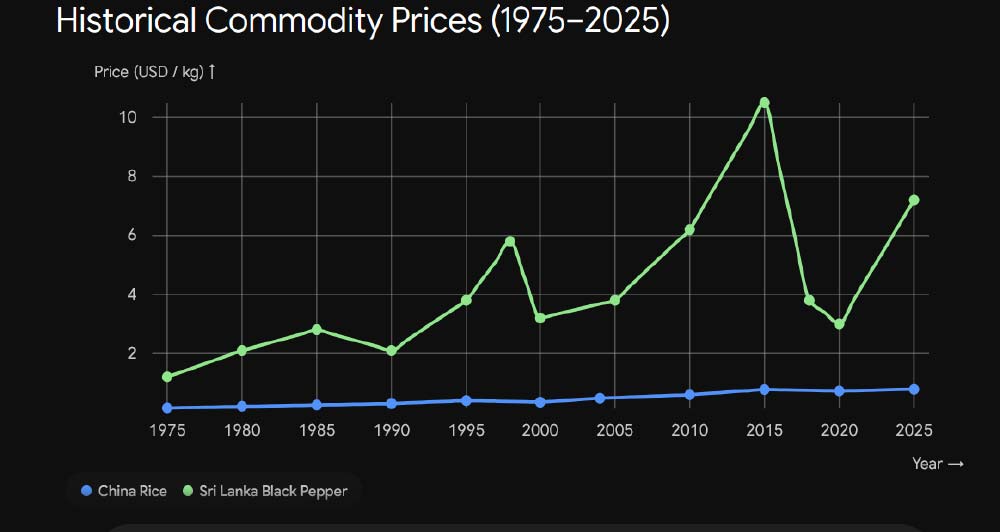
Can we truly look into the future? We live in the information age where data is at our fingertips; for example we could obtain fifty years of historical prices for a kilogram of rice in China or for a kilogram of black pepper in Sri Lanka. This could be accomplished using the search engine of choice.
The art and science of foresight studies has evolved to allow us to develop various perspectives of the future. Combined with the advantages of the information age, foresight studies allow us to essentially wield a "crystal ball" to look around and peer deep into a particular angle of what might be. This is a proven corporate discipline; multinational leaders like Shell have used foresight studies and scenario building since the 1970s to guide their strategy. The scenario planning carried out by Shell, enabled them to anticipate oil demand volatility and invest in renewables earlier than competitors. These strategy exercises would have typically been conducted over several weeks with dozens of experts providing inputs in different ways.
Artificial intelligence tools can be leveraged to sift through the ‘noise’ of current data in all its abundance. Unlike in the past, this automated use of established methods enables rapid generation of possible future(s). I say futures in the plural because this methodology is not an all-knowing crystal ball that knows the future with absolute certainty. Foresight studies are methods of identifying how the future can turn out based on what we know now. It identifies driving forces and trends that point toward the extremes that can be reached. These allow us to develop scenarios that essentially outline the borders within which the future can unfold.
To accurately understand the details of alternative futures, we must first examine the global foundations upon which they depend. To do this, we look at the current baseline and trajectories of environmental systems, politics, demographics, technology, and economic activity. By analysing large datasets that capture trends across these interconnected systems, we can even apply superforecasting techniques to develop more plausible and discernable pathways to the future. Superforecasting uses historical data and expert analysis to generate more statistically grounded scenarios. For example, our long-term resilience is directly determined by how sustainability is integrated across human activities. Accordingly, exploring the exact nature of technological innovation in energy management can reveal how sustainably we address future energy demand.
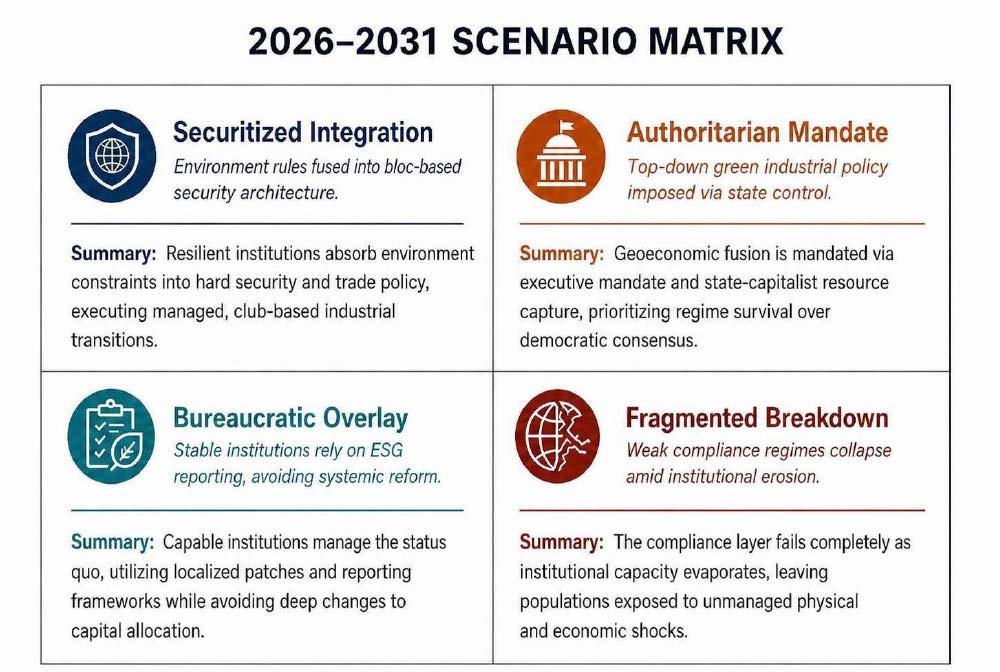
The 2026–2031 Scenario Matrix below, is a set of four distinct future scenarios outlining the global institutional structures that will dictate Sri Lanka's economic and physical resilience.
Future scenarios are interpreted as a cohesive map, not as individual scenarios that are likely to take place. The primary takeaway here is, the time for raising awareness about climate change and environmental stress is gone. We can no longer mitigate the impact of a changing climate. Even if the theory of climate change does not hold, the impacts of repeated destructive climate events and highly stressed global ecosystems are stark. The impacts are too costly to ignore. What we can do is adapt and build resilience. This is a process, not a quick fix. The capacity to adapt to the environmental and climatic realities we will face in the coming years is what will ultimately determine how we survive and thrive or whether we face abandonment and collapse.
Between 2016 and 2025, Sri Lanka experienced multiple extreme weather events, with only Cyclone Ditwah (2025) comprehensively assessed by the World Bank at $4.1 billion in direct physical damage. The total economic loss, including indirect impacts and recovery costs, reaches $6–7 billion, equivalent to 7% of GDP. This data underscores a critical reality: Sri Lanka's vulnerability to climate shocks is not theoretical. It is measured and documented.
The leaders we elect today will determine whether Sri Lanka builds resilient institutions, invests in distributed infrastructure, and negotiates meaningfully for a place within stable global systems, or whether we drift into abandonment
A Sri Lankan interpretation for the Securitised Integration scenario
According to the Global Climate Risk Index 2025, Sri Lanka ranks among the world's most climate-vulnerable nations, designated in the "red zone" of highest risk in the Asian-Pacific region . This index measures a country's exposure to extreme weather events, floods, cyclones, droughts, and heat waves. In the Securitised Integration scenario, this vulnerability has the potential to become a strategic disadvantage in a divided global economy.
By 2027, wealthy nations form tight economic blocs and treat climate policy as a national security matter. They re-write trade rules to protect their own supply chains, impose carbon tariffs on outsiders, and restrict access to green technology like advanced battery storage and AI-driven energy systems. Sri Lanka, if excluded from these blocs, faces steep tariffs on its exports of tea, spices, and garments. Export-dependent businesses cannot compete.
International investors and banks withdraw capital, viewing Sri Lanka as too risky and too far outside the protected economic zones. Capital and financing are not accessible to outsiders. Governments in allied blocs would use state resources and insurance schemes to protect their own industries and economies from climate shocks. Skilled Sri Lankan workers migrate to bloc countries for better opportunities, draining domestic talent and remittances. Climate disasters continue unabated: monsoons flood agricultural land, droughts devastate harvests, and rising seas threaten ports.
Sri Lanka must adapt alone, without access to affordable capital, protected markets, or international disaster relief. Citizens have little influence over these decisions, they are made by foreign governments and multinational corporations. By 2031, the wealthy blocs have successfully managed their own climate transition. Sri Lanka has fallen further behind, facing intensifying climate shocks with fewer resources and no institutional support.
Reality check
Extremes are needed to understand the scope of what we need to prepare for in the future. The scenarios explore situations that have already been faced on some level, worldwide. While it may take over a decade for these trends to impact on the level depicted by the future scenarios, they give us an opportunity to prepare early.
The foresight process outlined in this article is not prediction—it is context for preparation. Businesses must assess their readiness to adapt: Can your supply chains function outside protected economic blocs and in the face of global logistical bottlenecks? Do you have redundancy in power, water, and local logistics? Where can you relocate operations if floods or droughts make your current locations unviable? These are not comfortable questions, but they are necessary ones.
The responsibility extends beyond boardrooms. Citizens must recognise that these futures are not inevitable, they are a choice. The leaders we elect today will determine whether Sri Lanka builds resilient institutions, invests in distributed infrastructure, and negotiates meaningfully for a place within stable global systems, or whether we drift into abandonment. Patriotism in this moment means voting for leaders with the long-term vision and moral courage to prioritise collective adaptive capacity over short-term political gain. It means demanding transparency and action on climate policy, engaging constructively with environmental impact assessments, and holding the Government accountable for infrastructure investments that protect all Sri Lankans. It means recognising that each of us, in our professional and personal choices, contributes to either resilience or fragility. The time for awareness is over. The time for adaptation is now. The future of Sri Lanka depends on whether we act with the urgency our future demands.
(The author is Vice President at Trident Futures Group, is a Professor of Strategic Security at the Henley-Putnam School of Strategic Security, National American University (USA), and the Co-Editor in Chief of the National Defence College Journal (Sri Lanka)
1. See Bandara, Kelum, Daily Mirror (2025, December 24). Cyclone Ditwah: US $4.1 billion damage, replacement cost even higher. Daily Mirror Sri Lanka, and World Bank. (2025, December 22). Damage from Cyclone Ditwah in Sri Lanka estimated at $4.1 billion https://www.worldbank.org/en/news/press-release/2025/12/22/damage-from-cyclone-ditwah-in-sri-lanka-estimated-at-4-1-billion
2. See United Nations in Sri Lanka. (2023). Fact sheet: Climate impact in Sri Lanka. https://srilanka.un.org/en/254230-fact-sheet-climate-impact-sri-lanka