Wednesday Oct 07, 2026
Wednesday Oct 07, 2026
Wednesday, 7 October 2026 04:03 - - {{hitsCtrl.values.hits}}
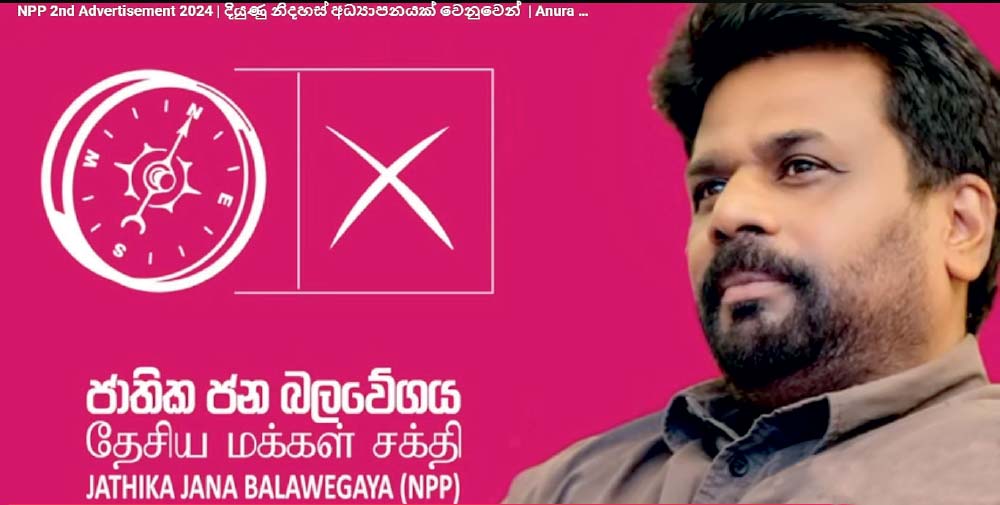
 NPP presidential election ad showcasing its promise to build a better education system accessible to all (https://www.youtube.com/watch?v=yvLZc6F966A), had a particular resonance coming on the heels of the Wickremesinghe administration’s unconscionable decision to impose an 18% VAT on hitherto tax-free category of books and educational materials. The NPP/JVP roundly criticised the decision. Two years on, books and educational materials continue to be taxed at 18%. Shortly before taxing books, the Wickremesinghe administration granted China’s Colombo Port Logistics Centre a generous 15-year tax exemption on income and dividends. In January 2026, the NPP Government approved a scheme granting 15-year tax holidays to billion dollar investments in the Port City
By Tisaranee Gunasekara
“In this country, even an animal shouldn’t go hungry.” NPP presidential election ad about street dogs (https://www.youtube.com/watch?v=PvjmRn3rYug)
A group of young people walk into a café. When the owner realises that one of them is blind, he presents her with a menu in braille. “What made you think of us?” she asks in wonder. “When I opened the shop, I thought of everyone,” the owner replies. “Are you a member of the Compass (NPP)?” she asks. “Yes, Miss,” he answers (https://www.youtube.com/watch?v=VxmIAWztYgc).
Knowingly or not, this and other NPP presidential election ads harked back to philosopher John Rawls’ famous thought experiment on how to build a fair and just society for all. Contained in his 1971 book, A Theory of Justice, the experiment imagines a situation where people have a chance of building the society they will eventually live in, but must do so from behind a Veil of Ignorance preventing them from knowing their place in that society. The best solution is to build a universally just society based on two pillars: the liberty principle ensuring that everyone has the maximum freedom without intruding on another’s freedom; and the difference principle ensuring that everyone has an equal opportunity to succeed.
That was in effect the NPP’s 2024 promise: a new Sri Lanka in which all her people could live in freedom and dignity.
Sri Lanka’s recovery from the havoc of Gotabaya-economics began and reached the key milestone of positive growth during the Ranil Wickremesinghe presidency. But a disproportionate share of the burden of this recovery was borne by those who could least afford it. Correcting this imbalance, and rebuilding Sri Lanka as a more just and liveable place was the NPP’s pledge to the electorate. And yet, two years on, the fundamentals of socio-economic injustice remain unchanged, untouched, unconsidered
Is this the direction in which the Compass is turned?
Sri Lanka’s recovery from the havoc of Gotabaya-economics began and reached the key milestone of positive growth during the Ranil Wickremesinghe presidency. But a disproportionate share of the burden of this recovery was borne by those who could least afford it. Correcting this imbalance, and rebuilding Sri Lanka as a more just and liveable place was the NPP’s pledge to the electorate.
And yet, two years on, the fundamentals of socio-economic injustice remain unchanged, untouched, unconsidered. While high indirect taxes continue to hike living costs, the Government is mulling over a cut in direct taxes. Increasing PAYE threshold from the current Rs. 150,000 to Rs. 200,000 is reportedly under consideration.
92% of formal private sector employees in Sri Lanka earn less than Rs. 100,000 a month. The proposed tax cut will thus benefit only a thin sliver of high-earning private sector employees. The reduced revenue will have to be recouped in the only way possible – more indirect taxes, leading to still higher living costs for ordinary Lankans.
Since the economy is the Government’s Achilles Heel, the Opposition should be shouting from rooftops, accusing the NPP of trying to introduce a policy benefitting a minority of high-earners while ignoring the economic pain of millions of mid and low earners. But the Opposition, which habitually opposes anything the Government does, seems supportive of this particular measure. The Government and the Opposition are also hand-in-glove in resisting IMF pressures to introduce a wealth tax and an inheritance tax for high-earners.
Why?
The furore around California’s Proposition 40 help explain this curious multi-partisan consensus. Proposition 40 contains a proposal to impose a one-time 5% wealth tax on the state’s billionaires. In a public letter, six Nobel-winning American economists hailed it as a likely “turning point in the battle between democracy and oligarchy.” Pointing out that billionaires pay only 1.6% in income taxes while the average Californian pays 5-6%, they wrote: “What will allow California to thrive in the future is not letting a handful of billionaires live tax-free; it is adequate public spending on health, education, and public infrastructure, key engines of economic growth to which it is only fair to ask the ultra-wealthy to contribute.” (https://www.commondreams.org/news/nobel-laureates-california-wealth-tax),
California’s billionaires are fighting the proposal, tooth and nail, understandably. The state’s Republican leaders too are opposed to it, understandably. So are most of the state’s Democratic leaders (including its supposedly-progressive Governor), not-so-understandably. Congressman Ro Khanna, one of only three of the state’s 54-strong congressional delegation supporting the Proposition explained why most of his own party leaders are opposed to a measure which aligns with the Party’s basic principles. “There’s a view that the biggest threat to American democracy is Donald Trump and not winning the House or Senate, and that we would be foolish to kneecap the prominent billionaires who are on our side” (https://www.newyorker.com/magazine/2026/10/12/the-battle-to-pass-a-billionaire-tax). In other words, the role of campaign contributions and the vested interests of millionaires and billionaires making them in deciding policy. Be it in the US or Sri Lanka.
The proposed PAYE tax cut will benefit only a thin sliver of high-earning private sector employees. The reduced revenue will have to be recouped in the only way possible – more indirect taxes, leading to still higher living costs for ordinary Lankans
Veils of unknowing
A teenaged-boy is working in a chena. His little sister is sitting close by studying. He has given up schooling due to unaffordability. His teacher comes looking for him, exhorting him to return to school, telling him that for ordinary people education is wings. The boy says that he will sacrifice his opportunity at flying to give his sister a chance.
That was the NPP presidential election ad showcasing its promise to build a better education system accessible to all (https://www.youtube.com/watch?v=yvLZc6F966A). That promise had a particular resonance coming on the heels of the Wickremesinghe administration’s unconscionable decision to impose an 18% VAT on hitherto tax-free category of books and educational materials. The NPP/JVP roundly criticised the decision. Two years on, books and educational materials continue to be taxed at 18%.
Since the economy is the Government’s Achilles Heel, the Opposition should be shouting from rooftops, accusing the NPP of trying to introduce a policy benefitting a minority of high-earners while ignoring the economic pain of millions of mid and low earners. But the Opposition, which habitually opposes anything the Government does, seems supportive of this particular measure. The Government and the Opposition are also hand-in-glove in resisting IMF pressures to introduce a wealth tax and an inheritance tax for high-earners. Why?
Shortly before taxing books, the Wickremesinghe administration granted China’s Colombo Port Logistics Centre a generous 15-year tax exemption on income and dividends. In January 2026, the NPP Government approved a scheme granting 15-year tax holidays to billion dollar investments in the Port City.
At a June 2026 seminar on taxation, KPMG Sri Lanka head of Tax and Regulatory Suresh Perera warned that Lankan policymakers “are in the dark” on new global investment rules which nullify the tax breaks granted by the BOI and Port City (https://www.ft.lk/top-story/Govt--in-the-dark-as-FDI-tax-incentives-become-obsolete/26-794423). He was referring to the Global Anti-Base Erosion rule (GloBe) known as Pillar Two adopted by the OECD in 2021. It introduced a global minimum tax rate of 15% on corporate profits of all multinationals with global revenues of at least 750 million euros in two of the last four fiscal years. If such a multinational company is given a tax holiday in Sri Lanka, that unpaid tax of 15% would be collected from its parent company by the country in which it is located (https://www.moodys.com/web/en/us/insights/public-sector/understanding-pillar-two-the-global-minimum-tax-policy.html).
Sri Lanka’s current socio-economic and political stability is part dependent on its poverty alleviation program, Aswesuma. The program was supposed to be time-bound, but cannot be because the Government has so far failed to create an effective path out of poverty for its recipients. This lack is exacerbated by the Government’s inability to understand the value of the informal sector in the lives of the poor and the lower middle class. The NPP Government seems to regard the informal sector not as a necessity which needs to be regularised and gradually incorporated into the formal economy but as an eyesore which needs to be wiped off. While the problems caused by some micro and small informal economic structures need to be addressed, it is also important to understand that this is often the only way out of poverty for many of the Lankan poor.
Sri Lanka’s current socio-economic and political stability is part dependent on its poverty alleviation program, Aswesuma. The program was supposed to be time-bound, but cannot be because the Government has so far failed to create an effective path out of poverty for its recipients. This lack is exacerbated by the Government’s inability to understand the value of the informal sector in the lives of the poor and the lower middle class
It is also a numbers game. According to Sri Lanka Labour Force Statistics for the Second Quarter of 2026, of the 8.25million employed Lankans, 2.63million are own account workers. This means they belong in the informal economy (including the gig economy). Even when not threatened by the NPP’s mania with surface beautification (an obsession they share with Gotabaya Rajapaksa), these workers exist at a very precarious level, vulnerable to any passing economic wind. Despite this, the informal economy is preferred by many due to the low pay and insalubrious working conditions prevailing in the private sector at low and even middle level. These people cannot be forcefully herded into the manufacturing sector, as some politicians suggest. The solution is to make private sector employment more attractive through fairer pay and better working conditions. Throughout capitalism’s history, such positive changes happened not because of capitalism internal logic but because of outside pressure and intervention, by workers, society, and the state.
The NPP Government acted with commendable fairness and foresight by increasing plantation sector wages. That timely action might have saved Ceylon Tea from oblivion. Whether the Government has the vision and the courage to intervene in the formal private sector to ensure a fairer deal for the employees remains to be seen. Understanding that a PAYE cut is not what an absolute majority of private sector employees need would be a good place to start.
The NPP Government acted with commendable fairness and foresight by increasing plantation sector wages. That timely action might have saved Ceylon Tea from oblivion. Whether the Government has the vision and the courage to intervene in the formal private sector to ensure a fairer deal for the employees remains to be seen. Understanding that a PAYE cut is not what an absolute majority of private sector employees need would be a good place to start
Another NPP election ad, promising to end impunity, at least for past crimes is perhaps the NPP promise that is broken the least. A good case in point is the law being permitted to take its course with Galagoda-Atte Gnanasara who was arrested while hiding in a forest hermitage. Ending impunity is of vital necessity, but, in the end, it is the Government’s ability to deliver on affordability and quality of life which would matter most politico-electorally
Wages of unfulfilled promises
An official places a stack of files before his new boss, a smartly dressed woman, telling her that he had been an investigative officer for 20 years, but was never permitted to do his job with ‘head held high’. The files are on abandoned investigations. His new boss tells him to resume work, because, now, his goals and the new administration’s goals are identical.
That was another NPP election ad, promising to end impunity, at least for past crimes. It is perhaps the NPP promise that is broken the least. A good case in point is the law being permitted to take its course with Galagoda-Atte Gnanasara who was arrested while hiding in a forest hermitage.
A digression. It is being said that during the time of ancient kings, royal guards would not have invaded a temple even in search of a criminal. History says otherwise. Kings did not hesitate to move against monks when necessary. As EW Adikaram points out, quoting form Manorathapūrani, Buddhaghosa thero’s commentary on Anguttara Nikaya, a young Bhikku fell in love with a lady of the royal household who was accompanying the king to the temple and she with him. They were both executed (Early History of Buddhism in Ceylon). King Kanirajanu-Tissa (89-92CE) ordered about 60 bad monks to be thrown down Cetiya-pabba (Mihintale). “They had not accepted his decision in a case regarding some monastic dispute and plotted to kill the king within the uposatha house itself” (ibid).
Ending impunity is of vital necessity, but, in the end, it is the Government’s ability to deliver on affordability and quality of life which would matter most politico-electorally.
American comedian and podcaster Theo Van called the measures introduced by New York mayor Zohran Mamdani to make life more liveable for ordinary New Yorkers – which range from rent control to free opera tickets – “giving people a chance to take a breath.” That was precisely what the NPP promised to do – and has failed to deliver so far.
What happens when promises remain unfulfilled and hopes sour?
Is the Government’s Protection of the State from Terrorism Act an insurance against such a day?
The latest draft of the Act does not contain some of the more egregious clauses present in the previous one. Yet the definition of terrorism remains amorphous enough to open the door wide to abuse, especially with vis-à-vis the minorities. For instance, since damage to cultural property falls within the new version’s definition of terrorism, it is easy to imagine how it could be used to arrest any Northern or Eastern Tamil protesting against the setting up of new Buddhist religious structures in areas without a single civilian Buddhist.
In the new version of the PTSA, armed forces and the coastguard still possess police powers to arrest anyone on ‘reasonable suspicion’ and conduct searches without warrants. How this would be abused in the North and the East is too obvious to be belaboured. The power conferred to take ‘any measure necessary’ to prevent a crime also provides limitless scope for abuse, wittingly or unwittingly. While all these repressive clauses would have an immediate impact on the minorities, the majority too would not be beyond their punitive reach, especially once the Government’s popularity begins to wane.
The latest draft of the Protection of the State from Terrorism Act does not contain some of the more egregious clauses present in the previous one. Yet the definition of terrorism remains amorphous enough to open the door wide to abuse, especially with vis-à-vis the minorities. The NPP has the mandate and the numbers to introduce laws which would deepen and broaden democracy but has opted to do the opposite
For no amount of repressive laws can protect a Government once it loses popularity and legitimacy. The only path out is honouring the promises for which it was elected. Will the Compass turn in that direction in the NPP Government’s third year?
The PTSA permits the Defence Secretary to declare any area a prohibited place and to obtain an order of a magistrate within 72 hours. How this can be used to crack down on peaceful and democratic dissent is again obvious.
Draconian laws, like the executive presidency, are akin to JRR Tolkien’s Ring of Power. You want to destroy the Ring only when it belongs to another. When it is yours, it becomes your Precious. The NPP has the mandate and the numbers to introduce laws which would deepen and broaden democracy but has opted to do the opposite.
Call it a political law. Repressive laws a governing party enacts to protect its power is used against that party when it is in the Opposition. For no amount of repressive laws can protect a Government once it loses popularity and legitimacy. The only path out is honouring the promises for which it was elected. Will the Compass turn in that direction in the NPP Government’s third year?



