Wednesday Oct 21, 2026
Wednesday Oct 21, 2026
Wednesday, 2 September 2026 00:20 - - {{hitsCtrl.values.hits}}
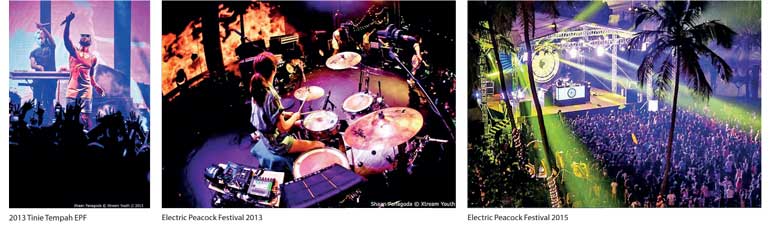
 In 2010, when the gates opened for the inaugural Electric Peacock Festival, the ambition behind it was immense. Bringing four contemporary live music artists from the UK to share local stages with three home-grown acts was a massive gamble: a high-stakes bet on Sri Lanka’s ability to build its own premium cultural platforms. At the time, charging Rs. 4,500 for a general admission ticket drew heavy domestic criticism despite the lineup featuring Grammy Award-winning artists; today, a local DJ event routinely commands entry fees anywhere from Rs. 5,000 to 15,000. It was never about delivering a flawless debut, but rather about setting a new baseline for what a home-grown platform could achieve. For a moment, it proved that Sri Lanka could set global cultural trends rather than just passively consume imported ones.
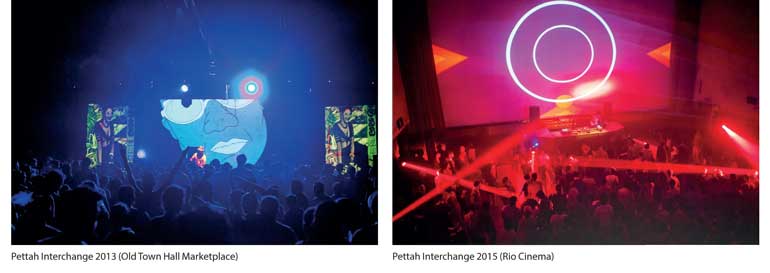
Over the next 16 years, independent movements across the arts doubled down on this pursuit of original concepts. From the cutting-edge curation of the Pettah Interchange and Colomboscope to pioneering independent theatre, the Ceylon Literary Festival, the Sri Lanka Design Festival, and ComicCon, our creative communities have repeatedly tried to build real cultural value.
Yet, 16 years after that first festival, independent creators remain stuck in a frustrating loop of stagnation. The moment the focus shifts away from rare collective wins, the drive to expand the broader industry is replaced by a defensive, insular mentality. We find ourselves trapped in a domestic market where originality is under-protected, creative labour is systematically undervalued, and territorial gatekeeping chokes the growth we need to survive over the long term.
The coastal friction: Protectionism vs. professional ethics
This tension is most visible on the geographic fringes of our creative economy. Look down the coast during the peak seasons in the South and East, and the competition for the tourist market often takes on an aggressive, unregulated form.
Many independent operators, frequently city-born or international creators who invest significant personal capital to build polished lifestyle spaces, find themselves operating under a shifting, unpredictable set of rules. They face constant pressure from established local operators who, despite running smaller or more traditional venues, demand that their own spaces or events be prioritised.
There is a glaring double standard at play here. These local gatekeepers eagerly welcome the financial rewards of global tourism, yet they frequently reject the professional ethics, fair play, and open competition that make global markets thrive. When challenged, the default defence is a shield of local entitlement: the belief that being locally rooted grants an absolute right to maximise earnings by controlling the neighbourhood and actively restricting surrounding nightlife options. Relying on the idea that historical or structural disadvantages justify total control over the tourist wallet is a short-term survival tactic, and one that simply cannot sustain a modern, long-term hospitality economy. 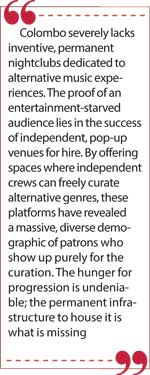
By treating fair competition as an existential threat, these gatekeepers end up fragmenting a delicate audience base. This friction is precisely why major milestones of industry maturity, like a recent eight-bar regional collaboration in Bangkok and similar initiatives in Singapore, remain such a fragile rarity. We have proven we can coordinate flawlessly to represent our island abroad, but back at home, territorial double standards keep the ecosystem localised and defensive.
The monoculture of “Playing it safe”
This reluctance to diversify has locked our urban entertainment landscape into a predictable loop. Step into the mainstream club scene in Colombo, and you are often subjected to a repetitive soundtrack of commercial pop, R&B, and standard chart hits playing on an infinite loop. The majority of commercial clubs rely on the same low-risk tracks, leaning heavily on outdated 80s and 90s nostalgia. Introducing a new DJ, a fresh sound, or an alternative music genre requires immense persuasion. My own experience trying to convince established venues and promoters to feature original acts who don’t rely on covers underscores a broader market reality: the system is designed to reward predictability over original creative equity, forcing independent promoters to absorb all the friction of pushing the culture forward.
Crucially, the country’s repetitive progressive house events exist almost entirely apart from these established, permanent venues, a telling symptom of a deeper structural void. Colombo severely lacks inventive, permanent nightclubs dedicated to alternative music experiences.
The proof of an entertainment-starved audience lies in the success of independent, pop-up venues for hire. By offering spaces where independent crews can freely curate alternative genres, these platforms have revealed a massive, diverse demographic of patrons who show up purely for the curation. The hunger for progression is undeniable; the permanent infrastructure to house it is what is missing.
The “Grateful” economy: Corporate control and idea skimming
This structural stagnation is heavily reinforced by how Sri Lankan private capital across the board, from independent businesses to major conglomerates, distributes its marketing and promotional budgets. To the creative community, the issue is rarely a complete lack of funding, but rather the risk-averse and patronising nature of that capital.
When an independent creator presents a pioneering lifestyle concept, festival framework, or cultural initiative to major commercial sponsors, they enter what can be called the “Grateful Economy.” They are rarely met with true institutional investment. Instead, they are handed a fraction of the necessary budget, tied to an exhausting, work-heavy mountain of deliverables. The implicit corporate assumption is that the creators should simply be grateful to be noticed. 
We see this exact dynamic play out with independent music artists. Many venue owners across the country offer minimal payouts, treating the artist as fortunate to have a stage at all, while expecting them to bring their own equipment, design the promotional artwork, market the event, and guarantee a crowd. The artist absorbs the entire financial risk, while the venue reaps the hospitality revenue.
When corporate entities do find an independent concept that works, the relationship frequently shifts from patron to predator. It is an all-too-familiar pattern for a legacy company to sponsor an original platform, only to cut ties with the creator the following year, hire a cheaper third-party executioner, and attempt to claim ownership over the intellectual property. Paradoxically, these same decision-makers will willingly open their vaults for cookie-cutter foreign franchises, paying premium rates for imported concepts while holding home-grown innovators to a standard of absolute, low-cost compliance. Corporate capital is too often weaponised as a tool of control, forcing projects into rigid corporate frameworks that neutralise their original creative integrity.
The Diaspora dilemma: Cynicism vs. cultural capital
This hesitation to trust home-grown innovation extends into a complicated relationship with our global diaspora. Across international creative capitals, diaspora Sri Lankans are breaking through highly competitive, merit-based systems. Whether operating as entrepreneurs, culinary and beverage pioneers, musicians, or multi-disciplinary creatives, they have succeeded in global landscapes where success cannot be bartered through local connections or territorial monopolies.
They often return to the island with world-class training, rigorous industry ethics, and an immense enthusiasm for their heritage. They treat their Sri Lankan roots as something to be celebrated and woven into their global identities. Thankfully, they are increasingly embraced by our local creative communities and counterparts. Yet, when it comes to the actual capital needed to realise their visions, a deeper frustration emerges. In my own work supporting returning individuals who are driven purely by a connection to their roots, I have seen highly impactful, altruistic projects designed to uplift rural or disadvantaged communities fall through because they cannot secure local financial backing. Instead of being treated as a strategic asset, these creators are frequently met by entrenched domestic gatekeepers with a protective cynicism, a “you’re not one of us” undercurrent fuelled by professional insecurity. Because they had the structural advantage of an overseas environment, their international credentials and goodwill are too often viewed with jealousy rather than institutional value. 
While progressive pockets of our media, arts, and business communities actively work to integrate these groups, the broader ecosystem remains insular. This is a major misstep. The global diaspora represents a massive, untapped pipeline of capital and intellectual equity. Unlike traditional local firms entrenched in legacy priorities, diaspora investors naturally understand the assignment. They grasp the economic value of cultural property, independent venues, and boundary-pushing subcultures because they have watched these exact ecosystems drive the economies of global cities. If we build an accessible, inclusive, and friction-free runway for them to reconnect, we unlock the alternative funding model our creative economy desperately needs.
Redefining the terms of capital
We know the state cannot save us. Bound to IMF recovery realities and an ongoing debt crisis, the government cannot afford to subsidise creative risk. But cultural capital cannot be treated as a luxury or a trivial afterthought while we wait for the national balance sheet to clear. It is a critical driver of our international soft power and premium tourism. The problem has never been a lack of vision; it is the terms of our capital.
If we want Sri Lanka to be recognised as a progressive, premium global destination, our affluent local investors and wealthy diaspora must redefine what it means to support the arts. Funding independent venues, experimental subcultures, and original intellectual property is an investment in the country’s foundational cultural infrastructure. This capital must come with fewer commercial strings and a greater respect for creative autonomy.
Until we stop letting territorial local politics dictate our creative boundaries and start investing in the long-term expansion of our entire industry, we will remain a culture that is fully capable of commanding the global stage, yet inexplicably restrained at home.




