Monday Sep 14, 2026
Monday Sep 14, 2026
Monday, 16 March 2026 03:08 - - {{hitsCtrl.values.hits}}
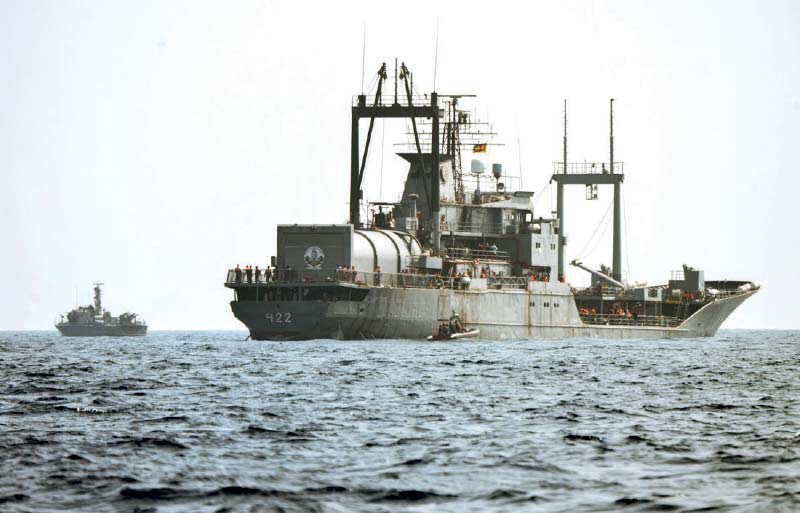
Iranian naval vessel IRIS Bushehr in Colombo en route to Trincomalee Port
 Both Sri Lanka and the Maldives are small island States and the effects of this ill wind will darken our economic skies and threaten our economy and the health and well-being of our people
 The on-going attacks on Iran and the ensuing counter attacks on US allied Arab oil infrastructure and selected traffic in the Straits of Hormuz, is now more than 2 weeks old. And there’s nary any indication, or indeed any real reason to be optimistic of the sudden emergence of silver linings.
Much like flotsam in these turbulent seas, our 2 countries, Sri Lanka and Maldives, need to first acknowledge our relative inability to affect the outcome. Instead, we will need to trim our sails, and pray that we will not have to jettison cargo, in order to survive and to finally sail into calmer seas.
The effect of geography
Five days into the storm, on 4 March, an Iranian Moudge-class frigate, IRIS Dena, with 180 crew was sunk by a US submarine, 40 nautical miles off Galle, Sri Lanka. In International waters. Of the 180 strong crew, Sri Lankan navy rescued 32 and recovered 87 bodies.
Common law of the sea warrants safe waters even to any enemy vessel in distress. However, on the very next day, 5 March, when a second Iranian vessel sought approval to dock, Lankan authorities transferred 204 crew and took control of the vessel.
Sri Lankan authorities here are, of course, seeking a delicate balance between common law of the sea in offering humanitarian assistance and not getting into the bad books of Uncle Sam.
Meanwhile, after the death of the Iranian Supreme Leader on the first day of attacks, in testament to Wordsworth’s immortal lines that ‘the son is the father of the man’, the new Iranian Supreme Leader Mujthaba Khamanei, is projecting an even harder stance. The War Cabinet of Trump, Hegseth and Netanyahu, being who they are, and with Iranians refusing to take a knee, none should be under the illusion that this would be the last incident near our shores.
Economic uncertainty
The onset of the attacks on the last day of February, immediately raised Platts prices from mid 70s to mid-90s. The younger Khamanei having declared that he will continue to use ‘the lever of blocking the Strait of Hormuz’ as a tactic, and with continued attacks on oil related infrastructure on US allied Arab countries, oil prices have travelled north of 120. How far up North, not even crystal-ball gazers are able to state with confidence.
Both Sri Lanka and the Maldives are small island states and the effects of this ill wind will darken our economic skies and threaten our economy and the health and well-being of our people.
Rising commodity and therefore producer prices, which will inevitably keep pace with rising energy costs, will make our exports more expensive and deprive us of economic margin.
Tourism and travel industry, which play such an outsized role in the economy of both our countries, is extremely sensitive to economic uncertainty, especially amidst inflationary pressures. And a loss of appetite for international travel will hit both our economies where it hurts the most.
Sri Lanka was slowly but steadily recovering from an estimated 20% loss of GDP in the storms of 2022. However, with the global economic forecast at ‘unsettled’ at best, momentum and direction of recovery is now uncertain, and Sri Lankans are fearful of a déjà vu of the wild hikes of early 2022.
In the first week of the attacks Maldives already witnessed the sharpest rise of oil prices in recent times.
With both our Governments consulting and crafting plans, both have issued advisories to be cautions. However, it is not just governments that have to trim their sails for rough seas and turbulent winds.
Private enterprises, media and Joe Public too, have a duty at such times. In Maldives we have a saying ‘rakkaave thibiyyaa dhathureve’ which roughly translates to ‘a smooth journey for those who are prepared’.
(The author is an economist based in the Maldives. After a BA in Economics at the University of South Pacific, Fiji, and a MBA from Monash University, Australia, served at CEO level and Board positions of some of the biggest and most diversified corporate entities of the Maldives. He also served as a Board Director of the Capital Market Development Authority; CMDA and for a brief, but eventful period at MMA; the Central Bank of the country as the first Head of the Financial Intelligence Unit. For over 20 years, Athif has published extensively in both Dhivehi, the local language, and English, focusing on economic matters. During this period, he has worked through various formats to increase public awareness of economic issues within the community.. He could be reached via email at [email protected])




