Friday Oct 02, 2026
Friday Oct 02, 2026
Saturday, 27 June 2026 03:12 - - {{hitsCtrl.values.hits}}
 There are railways. And then there are railways that carry the spirit and the imagination of a nation. For months after Cyclone Ditwah tore through Sri Lanka’s hill country, our world-famous upcountry line was not merely out of service. It was out of sight, it was out of reach, and it was perilously close to being out of mind.
Last weekend, however, after months of absence – and a silence imposed by a tropical storm’s fury on the clickety-clack, chuff-chuff and cheerful toot – our island-nation’s iconic upcountry line roared back to life.
The return of railway services (including, potentially, the popular Ella Odyssey train) along the Badulla line is more than a transport and logistics success story. It is the resurrection of arguably Sri Lanka’s most photographed tourism product after Sigiriya.
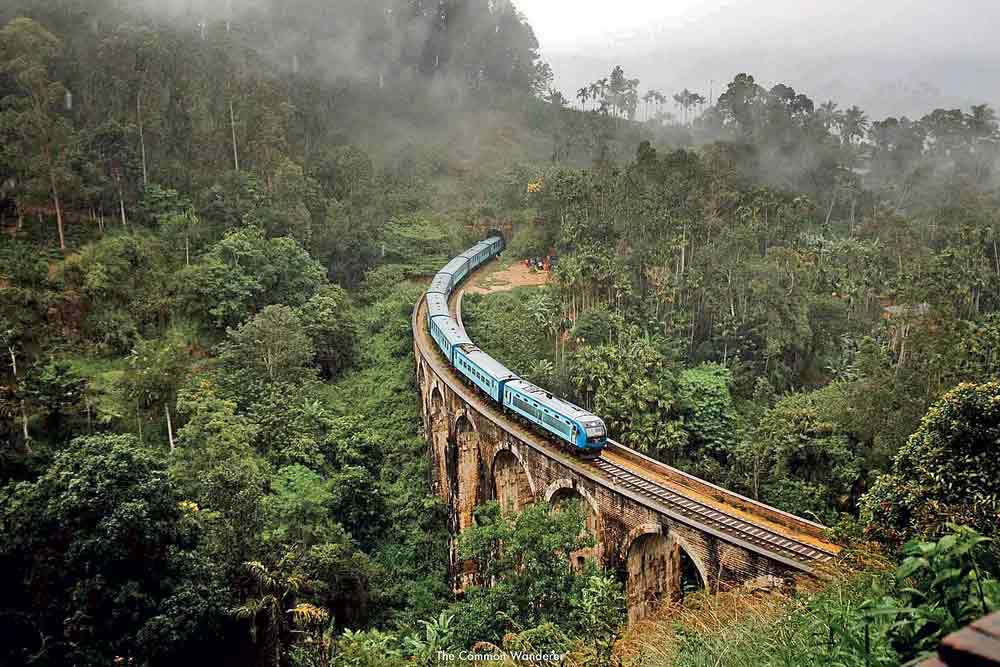
It is the journey that travel writers routinely rank as being amongst the greatest railway adventures. It is also the route that traverses tea-clad slopes, skirts dizzying precipices, crosses the celebrated Nine Arches Bridge, loops eponymously around Demodara’s engineering marvel, and appears daily on literally millions of social-media feeds. And it promotes Sri Lanka far more effectively than any or many marketing campaigns could ever hope to do.
So when Ditwah struck with the full force of a tropical cyclone, it did not merely interrupt train services. It also disrupted a long-running epic saga of intrepid adventure.
TML
The ensuing damage was immense. Note myriad landslides, embankment failures, soil erosion, damaged culverts – leaving bridges, and track segments including lengthy segments of The Main Line (TML), utterly unusable.
When railway authorities reported nearly a hundred major damage sites between Maradana and Peradeniya (on the lower runs of The Main Line), rail fans and tourism buffs alike knew that it was an unprecedented disaster.
And it was merely common knowledge, not news later, when it transpired that the Nanu-Oya to Ambewela sector (on the upper slopes of the Main Line) suffered extensive destruction at multiple locations, demanding months of painstaking engineering interventions.
 For if a colonial relict of a railway line blasted through rocky mountains by Victorian engineers, neglected by generations of politico-legislators, battered by unprecedented weather and buried under the muddy tonnage of landslides can find its way back into service, surely a slowly recovering nation can do so too
Still the Nine Arches Bridge stood, as well as the track remained largely intact around the Demodara Loop.
But in the aftermath of the worst natural disaster to sunder our tropical paradise was the seed of the railway’s future recovery.
And although what followed took many months to bear fruit, what ensued was a remarkable exercise in national resilience.
All
Railway workers, engineers, technical officers, transport officials, geologists from the National Building Research Institute, contractors, suppliers and policymakers laboured long and hard under extraordinarily difficult conditions.
In many places, access to damaged stations, bridges and culverts existed only along the disappeared railway line itself. Materials had to be transported by special service trains or manually conveyed to remote mountainside locations.
Internationally reputed and experienced engineering firms joined local expertise. Politicians supplied policy support and State funding.
Taxpayers ultimately underwrote the reconstruction effort. Commuters had endured much inconvenience with remarkable fortitude and patience. Meanwhile, entire hillside communities and remote villages had waited in hope...
And that sterling hope, on top of the stalwart efforts of the Sri Lanka Railway (SLR) and its stakeholders, has realised rich dividends for a land often languishing under lamentable natural and man-made disasters.
That railway line, which many feared would remain crippled and out of commission well into a bleak future, is once more carrying passengers aboard the Podi Menike and Udarata Menike through the deep heart of our hill country again.
Heart
And what a heart it is. Travel publications routinely rank the Kandy-Ella-Badulla railway line as being among the world’s most scenic train rides.
Tea estates drape emerald hillsides. Waterfalls tumble through the sylvan glades. The famed Demodara Loop remains one of railway engineering’s most jaw-dropping marvels. The Nine Arches Bridge continues to draw gobsmacked visitors from every continent.
 The real achievement lies in the overwhelming departmental and national response.
Engineers. Inspectors of Permanent Ways (IPWs). Track gangs. Signal technicians. Geological specialists. Building research experts. Locomotive crews. Ordinary labourers. Ornery politicos! And public servants of all ilks. Not forgetting entire communities
Social media has turned the route into Sri Lanka’s unofficial ambassador, generating multiple millions of views annually and inspiring countless travel itineraries.
So when trains stopped perforce, the losses extended beyond mere passenger and cargo revenue, negligible though the latter may be, despite the line’s colonial provenance of being built to haul tea and other commodities.
Hotels, guesthouses, tuk-tuk operators, cafes, restaurants, guides, photographers, artisans and small businesses throughout the central highlands felt the impact. International travellers postponed journeys and some altered their itineraries altogether.
SLR
It soon became evident to even the most agnostic policymakers that a railway line built by Victorian engineers more than a century and a half ago had become a critical artery of the modern tourism industry and the national economy it supported.
The cyclone exposed the vulnerability of a network that had long suffered from deferred maintenance, chronic under-investment, and the institutional paradox of being simultaneously indispensable and underfunded.
In 2023, Sri Lanka Railways transported more than 109 million passengers and almost two million tonnes of freight. Yet, against revenues of Rs. 16 billion stood expenditures approaching 39 billion rupees. The gap between aspiration and affordability was already wider than Sensation Gap at Kadugannawa before the first embankment collapsed.
30%
Enter Ditwah. At the nadir of the disaster, only about 30% of the national network – mostly along the western coast line – remained operational. More than 90 locations suffered major track damage. Some 75 bridges were rendered impassable. Landslides buried long sections of the line. Embankments vanished. Cuttings failed. Culverts were inundated. Mother Nature, having patiently audited decades of neglect, submitted her stern invoice.
And what an invoice it was. Railway reconstruction estimates have ranged from $ 320-400 million. Across the wider economy, Ditwah inflicted damage that was estimated at over four billion dollars.
Yet, the numbers tell only part of the story. The real achievement lies in the overwhelming departmental and national response.
Engineers. Inspectors of Permanent Ways (IPWs). Track gangs. Signal technicians. Geological specialists. Building research experts. Locomotive crews. Ordinary labourers. Ornery politicos! And public servants of all ilks. Not forgetting entire communities.
Together they undertook a restoration effort of extraordinary complexity. Materials had to be hauled to difficult-to-access locations over rough ruined terrain. In some places, one damaged section had to be repaired before access to the next could even be contemplated.
Crews had to repair one sector to reach the next, and then repair a next before moving on to restore another segment. And then later repeat the process dozens of times across hundreds of kilometres of mountain country.
Nth
This was not merely reconstruction. It was a gargantuan effort oriented towards national perseverance. All those railway engineers, IPWs, locomotive crews, signal technicians, construction personnel, geologists, planners, administrators and parliamentarians found themselves engaged in a project that was simultaneously technical, logistical, financial and political.
The reopening of the upcountry line therefore carries significance beyond railway enthusiasts delighted to hear steel singing on steel once again. It signals renewed confidence to travellers who postponed visits to paradise lost.
It restores livelihoods to all those previously affected hoteliers, guides, cafe owners, drivers, artisans and small entrepreneurs from Nanu Oya to the nth station along the line.
It revives a tourism icon at a time when Sri Lanka is ambitiously targeting three million arrivals and hopes to build on last year’s record earnings of $ 3.2 billion.
Can/will
There is also something more intangible at play. After months of headlines dominated by disaster, loss and recovery, the much anticipated return of the Ella Odyssey and its sister services offers a rarer commodity: encouragement.
For if a colonial relict of a railway line blasted through rocky mountains by Victorian engineers, neglected by generations of politico-legislators, battered by unprecedented weather and buried under the muddy tonnage of landslides can find its way back into service, surely a slowly recovering nation can do so too.
The truth be told, the most important thing returning to the upcountry line last week was not the train alone. It was momentum along another track also... now, the shrill whistle blows again. And the horns of elfland – haunting klaxons on a triple air horn of a Class M2, I would like to say – peal through the gorges again. But the stalwart reconstruction effort offers a lot more than restored connectivity.
It sends a message: Sri Lanka can recover; Sri Lanka will recover.
More
Be that as it may, there remains work to do. Some sections of the broader network continue under repair. Slope protection, drainage improvements, and climate-resilient infrastructure must become priorities in an era of increasingly extreme weather. With the impending El Niño, something wicked this way comes?
The truth be told again though, the most encouraging thing about steel singing in the mountains again is not that it celebrates a journey completed. It hints at one that is just beginning.
Sri Lanka hopes to attract three million visitors this year after tourism earnings exceeded $ 3.2 billion last year. For many of those visitors the upcountry railroad is not a side excursion. It is the main destination.
It is the image they saw online. It is the memory they intend to take home. Every compartment seat filled represents not merely tourism revenue, but hotel occupancy, restaurant receipts, guide fees, handicraft purchases, transport services and foreign exchange.
LKR
In short, the railway multiplies value far beyond the ticket price. It is also why the reopening of this much celebrated stretch of railway invites a larger question. Have we merely restored what existed before Ditwah? Or have we learned enough from the cataclysm to build back better what comes next?
Climate resilience. Modern signalling. Better drainage. Slope monitoring. Smarter maintenance. Greater integration between tourism policy and transport planning. A railway fit not only for picture postcards but a profitable future ahead.
But for now, perhaps we should simply celebrate! A train emerging from the mist near Ella may seem an ordinary sight again. And today, a week after the Menike wound its way along the mountain passes once more, it feels more like a special symbol.
Steel rails repaired. Communities reconnected. Tourists returning. Spirits uplifted. After Ditwah’s devastation the upcountry line reminds us that nations too, like railways, are not defined by where they break – but by how well and determinedly they rebuild.
The truth be told for the final time then, that whistle sounds a lot like hope. And so it is that a funny thing happened on the way to despair: the train returned. But better, as strong as before, on the fast track to a national dream.
(The author is the Editor-at-large of LMD and is a senior journalist with a Post-graduate Diploma in Politics and Governance)



