Sunday Sep 13, 2026
Sunday Sep 13, 2026
Friday, 29 May 2026 03:46 - - {{hitsCtrl.values.hits}}
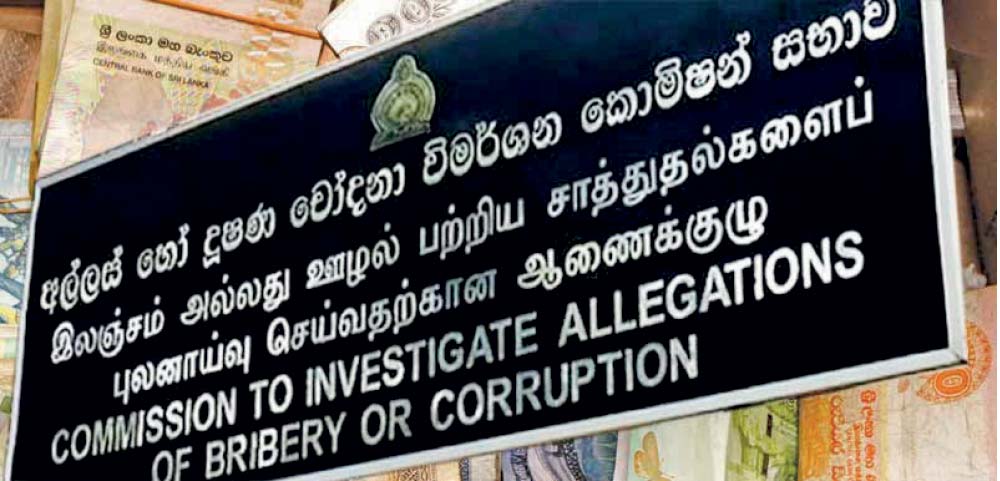
 Sri Lanka’s anti-corruption struggle cannot succeed if the institutions leading that battle themselves become subjects of persistent controversy. The answer is neither blind defence nor politically motivated attacks. What is required is consistency, transparency, independent oversight, and equal application of the law. In a democratic society governed by the rule of law, institutions tasked with fighting corruption must themselves remain beyond reproach. Transparency, consistency, and independence are not optional ideals — they are the very conditions upon which public confidence in justice depends
By Legal Eagle
Controversies and criticism
Sri Lanka’s fight against corruption depends not only on strong laws and institutions, but also on public confidence in the integrity, impartiality, and independence of those entrusted to enforce them. It is for this reason that the ongoing controversies surrounding the tenure of Ranga Dissanayake as Director-General of the Commission to Investigate Allegations of Bribery or Corruption deserve careful public discussion rather than partisan dismissal or blind defence.
The criticisms directed at the present Director-General revolve around several recurring concerns: alleged political affiliations, questions regarding impartiality in investigations, legal qualifications for office, the transparency of the Constitutional Council’s appointment process, and allegations that have increasingly placed the institution itself under public scrutiny.
Among the most widely debated accusations is the claim that Dissanayake had prior associations with the JVP/NPP political movement. Former JVP member Nandana Gunathilake publicly alleged that the Director-General had once served on the party’s legal committee. Opposition politicians subsequently argued that such links, if true, could compromise the neutrality expected from the head of the country’s anti-corruption watchdog.
Dissanayake has firmly denied any political affiliation, correctly noting that active political involvement would have been incompatible with his judicial career. However, the allegation raised by Gunathilake related to a period prior to his judicial appointment. If the allegation were inaccurate, critics argue, it should have been directly and comprehensively addressed at the outset. In institutions such as CIABOC, public perception carries immense importance. Even unproven allegations can create doubts when investigations involve political figures across party lines. In democracies governed by the rule of law, justice must not only be done but must also be seen to be done.
Another major controversy concerns whether the Director-General fulfilled the statutory qualifications required under Section 19 of the Anti-Corruption Act, particularly the requirement of fifteen years’ experience in criminal prosecutions. Critics argue that judicial service alone does not satisfy the legislative intent behind the provision.
This debate is especially significant because former Director-General W.K.D. Wijeratne was effectively compelled to vacate office on similar grounds. The apparent inconsistency has raised uncomfortable questions: if one office-holder was deemed unsuitable due to insufficient prosecutorial experience, why has the same standard not been uniformly applied in the present case? It is ironical that the two cases were heard by the current Chief Justice.
Dissanayake has defended his eligibility by citing his years as a practicing attorney and his extensive experience presiding over criminal matters as a judge. Yet the issue extends beyond individual qualifications. It concerns whether legal standards are being interpreted consistently or selectively depending on political circumstances.
Concerns have also emerged regarding the process followed by the Constitutional Council in making the appointment. Given the importance of CIABOC as an independent anti-corruption institution, the public is entitled to know whether all constitutional and statutory criteria were rigorously examined before approval was granted.
Separately, allegations surfaced regarding whether influence had been improperly used to secure admission for the Director-General’s child to Royal College Colombo during his judicial tenure. CIABOC later announced that an internal inquiry found no wrongdoing and concluded that the admission complied with Education Ministry provisions applicable to judicial officers.
Headline-driven” anti-corruption enforcement
While that finding may legally resolve the matter, critics point out that an inquiry conducted within the same institution headed by the subject of the complaint inevitably creates questions about independence and public perception. Public institutions must be especially careful to avoid situations where internal investigations may appear self-protective, even if procedurally valid.
Additional criticism has arisen over what some Opposition figures describe as “headline-driven” anti-corruption enforcement. They argue that highly public statements and media-focused operations risk politicising investigations and undermining the strict confidentiality expected under the Anti-Corruption Act. Supporters of the Director-General, however, contend that public communication is necessary to demonstrate that corruption cases are actively being pursued after years of institutional inaction. Whether those actions are genuinely independent or selectively partisan remains a question that continues to dominate public debate.
Criminal proceedings
More troubling are allegations emerging from specific criminal proceedings. An affidavit submitted in the Kapila Chandrasena case reportedly alleged that pressure was exerted to implicate former President Mahinda Rajapaksa. Although these allegations were never proven in a court of law, they nevertheless raise serious concerns regarding investigative methods and prosecutorial conduct.
The subsequent deaths of Kapila Chandrasena and another accused individual, Nihal Sisira Kumara, further intensified public scrutiny. It would be irresponsible to draw conclusions without evidence. However, in any democratic society, allegations involving coercion, political targeting, or custodial pressure must be examined with transparency and independence.
Equally puzzling is the withdrawal of the legal challenge filed against the current Director-General concerning his qualifications. The sudden disappearance of litigation in matters of substantial public importance naturally invites speculation and suspicion. Greater transparency from all parties involved would help prevent misinformation and restore confidence in institutional processes.
Further allegations now circulating in political and legal circles concern the alleged manipulation of transfers, promotions, and disciplinary proceedings involving High Court judges and Magistrates. Critics claim that undue influence is being exerted over judicial administrative processes, allegedly with the support of powerful figures within the higher judiciary. Additional allegations on social media have sought to connect members of the judiciary to controversial political and personal dealings, including discussions surrounding retirement-age reforms and politically sensitive criminal prosecutions.
These allegations are grave and strike at the very foundation of judicial independence. At present, however, they remain allegations and have not been proven before any court or independent tribunal. Precisely because of the seriousness of such claims, they cannot simply be ignored or dismissed as political noise. Equally, they cannot responsibly be treated as established fact without credible evidence and due process. What they underscore is the urgent necessity for transparent institutional safeguards, independent oversight mechanisms, and public accountability capable of protecting both the integrity of the judiciary and public confidence in the administration of justice.
None of these concerns automatically establish wrongdoing. Allegations are not convictions, and public officials are entitled to fairness and due process. However, the credibility of anti-corruption institutions depends on maintaining standards that are above political suspicion and administrative inconsistency.
Sri Lanka’s anti-corruption struggle cannot succeed if the institutions leading that battle themselves become subjects of persistent controversy. The answer is neither blind defence nor politically motivated attacks. What is required is consistency, transparency, independent oversight, and equal application of the law.
Ultimately, the integrity of CIABOC matters far beyond any single individual. Public trust in anti-corruption enforcement is one of the foundations upon which democratic accountability rests. Once that trust is weakened, rebuilding it becomes infinitely more difficult. This becomes all the more significant against the current backdrop where allegations of high-level corruption have also surfaced against members of the present administration, yet many critics argue that such matters have not attracted the same vigour, urgency, or prosecutorial intensity seen in investigations against political opponents of the government.
In a democratic society governed by the rule of law, institutions tasked with fighting corruption must themselves remain beyond reproach. Transparency, consistency, and independence are not optional ideals — they are the very conditions upon which public confidence in justice depends.




