Saturday Oct 03, 2026
Saturday Oct 03, 2026
Saturday, 17 January 2026 00:14 - - {{hitsCtrl.values.hits}}
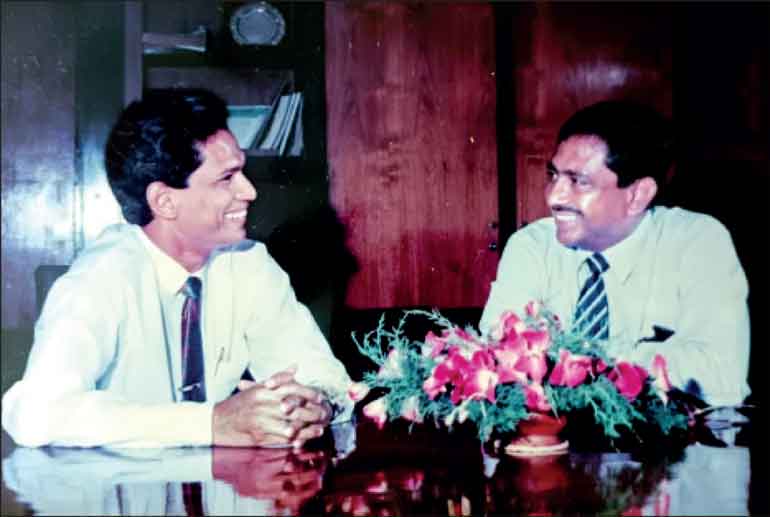
Iqbal Athas (right) with the author Jumar Preena
The newsroom was always alive when Iqbal was around. Despite his stature, Iqbal was profoundly down-to-earth. A gentleman in every sense—kind-hearted, approachable, and always willing to help. His professional eloquence was matched by personal warmth
By Jumar Preena
I first met Iqbal Athas in 1979, soon after I joined the news desk of the once-popular Sun Newspaper as a trainee. He was the News Editor then, and unknowingly to us, already a Master Class in journalism personified.
My very first lesson in news reporting was taught by Iqbal. Born on 1st September, 81 years ago, he was truly one of the rare gems of the news fraternity. He spoke with the same clarity and charm with which he wrote—measured, engaging, and effortlessly authoritative.
A by-lined article by Iqbal Athas was a scoop, what we would today call breaking news, and more often than not, it led the paper. Yet, he never wrote to impress himself or peers. He wrote for the average reader. His style was simple, well-explained, lightly dramatic without being sensational, and invariably spellbinding.
He had mastered all three languages, English, Tamil, and Sinhala, with enviable fluency. He would walk into the newsroom with grace and quiet charm, always carrying his trademark brief case. Outside waited his bluish Mitsubishi Lancer (the “L-light model,” as we called it), a symbol of quiet success in an era when such comforts were rare.
Flanking him were the News Editors of Dawasa and Thinapathi. It was common to see them discussing the day’s cracker stories even before work formally began. Those conversations alone were lessons in editorial judgment.
Despite his stature, Iqbal was profoundly down-to-earth. A gentleman in every sense—kind-hearted, approachable, and always willing to help. His professional eloquence was matched by personal warmth.
His network of sources read like a who’s who of the era: state dignitaries, local and foreign diplomats, trusted political figures, and respected academics. They spoke to him because they trusted him. And what they shared was credible, consequential news.
Iqbal would usually walk into the newsroom around 10 in the morning and often stay well into the night, sometimes until dawn, when a major story broke. We reporters were permitted to call him at any godly hour for guidance. This was long before mobile phones, personal devices, or laptops became part of newsroom life.
He typed at breath-taking speed on his Olivetti typewriter. Whenever we heard that familiar rhythm, we knew something important was taking shape. Yet, we only discovered what it was when the proof copy arrived around 6.00 p.m.
The newsroom was always alive when Iqbal was around.
One day, he called all of us into the boardroom and announced his idea of launching a regular column, or rather, a full page, and invited everyone to contribute topic ideas. He named it “Fun Finding Out.”
I was assigned the topic of postal services, with the headline he himself coined: “Post Haste.” It was a comprehensive piece on the workings of the postal system. This was followed by another assignment, “The Cup That Cheers,” an in-depth article on Sri Lanka’s tea industry. Those were not just articles; they were lessons in research, narrative balance, and respect for the reader
Occasionally, I was entrusted with carrying Iqbal’s news dispatches to foreign news agencies through the now-defunct OTS, Overseas Telegraph Service, ticker system. This was long before the luxury of the internet, email, or uploading stories from one’s desk was even imaginable, concepts that simply did not exist in our newsroom vocabulary.
This task was not formally part of my journalistic duties. It was done purely as a favour to my editor—and to me, it was a privilege. In the process, I learnt how international news transmission worked, how time-sensitive information moved across borders, and how accuracy and speed were treated with equal seriousness. That learning was not taught; it was absorbed. And that, in hindsight, was knowledge in its purest form.
Those trips to OTS were silent lessons in responsibility and trust. A young trainee was being allowed to handle material that carried the weight of credibility, reputation, and international readership. Iqbal did not need to explain the importance of the task. His confidence in me conveyed it more powerfully than words ever could.
Looking back, these moments define what mentorship truly meant in those days. It was not about structured training programs or formal inductions. It was about exposure, trust, and learning by doing—under the quiet watch of a master who believed that growth comes from responsibility. Those experiences, like so many others under Iqbal Athas, shaped not just a journalist, but a way of thinking that stayed for life.
Years later, our paths crossed again, this time under very different circumstances.
The photographs capture Iqbal (on the right) during one of his visits to my office. By then, much had changed in our respective journeys. We had parted ways after a three-year stint at the newsroom, each moving on to different professional responsibilities. Yet, the bond forged in those formative newsroom years never faded.
Our relationship evolved organically. I became one of his trusted sources, and for me, he remained an invaluable and dependable media contact, one whose judgment I respected implicitly. What made this association special was the mutual understanding that came from shared newsroom discipline, ethics, and an unspoken commitment to accuracy.
The conversations during such visits were never merely social. They were exchanges rooted in context, perspective, and credibility. There was no need for dramatics or persuasion. Facts spoke for themselves because trust already existed.
Looking at these images today, what stands out is not formality, but familiarity. Two professionals in quiet conversation, bound by a shared past and sustained by mutual respect. The mentor had become a peer yet never stopped being a guide.
That, perhaps, is the true measure of a great editor, not only the journalists he shapes, but the lifelong professional relationships he nurtures.
(The author is a specialist in marketing, PR and media communications)



