Thursday Oct 15, 2026
Thursday Oct 15, 2026
Wednesday, 17 June 2026 06:29 - - {{hitsCtrl.values.hits}}
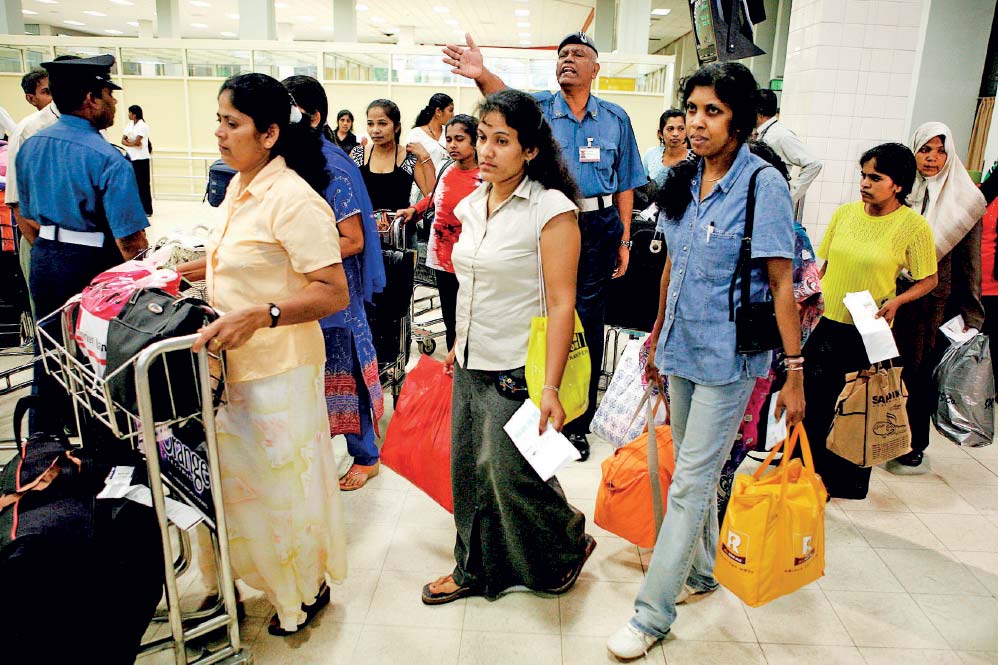
 Every year on 16 June, the world observes International Day of Family Remittances, a United Nations-recognised day dedicated to acknowledging the sacrifices and contributions of migrant workers and the families who depend on them. The day recognises that remittances are not merely money transfers; they are lifelines that support education, healthcare, housing, food security, and economic stability for millions of families worldwide.
For Sri Lanka, this day carries a significance far greater than ceremonial recognition. It is a day that should remind the nation that behind every remittance dollar stands a worker separated from family, often enduring difficult working conditions abroad, making sacrifices that sustain both households and the national economy.
Yet, despite the immense contribution of migrant workers over more than four decades, Sri Lanka has never officially commemorated International Day of Family Remittances in a meaningful national manner. Neither the Ministry of Foreign Employment nor the Sri Lanka Bureau of Foreign Employment (SLBFE) has established a nationally recognised annual program to mark this important occasion and educate the public about the economic and social value of migrant workers.
This silence must end.
The economic backbone that Sri Lanka continues to overlook
At a time when Sri Lanka continues to struggle with economic recovery, migrant workers remain one of the country's strongest pillars of economic resilience. Recent remittance figures demonstrate this reality clearly. In April 2026, workers’ remittances reached $767.9 million, representing an impressive 18.9% increase compared to April 2025. In May 2026, remittances surged further to $847 million, recording a remarkable 36.2% year-on-year increase and becoming the highest monthly inflow since December 2025.What makes these figures even more significant is that they have been achieved despite continuing geopolitical tensions and conflict in the Middle East—the region that remains the largest employment destination for Sri Lankan migrant workers. While wars, regional instability, and economic uncertainty have disrupted many sectors globally, Sri Lankan migrant workers have continued to send home the foreign exchange that helps stabilise the national economy. Their commitment has never wavered.
More than four decades of service to the nation
Labour migration has remained one of Sri Lanka's most important economic sectors for over forty years. Since the expansion of organised foreign employment during the 1980s, millions of Sri Lankans have sought employment opportunities abroad. Today, Sri Lankan workers are employed across the Gulf region, the Middle East, East and Southeast Asia, Europe, and emerging labour markets.
Over the past two decades alone, migrant workers have contributed well above $100 billion to the national economy through remittances and household income generation. Between 2023 and 2026, annual remittance inflows have recovered strongly to an estimated $6.5–8 billion, contributing approximately 8–10% of GDP and reaffirming labour migration as one of the country's largest sources of foreign exchange. Few sectors have demonstrated such consistency.
Few sectors have rescued the economy during times of crisis as often. Yet few sectors receive so little recognition.
Invisible in national planning, visible only when dollars arrive
Despite their contribution, migrant workers remain largely invisible in national planning.
Successive governments have celebrated remittance inflows but have failed to provide a comprehensive policy framework that recognises migrant workers as economic stakeholders, democratic participants, and development partners.
Budget allocations relating to migration have generally been limited to welfare-oriented interventions such as housing assistance, pension schemes, insurance programs, and selected social protection measures.
While these initiatives are important, they do not address the deeper structural issues facing migrant workers and their families.
Among the unresolved concerns are:
Migration continues to be treated primarily as a labour export program rather than a human development and governance sector.
A memorandum for Budget 2027: A call for structural change
Recognising these longstanding gaps, the Voice of Migrants (VOM) Network has submitted a memorandum to the Ministry of Foreign Employment calling for the inclusion of key migration-related proposals in the National Budget 2027.
The memorandum argues that migrant workers should no longer be viewed merely as beneficiaries of welfare programs.
Instead, they should be recognised as:
The central message is simple but powerful:
If migrant workers are among the largest contributors to the national economy, national Budget allocations must proportionately invest in the people, families, and communities that sustain the migration industry.
From welfare to empowerment
The proposals submitted by VOM advocate a significant policy shift.
They call for investments in:
Family protection and social support
Migration creates enormous social challenges for families left behind. Children, elderly parents, and women-headed households often require specialised support services.
Comprehensive counseling services, educational assistance, caregiver support programs, and community-based interventions are urgently needed.
Enhanced protection and risk coverage
Workers continue to face exploitation, unpaid wages, workplace injuries, legal disputes, and emergencies overseas.
Expanded insurance coverage, legal assistance, compensation mechanisms, and emergency support systems are essential for safeguarding migrant workers and their families.
Leadership development and participatory governance
Perhaps the most important proposal is the establishment of pathways for meaningful migrant representation in migration governance institutions, including the SLBFE.
For decades, migrant workers have financed the migration industry, yet they remain largely absent from decision-making processes.
This imbalance must be corrected.
Transforming remittances into development
Another major recommendation focuses on maximising the developmental impact of remittances.
A large proportion of remittance income is currently utilised for household consumption, which is understandable given economic realities.
However, appropriate policy incentives could encourage productive investment through:
Remittances should not only support families today but also help create sustainable economic opportunities for tomorrow.
The right to participate in democracy
One of the most persistent grievances among migrant workers is the inability to effectively exercise their democratic rights.
Hundreds of thousands of Sri Lankans living and working overseas continue to face barriers to voting.
VOM has proposed pilot programs to test postal, overseas, and digital voting mechanisms, enabling future electoral reforms that recognise migrant workers as full citizens regardless of where they work.
Economic contribution should not come at the cost of democratic exclusion.
Why 16 June matters
International Day of Family Remittances is not simply another date on the calendar.
It is an opportunity for national reflection.
It is an opportunity for Sri Lanka to publicly acknowledge the sacrifices of mothers working as caregivers abroad, fathers separated from their children, young workers enduring hardship in unfamiliar countries, and families who carry the emotional burden of migration.
Most importantly, it is an opportunity to recognise that remittances are not gifts. They are earnings generated through hard work, sacrifice, and personal cost.
Every school fee paid, every home built, every loan settled, and every dollar deposited into the country's foreign reserves carries the story of a migrant worker.
A national call to action
As Sri Lanka prepares to mark International Day of Family Remittances on 16 June, the Government, the Ministry of Foreign Employment, and the Sri Lanka Bureau of Foreign Employment must move beyond symbolic appreciation.
The country needs a nationally recognised annual program that mainstreams this important day and educates every citizen about the role migrant workers play in sustaining the nation.
Recognition must be matched by policy.
Gratitude must be matched by investment.
Respect must be matched by representation.
For too long, migrant workers have carried the economy on their shoulders while remaining at the margins of national planning.
On June 16, Sri Lanka has an opportunity to correct that injustice.
The nation must not allow this day to pass in silence. It must stand together and say, with one voice:
Sri Lanka remembers, recognises, and salutes its migrant workers and their families—the true backbone of the nation's economy.
(The author is the Executive Director Voice of Migrants, a National Network established in Sri Lanka with a membership of 32 CSO and 6 trade unions. He could be reached via email [email protected])




