Sunday Sep 13, 2026
Sunday Sep 13, 2026
Tuesday, 21 July 2026 07:00 - - {{hitsCtrl.values.hits}}
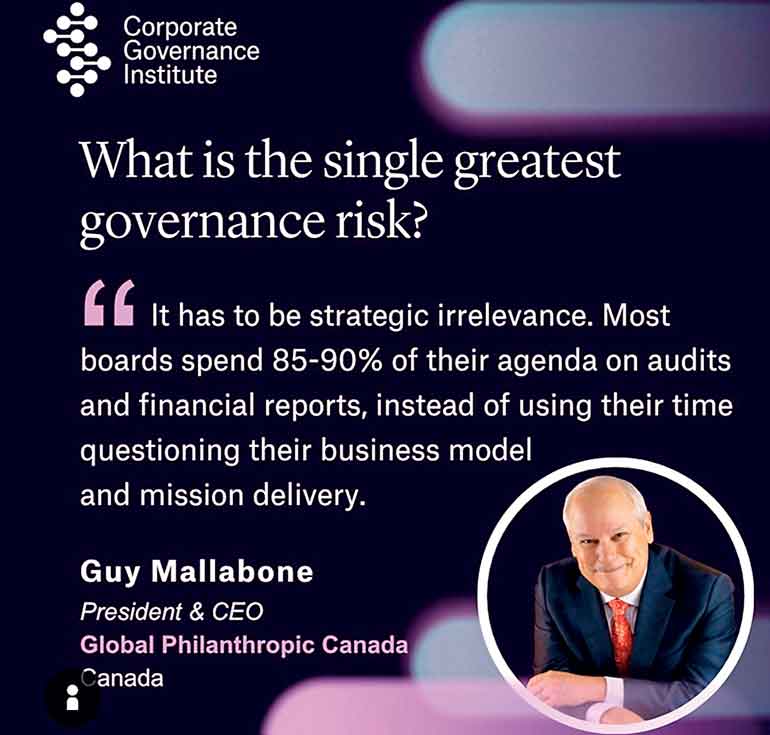
T he Corporate Governance Institute recently posed a question that cuts to the heart of modern directorship: What is the single greatest governance risk facing Boards today? My answer, after over 25 years of serving on Boards across banking, listed companies, public institutions, and multinational organisations, aligns with Guy Mallabone’s perspective: strategic irrelevance and also know-it-all attitude. Not fraud, not regulatory penalties, not even a cyber attack—though all can be devastating. The most serious governance failure occurs when a Board becomes so focused on managing yesterday’s risks that it fails to recognise tomorrow’s realities, often because it has stopped learning. A Board can be fully compliant, receive clean audit reports, and conduct regular reviews, yet still fail if it loses the ability to anticipate change. The greatest danger is a Board that performs its duties diligently while becoming intellectually disconnected from the world around it, harbouring the quiet, corrosive belief that it already knows everything. Recent research by The Corporate Governance Institute highlights this very challenge, revealing a widening gap between Boardroom confidence and Board readiness. While many directors express confidence in their overall effectiveness, significant gaps remain in their preparedness to navigate emerging risks such as artificial intelligence, cyber security, ESG expectations, and regulatory complexity.
Governance has moved beyond compliance
When many of us first entered Boardrooms, governance was largely viewed through a compliance lens: approving budgets, reviewing financial statements, monitoring controls, and ensuring regulatory obligations were met. Those responsibilities remain essential, but they are no longer enough. Today’s directors operate under unprecedented scrutiny from shareholders, regulators, employees, customers, the media, Gen Z and society at large. Boards are expected not only to provide oversight but also to demonstrate foresight and leadership.
The modern Board agenda
The modern Board agenda must address cyber security threats and the disruptive impact of artificial intelligence; geopolitical uncertainty and shifting economic realities; climate risks and sustainability expectations; talent shortages and workforce transformation; and the challenge of balancing stakeholder expectations with long-term value creation—all in an environment where information is often incomplete and decisions must be made at speed.
The Social Media accelerant
One of the biggest changes in governance has been the rise of social media. Previous generations of directors never faced an environment where a single incident—whether accurate, exaggerated, misunderstood, or entirely false—could spread globally within minutes. A reputation built over decades can be damaged in hours. The challenge is not simply responding quickly; it is responding responsibly. Boards must separate facts from speculation, communicate with clarity, and protect stakeholder confidence while ensuring every word is legally sound. Misinformation often travels faster than the truth, and directors are expected to act immediately, even as every response must withstand intense scrutiny. Traditional governance frameworks were not designed for this speed and complexity. The defining capability of future Boards will therefore be not just knowledge, but judgement under uncertainty.
What future-ready Boards do differently
Future-ready Boards do not merely review history. Research shows that they interrogate the future. This means rethinking priorities. Financial performance and compliance remain critical, but they should not dominate the agenda. More time must be devoted to deeper questions: What assumptions are we making today that may no longer hold true tomorrow? Are we creating tomorrow’s businesses or simply protecting yesterday’s? Do we have the Talent capable of navigating an uncertain future? What risks are we prepared to take, and are they aligned with our strategy and stakeholder expectations ?Most importantly, strong Boards normally encourage constructive challenge and create an environment where directors can ask difficult questions without fear. The first sign of an irrelevant Board is often not disagreement, but silence—and the moment it stops learning.
The most serious governance failure occurs when a Board becomes so focused on managing yesterday’s risks that it fails to recognise tomorrow’s realities, often because it has stopped learning
Stewardship in a changing world
The greatest evolution I have witnessed in governance is the shift from narrow shareholder oversight to broader stewardship. Boards are no longer judged only by the decisions they make, but by how quickly they identify emerging threats, how transparently they respond during crises, and how effectively they protect the organisation’s most valuable intangible asset: trust. Financial losses can be recovered, strategies can be changed, and brands can be rebuilt. But trust, once damaged, is exceptionally difficult to restore.
Keep learning
The Boards that succeed in the next decade will not be those with the longest governance manuals or the most detailed compliance checklists. They will be the Boards that remain curious, humble, and strategically and intellectually restless. Perhaps the greatest governance risk of all is not the failure to anticipate change, but the dangerous belief among directors that they already know everything. The moment a Board stops learning, questioning, and challenging its own assumptions is the moment it begins to lose relevance. In an era of relentless disruption, the greatest governance risk is not making the wrong decision. It is realising, too late, that the Board stopped asking the right questions while the answers still mattered for the future.
References
https://www.dailymirror.lk/print/hr-marketing/Board-governance-connecting-the-dots/275-111154
https://www.thecorporategovernanceinstitute.com/ Boards feel confident, but most admit they are not ready for the risks of 2026, finds new research




