Sunday Sep 13, 2026
Sunday Sep 13, 2026
Wednesday, 8 July 2026 00:24 - - {{hitsCtrl.values.hits}}

If you sit down with a calculator and look at the official agricultural reports coming out of Colombo, you will quickly find yourself staring at a glaring financial contradiction.
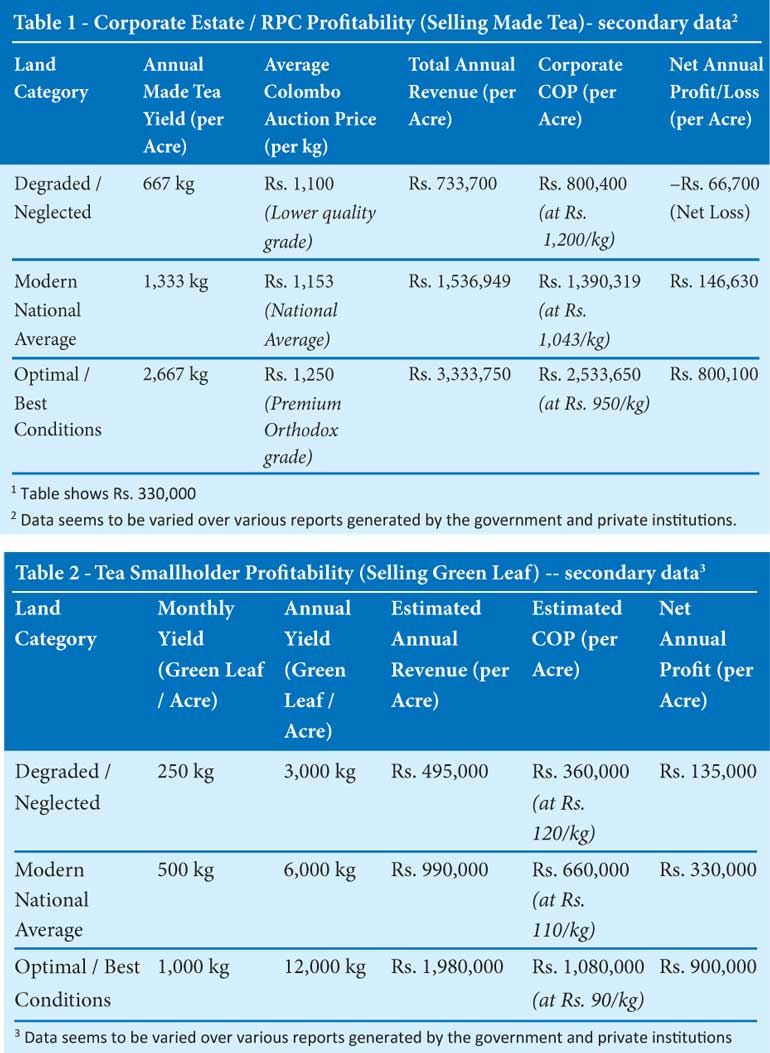
On paper, the math behind Sri Lankan tea cultivation doesn't just look tight—it looks downright irrational. Even under modern national average conditions, a well-managed acre of smallholder tea land yields a net profit cap hovering around Rs. 350,000 per year (Rs. 29,000 a month approximately). On degraded land, that number plummets to near-zero or slips into a net loss.
This reality forces us to confront a brutal double-question: Is our national data fundamentally flawed, or is tea truly unprofitable? And if the latter is true, why on earth did generations of Sri Lankans choose tea over every other crop? Who in their right mind signs up for a backbreaking, year-round agricultural venture that caps their optimum yearly return at the price of a mid-range smartphone?
The answer lies in a mix of statistical optical illusions, unique rural economics, and a powerful human factor that spreadsheets fail to capture.
Part I: Is tea truly unprofitable? The monthly cash machine and choice of tea
The first step in solving this riddle requires a fundamental shift in perspective. Agricultural economists love to evaluate farming on an annual basis. But a rural family doesn't survive on annual balance sheets; they survive on monthly cash velocity.
When we re-run the numbers using the true monthly harvesting cycles observed on the fields, the entire narrative shifts. A struggling or underperforming smallholder plot harvests roughly 250 kg of raw green leaf per acre per month. Meanwhile, a highly optimised, well-managed field in prime condition can achieve a peak of 1,000 kg of green leaf per acre per month. When you scale this monthly reality into annual revenue, the true biological power of tea is revealed:
1. The statistical optical illusion: Imputed vs. actual cash
The first part of the riddle lies in how "profit" is calculated by economists versus how it is experienced by a rural family. When Government departments or the TRI publish a Cost of Production (COP), they use standard accounting principles. They calculate the cost of fertiliser, transport, and crucially, labour. They assign a market monetary value to every hour spent weeding, pruning, and plucking.
But in the smallholder sector—which commands over 75% of our tea production—the reality looks very different:
Therefore, what an official report categorises as a "low-profit margin" is experienced by a rural family as direct, livable household income. If the data isn't necessarily lying, it is measuring a business structure on land that operates purely as a family survival ecosystem.
2. The power of the 7-day cash cycle
To understand why people chose tea over other lucrative crops like pepper, cinnamon, coconut, or vanilla, you have to look at cash flow velocity.
Most agricultural crops are seasonal gambling chips. If you cultivate paddy, you harvest twice a year (Maha and Yala). If you cultivate cloves or pepper, you wait months for a single harvest, completely at the mercy of sudden weather changes or sharp market price crashes at the exact moment your crop hits the boutique buyers. If the crop fails, or the middleman cheats you, your family starves for six months.
Tea breaks this cycle entirely. Tea can be plucked every 7 to 10 days, all year round. The tea smallholder has a guaranteed, highly predictable weekly or bi-weekly cash flow. In rural economies, consistent liquidity is king. It pays for daily groceries, weekly school fees, and immediate medical needs. Farmers didn't choose tea because it offered the highest long-term Return on Investment (ROI); they chose it because it acted as a dependable, recurring ATM right in their backyard.
3. The infrastructure trap
Choosing an alternative crop assumes that a farmer operates in a frictionless, open market. In reality, Sri Lanka's rural landscape is hardwired exclusively for tea.
Over the last century, a massive, hyper-efficient logistical web was built around the tea sector:
If a farmer decides to switch their acre of land to an alternative crop like high-value fruit or exotic spices, that safety net vanishes. There are no daily collection trucks for passionfruit or cardamom at the village junction. The cold-chain logistics don't exist, transport costs eat up the revenue, and the risk of perishability skyrockets.
4. The sunk-cost captivity
Finally, there is the historical weight of the land itself. An acre of tea isn’t a blank canvas; it is a long-term inheritance. Uprooting an acre of old tea bushes, treating the heavily acidified soil for a year, buying new seed varieties for an alternative crop, and waiting 3 to 5 years for those new crops to mature requires immense capital. For a smallholder, missing out on weekly tea income for multiple years while funding a costly crop conversion is financially impossible. They are held captive by the historic investment already buried in their soil.
The verdict: A safety net, not a wealth engine
Ultimately, the argument that tea is fundamentally unprofitable holds true if we define profit as an engine for wealth accumulation. An acre of tea will never make a rural family rich; a maximum potential cap of Rs. 350,000 per year proves it is a tool for baseline subsistence, not economic mobility. People did not choose tea because it was the most profitable option on paper. They chose it because our economy failed to provide viable alternatives, leaving tea as the only crop that offered an unbroken weekly lifeline, a guaranteed buyer, and a way to monetise family labour.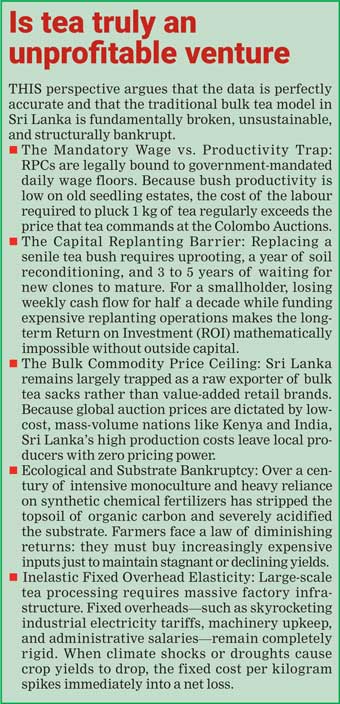
The data tells us the cold corporate truth: as a business, raw bulk tea is a failing model. But the rural reality tells us a different story: as a socio-economic shock absorber, tea has been the only thing keeping rural Sri Lanka afloat. Moving forward, the goal cannot be to keep funding this bare-minimum survival loop; we must aggressively transform the infrastructure so that farmers can actually extract real wealth from their land.
Part II: The data crisis — Why national formulas are blind to the ground reality
However, accepting the "low-profit survival loop" explanation requires us to trust the underlying statistics in the first place. This is where the argument takes a much more alarming turn:
What if our national tea data is fundamentally unscientific and inaccurate?
When we drill down into how agricultural metrics are collected in Sri Lanka, it becomes clear that the "average yield per acre" is an administrative fiction. On the ground, the very unit of measurement—the acre—is treated as a flat, uniform geometric shape. But a tea bush does not care about geographic boundaries; it cares about spacing.
The bush-density mirage: Plants vs. land size
In modern agronomy, what matters is not the raw size of the land, but plant density—the actual number of productive tea bushes packed into that space.
When the Government aggregates data by simply dividing total village output by registered land deeds, it flattens this massive discrepancy. It treats a thriving, high-density matrix of tea clones exactly the same as a half-barren hillside.
The unbelievable variance: 250 kg vs. 1,500 kg
Because the current data structure fails to account for plant density, soil health, and microclimates, it generates an eco-statistical distortion that no universal formula can fix.
Step onto the fields, and the true ground reality reveals a staggering, almost unbelievable variance:
A severely degraded, undermanaged acre on highly acidified soil might yield a miserable 250 kg of green leaves per year. Walk just a few kilometers away to a well-managed block featuring premium soil conservation, optimised shade trees, and high-yielding clones, and that exact same land area can pump out 1,500 kg of green leaves.
This is a 600% variance happening within the same valleys. Attempting to compress this wild spectrum into a single "national average yield" to dictate policy is not just lazy math—it completely distorts the truth. It masks the hyper-profitable farms while failing to pinpoint the dying ones.
The scientific blind spot of the data collection
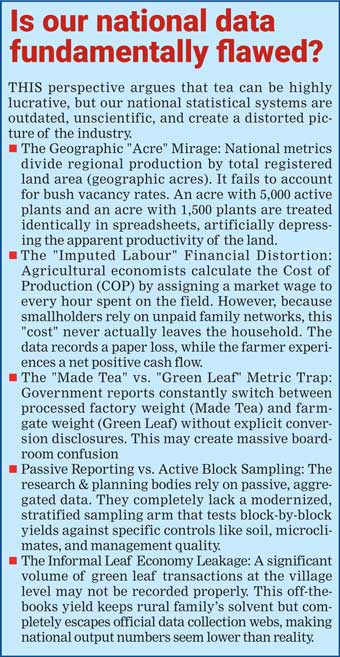
This brings us to the root of the administrative failure: the research and Government planning arms are currently operating without a rigorous, modernised data-collection framework.
To provide policy makers with metrics that actually reflect reality, the TRI cannot rely on passive, self-reported factory returns or broad-stroke regional summaries. True agricultural research requires localised, high-fidelity block sampling methods. Yield data must be scientifically categorised, statistically isolated, and cross-referenced against three strict controls:
1. Climatic Variables: Segmenting data by precise agro-ecological zones (Up-country, Mid-country, Low-country) and tracking localised rainfall and humidity shifts.
2. Substrate (Soil) Integrity: Measuring real-time soil pH, organic matter content, and nutrient depletion levels block-by-block.
3. Management Quality: Grouping data by farming practices—separating fields using mechanical harvesting, systemic weeding, and targeted fertilisation from those left to nature.
If the TRI fails to execute this level of rigorous statistical analysis, any report they publish is just a spreadsheet of assumptions.
The Treasury threat: Siphoning funds on blind targets
When policymakers are fed distorted, flattened data, the solutions they design become fundamentally broken. For years, the Government has set arbitrary national production targets—like aiming for a blanket 360-million-kilogram output—without identifying the micro-level structural truths of the fields. If the Government looks at an inaccurate "average" and decides the remedy is simply to distribute generalised fertiliser subsidies or cheap machinery grants across the board, they are engaging in a dangerous economic gamble.
Without targeted block data, millions of rupees in Government funding are directed toward lands that are biophysically incapable of recovering without intensive soil restoration, while still challenging the results of some high-density, high-potential blocks that have been enhanced with specialised technology. We must restart a broader discussion with a basic formula that farming must be profitable, must provide the best RoI, and competitive advantages whether that’s tea or any other crop.
The core policy mechanism: Incentives only for the market shock absorber
Instead of a permanent, blanket subsidy that breeds long-term dependence, this framework functions as a market shock absorber, conceptually similar to the national bus fare index. The cost of fertiliser is calculated transparently based on Cost, Insurance, and Freight (CIF) plus a Reasonable Profit for Importers (RPI).
To ensure administrative ease and responsiveness to the volatile tea auction market, the formula is executed at a Regional Level (e.g., Low Country, Mid Country, Up Country) or by factory level by the TRI on a quarterly basis. It utilises the Sri Lanka Tea Board’s (SLTB) Quarterly Reasonable Price Average to accurately reflect the smallholder's income.
The backward calculation (A simulation) for Maximum Affordable Price (PF quarterly*)
PF_quarterly* = [ (YQ × PSLTB_Q) - (CQ + ΠQ) × (1 + i)] / QQ
Where:
The subsidy trigger equation
SF = Max(0, PM - PF-quarterly*)
Where SF is the subsidy paid per kg of fertiliser from the Factory-Funded Pool, and PM is the regulated market price of fertiliser (CIF + RPI). RPI=Reasonable profit for Importers
Strategic benefits to the Government and industry
1. Zero Budgetary Burden: The entire subsidy framework may be established at the factory level. The Government acts purely as a regulator and trustee, without dedicating taxpayer funds. The SLTB will act as the chief auditor to ensure funds are funneled cleanly back through the processing factories or any other every quarter based on verified green leaf delivery slips or recorded by the proposed mobile application.
2. Drives Quality and Yield Automatically: The Dual-Tier Leaf Quality Formula (Ran Dalu vs. Coarse): Split the core equation to incentivise quality harvesting. If an estate submits a high proportion of prime "bud-and-two-leaves" (Ran Dalu), their PSLTB-Q will reflect a premium, lowering their calculated fertiliser cost barrier. Conversely, lower-grade coarse leaves will pull a discounted rate, force a lower affordable limit and ensure that the framework explicitly rewards premium agricultural output.
3. Because the formula assumes an optimum yield (YQ), farmers who neglect their fields or produce low-quality leaf will fall below the profit baseline. This implicitly rewards highly productive, quality-focused farmers.
4. Eliminates Political Vulnerability: Fertiliser subsidy pricing ceases to be a political battleground. Price adjustments occur transparently via a math-driven index managed objectively by the TRI and SLTB.
5. Leakage and Misuse Prevention Controls: Added strict guardrails to prevent exploitation. Fertiliser quotas will be legally hard-capped against the farmer's registered acreage and the TRI technical split-application guidelines. Furthermore, factories will disburse the subsidy as either fertiliser or non-transferable fertiliser credit vouchers mapped to the farmer's national identity profile, bank accounts (preferably more than cash payouts).
6. Farmers will be encouraged to increase the productivity and optimise the yield while maximising the profit
If our current data collection remains an unscientific guessing game, blindly throwing money at the tea sector does nothing but siphon scarce funds from the national treasury. Until the Government establishes a powerhouse research arm to publish data-driven, quarterly realities and targeted remedies, we aren't funding an industry—we are funding a blind spot.
(The author is a Digital Agriculture Strategy Expert, a former top agriculture and policy specialist for the Sri Lankan and US governments, is currently leading a number of agriculture sector policy and digitalisation initiatives locally and internationally. His considerable experience combines policy formulation and the use of digital tools to improve efficiency and sustainability in the agricultural sector.)




