Tuesday Sep 22, 2026
Tuesday Sep 22, 2026
Tuesday, 22 September 2026 05:09 - - {{hitsCtrl.values.hits}}
 Every Sri Lankan who has tried to build something knows this story.
Someone has a good idea. A buyer abroad is interested. Then the idea meets the State. One institution is waiting on a clearance from another. A regulation written twenty years ago never imagined this kind of business. Two officers read the same rule in two different ways. Months pass. The buyer places the order in another country.
Ask afterwards who refused, and you will not find anybody. Nobody said no. Nobody had the authority to say yes.
That gap has quietly cost this country more than any of us can calculate.
The door that has now opened
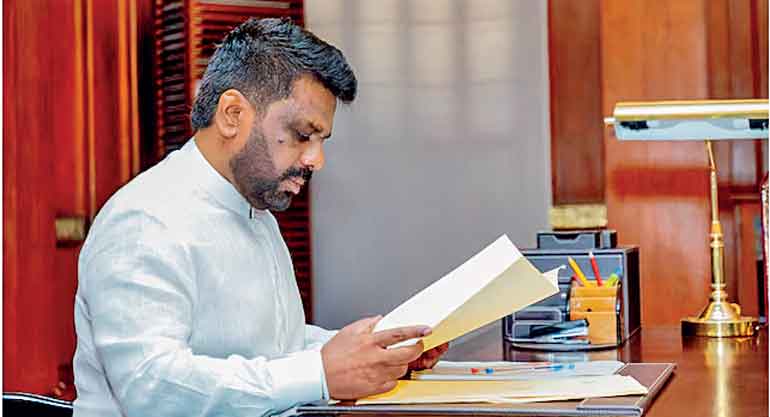
On 22 September the National Business Facilitation Centre begins work at Hector Kobbekaduwa Mawatha in Colombo 7, under the Presidential Secretariat, guided by a National Steering Committee chaired by the Secretary to the President, with ministry secretaries and the heads of institutions around one table.
Officials say it will work in two stages. First it will take on the regulatory, legal and policy problems entrepreneurs run into with State institutions. Later it will offer end to end guidance under a single window, including for people who have capital but no business plan. A website is to follow, so that a person in Ampara or Jaffna can raise an issue without travelling to Colombo.
For months, many of us in industry have been asking for a window. Somewhere a business could say what is holding it back, propose a fix, and have the relevant institutions brought together. The country asked for a window. The President opened a door.
Its position matters. Placing the Centre under the Presidential Secretariat accepts that the problem was never one slow institution. It was that nobody had the standing to make several institutions move together.
Nobody said no. Nobody had the authority to say yes
Why this matters so much
Officials have linked the Centre to the debt repayments that resume in 2028, and that is exactly the right way to see it.
From 2028 the repayments on our restructured foreign debt fall due year after year, and they must be paid in foreign currency. Taxes are collected in rupees. That foreign currency has to come from what Sri Lanka earns or saves from going out.
We have already lived through what happens when a country’s earnings cannot carry its obligations. The queues of 2022 were not caused by a shortage of rupees.
The safest reserve is the foreign exchange a country can keep earning or saving.
So this Centre should never be measured as a convenience for business. Done well, it is the place where the earning capacity of this country is rebuilt, reform by reform and industry by industry. That is the possibility in front of it, and it is the possibility the rest of us must help it reach.
Solve the case, then fix the cause
Complaints from business owners already reach the Presidential Secretariat regularly. Once the country hears that a powerful office has opened specifically to help, that flow will multiply, and a transformative institution could drown in individual grievances within months.
Those problems are real and deserve answers. But if the Centre only settles them one by one, it will be very busy while the country stays exactly where it is. The fifth business will arrive carrying the problem the first business already brought.
So every case should end with two further questions. Why did this happen at all, and how many others is it happening to? Solve the case, and then fix the cause.
When many businesses hit the same wall because of an outdated regulation, two institutions asking for contradictory things, or a rule that never imagined the activity, that is not a complaint. That is a reform waiting to be written.
The form is the filter
The website that is to follow may turn out to be the most important thing the Centre designs in its first month. A form is a filter. Whatever it asks for is what the country will send.
The safest reserve is the foreign exchange a country can keep earning
If it asks only what your problem is, it will receive a hundred thousand problems. A few more questions would bring in what the Centre can act on, in a page or two:
n What is the opportunity, or the problem?
n What exactly is stopping it? Name the regulation, the approval, the conflicting requirement, or the rule that does not exist yet.
n What do you propose instead?
n What does Sri Lanka gain? Foreign exchange earned or saved, investment, employment, technology, local value addition.
n Which institutions have to move for this to happen?
n What do you need from the Centre? Coordination, a clarification, a change of procedure, a policy decision, or permission to run a pilot.
No consultants and no hundred-page reports. A capable person with a real idea can answer that in one evening, and the proposals showing real national value can then be asked for the detail.
Our chambers of commerce, industry associations and professional bodies should set the standard here. Not lists of member complaints forwarded upward, but recurring problems traced to their root and submitted with worked out solutions. A complaint tells the Government that something is wrong. A diagnosis tells it what to do on Monday morning.
The businesses we do not have yet
The Centre should not only make it easier to run the businesses Sri Lanka already has. It should help us find the businesses Sri Lanka does not have yet.
Solve the case, and then fix the cause
Whole industries stay outside a country because its rules were written for an earlier economy. A new activity may need Customs, the BOI, Inland Revenue, the Central Bank and a regulator to look at the same proposal in a new way. No single institution has done anything wrong. Each is applying its own rules correctly. And between them, the opportunity quietly goes somewhere else.
Some of our best opportunities are not short of money. They are short of permission.
So the first question should stop being which institution has jurisdiction. The better question is this. If the activity is legal, safe and good for the country, what do we have to change to make it possible? The day that becomes the Centre’s working habit, facilitation turns into transformation.
What the Centre will owe in return
A proposal that enters the Centre should not disappear into another process. It should have a named officer, a way for the sender to see where it stands, a timeline, and somebody able at the end to say one of three things. Yes. No. Or this is what would have to change to make it possible.
Endless consideration is itself a decision. It tells the investor to try another country.
Success should be counted in rules permanently removed, procedures rewritten and investments actually started, and above all in one question. How much net foreign currency did this reform allow Sri Lanka to earn or save?
A complaint tells the Government that something is wrong. A diagnosis tells it what to do on Monday morning
The rest belongs to us
The Government has done the harder part. It has created a place where an idea belonging to no single ministry can finally be received.
Now chambers must search out systemic bottlenecks. Entrepreneurs must bring opportunities. Professionals and citizens who see what others have missed must write it down clearly and send it in. And officials inside the Centre must meet every sound proposal by asking how it can responsibly be made possible.
Imagine where this can take us. A Sri Lanka where a good idea moves from proposal to operation in weeks. Where the dollars that repay our debt are earned by industries that did not exist in 2026. A country that borrows its way forward will always live at somebody else’s convenience. A country that learns to earn its way forward decides its own future. That is what this door is for.
Some of our best opportunities are not short of money. They are short of permission
(The author, CEng FIMechE FIET (UK) CEng FIE (SL), is Founder and Chairman of the KIK Group of Companies, an export-oriented engineering and switchgear manufacturer and a Presidential Export Award winner, and serves on the Executive Committee of the Free Trade Zone Manufacturers’ Association of Sri Lanka. The views expressed are his own. He can be reached at [email protected].)
A country that learns to earn its way forward decides its own future
Recent columns
COMMENTS




