Friday Nov 06, 2026
Friday Nov 06, 2026
Friday, 6 November 2026 00:21 - - {{hitsCtrl.values.hits}}
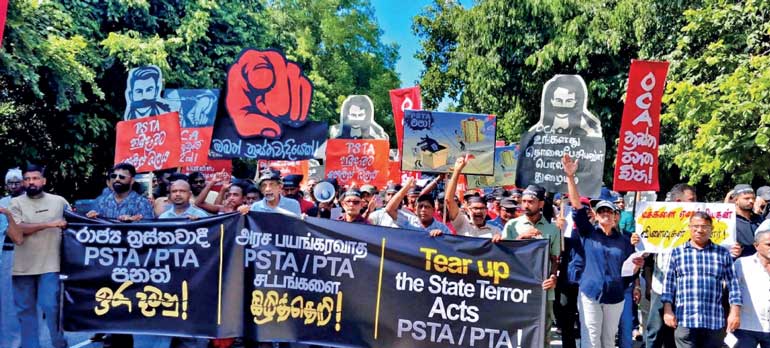
A public protest against the proposed PSTA and POCA
 The National People’s Power (NPP) Government has Gazetted two Bills ostensibly intended to replace the Prevention of Terrorism (Temporary) Act (PTA), enacted in 1978—nearly five decades ago—despite the word temporary in its title. The repeal of the PTA has long been regarded by local and international human rights and democratic activists as imperative for the establishment of democratic governance and the rule of law. Nevertheless, successive Governments since 1978 have refused to repeal it. Moreover, the PTA has been extensively deployed to suppress and oppress political opponents. The NPP Government, which came to power promising to repeal the Act, has itself resorted to its provisions over the past two years to harass potential political opponents.
The Government has now taken steps to fulfil its promise of repealing the PTA, only to propose replacing it with two equally if not more draconian pieces of legislation: the Protection of the State from Terrorism Act (PSTA) and the Prevention of Organised Crime Act (POCA).
These two Bills would provide the Government with greater coercive powers under the guise of protecting the state and preventing organised crime. Lawyers, democratic and human rights activists, and international organisations have demonstrated in considerable detail how the enactment of these bills would undermine citizens’ rights. The focus of this note, however, is not on their legal ramifications. Rather, it seeks to examine their political-economic dimensions.
Political economy posits that understanding a phenomenon requires situating it within its broader social, economic, and political context. What explains the NPP Government’s decision to introduce a new set of draconian laws despite its electoral promise to abolish such existing legislation? Could the Government continue to function without these laws? Or is their enactment intrinsically connected to the Government’s broader socioeconomic policies? This article seeks to examine these and other related questions.
Towards the concentration of power
In the current discourse, two principal, though closely related, explanations have emerged.
The first explanation draws on a foundational concept in the social sciences: the self-reinforcing feedback loop. This concept suggests that once an individual or collective acquires power, it also gains access to resources and institutional mechanisms that can be mobilised to accumulate still more power. Hence, the familiar saying that “power begets power.”
The Janatha Vimukthi Peramuna (JVP), the core political force within the NPP, was established approximately six decades ago. For the first time in its history, it has acquired the opportunity to exercise state power and control and manage resources and Governmental mechanisms that have long been affected by multiple forms of corruption. Historical experience, particularly in the Global South, provides ample evidence of the concentration of power and resources in the hands of a small political elite.
The second explanation relates the proposed legislation to the ideological history of the JVP. Proponents of this view argue that the JVP’s ideological orientation essentially favours a totalitarian or authoritarian state, drawing inspiration from models associated with either Hitler or Stalin. According to this interpretation, the proposed legislation reflects an essentially undemocratic political project aimed at defending the regime rather than merely enriching particular individuals or groups. Nevertheless, the distinction between a model of individual or group enrichment and one of regime preservation is not fundamental. As international experience demonstrates, the transition from one to the other can be relatively easy.
In defending the Government’s intentions, NPP leaders repeatedly emphasise that their Government has so far refrained from using excessive force in dealing with protests and demonstrations against it. They therefore present the proposed legislation as essentially precautionary measures rather than instruments intended for immediate use. However, two fundamental features must be present in any counterterrorism legislation if it is to possess legal and moral legitimacy.
First, the legislation must be clear and precise, leaving little room for arbitrary interpretation or misuse. Yet the definition of terrorism in the proposed legislation is excessively broad.
Second, counterterrorism legislation must incorporate effective safeguards for freedom of expression, peaceful assembly, association, religion or belief, and participation in public affairs. Any restrictions on these rights must be lawful, necessary, and proportionate to a legitimate objective.
The two proposed bills appear to fail these tests. As international human rights organisations have demonstrated, the PSTA, together with the POCA, seeks to impose “unjustified restrictions on freedoms of expression, including media freedom, peaceful assembly and association, despite the new safeguards in sections 3 (4), 8 (2), 10 (3) and 11.”
The former Chief Justice, former and incumbent presidents of the Bar Association of Sri Lanka, and other distinguished legal professionals have also pointed out that many provisions of the proposed legislation are imprecise and excessively broad. Such provisions could potentially allow even routine and innocent media reporting to be categorised as an act of terrorism.
Austerity and authoritarianism
The Italian political economist Clara E. Mattei has drawn attention to the nexus between the concentration of political power and the imposition of austerity policies. In 2017, Mattei first developed this argument in her article, “Austerity and Repressive Politics: Italian Economists in the Early Years of the Fascist Government,” published in The European Journal of the History of Economic Thought. She subsequently elaborated on the argument in her book The Capital Order: How Economists Invented Austerity and Paved the Way to Fascism.
Mattei’s central argument is that austerity is not merely a technical economic policy but also a political instrument for protecting capitalism and suppressing working-class challenges to the existing social order. To preserve and protect what she calls the capital order, painful measures must be imposed, supported by carefully designed instruments of political power.
For example, the Central Bank of Sri Lanka (CBSL) Governor Dr. Nandalal Weerasinghe has reportedly argued that the “correct” policies should have been adopted even if they ran counter to the wishes of the people. This position resonates with the views expressed by former Chair of the US Federal Reserve System Jerome Powell. Powell argued that, in order to “restore price stability,” economic policymakers must use their instruments “forcefully,” acknowledging that doing so “will also bring some pain.” The pain, in this formulation, is to be borne by those held responsible for inflation, particularly those who are consuming too much and working too little.
The former Chair of the US Federal Reserve and the present CBSL Governor, thus appear to articulate a similar position: corrective economic measures must be implemented even when they impose considerable hardship on the population.
But what happens when such measures encounter resistance? If opposition emerges from the lower strata of society, the necessary political and institutional precautions must be taken to ensure their implementation.
Authoritarian political power can facilitate the implementation of austerity by suppressing resistance from workers and other popular groups. Mattei argues that, “in the Italian case, Fascism and austerity reinforced one another: Fascism provided the coercive political conditions for austerity, while austerity helped restore capitalist social relations”.
According to Mattei, repressive legislation, an empowered executive, and a subservient judiciary are not necessarily isolated institutional developments. They can form part of a broader political project directed towards the implementation of austerity policies, including cuts in public expenditure on health and education, reductions in social security, and the dismantling of the remaining institutions of the social welfare order.
From this perspective, the proposed PSTA and POCA should not be examined solely as counterterrorism or crime-prevention measures. They must also be situated within the broader political economy of the NPP Government’s economic program designed, developed and backed by the International Monetary Fund.
The critical question, therefore, is whether the concentration of coercive power and the implementation of austerity are mutually reinforcing processes in contemporary Sri Lanka, as Mattei’s historical analysis suggests. If so, the proposed legislation may represent not merely an attempt to strengthen the State’s capacity to maintain law and order, but also an effort to establish the political conditions necessary for restructuring the existing social order in favour of capital.
(The author is a retired teacher in economics and could be reached via email [email protected])




