Thursday Oct 22, 2026
Thursday Oct 22, 2026
Wednesday, 18 March 2026 00:30 - - {{hitsCtrl.values.hits}}
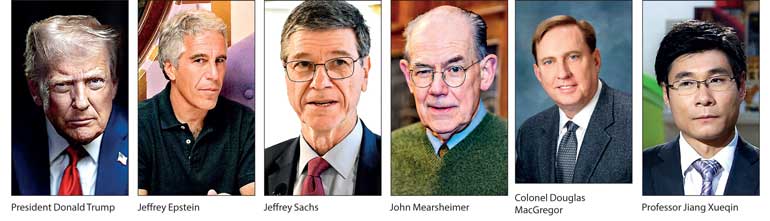
 The United States finds itself ensnared in a perfect storm of its own making: a debilitating war in Iran, a transatlantic alliance on life support, and the quiet unravelling of the financial mechanism that has underpinned its global dominance for fifty years. The root cause, argue a growing chorus of strategic thinkers, is not incompetence, but a fundamental capture of foreign policy by interests that are profoundly at odds with American national security and economic stability
In the corridors of Washington and the trading floors of London, a disturbing question is gaining currency: Is the world’s sole superpower being steered toward disaster by forces it can no longer control? The year 2026 has unleashed a cascade of crises—a hot war with Iran, a cold war with NATO allies, and the selective unsealing of the Epstein files—that point to a deeper, more systemic breakdown.
This is not merely a story of geopolitical miscalculation. It is a story of a ruling elite held in place by mutually assured vulnerability, a currency weaponised into decline, and a strategic vacuum filled by messianic ideology. Four analysts who have long been considered fringe voices in the establishment—Jeffrey Sachs, John Mearsheimer, Douglas MacGregor, and Professor Jiang Xueqin—now find their bleak assessments adopted as the most plausible explanation for the chaos.
The Epstein Files: The architecture of coercion
The long-awaited release of documents related to Jeffrey Epstein was supposed to be an exercise in transparency. Instead, it has become a primer on the architecture of power. The Epstein Files Transparency Act, signed in late 2025, has yielded millions of pages, yet the pattern of disclosure has raised more questions than it has answered. As The Wall Street Journal reported, key witness statements concerning a current president were withheld, while others were published. The impression, as one analyst put it, is of “editorial judgment applied to a federal transparency mandate.”
This has fuelled a more unsettling hypothesis: that the Epstein network was less a paedophile ring and more an industrial-scale intelligence operation. The collection of compromising material—kompromat—on politicians, royals, and business leaders from both sides of the Atlantic created a parallel system of leverage. As retired US Lieutenant Colonel Earl Rasmussen noted, the files may represent a “tool of political blackmail,” a shadowy ledger of debts and vulnerabilities that now dictates policy.
The implication for global markets and foreign policy is profound. If key decision-makers are compromised, then the rationale for the war in Iran, the fracture with Europe, or the sudden lurch toward protectionism may have less to do with national interest and more to do with the personal survival of the compromised. It suggests a system where policy is a symptom of coercion, not a product of strategy.
The Sachs doctrine: The cost of a captured state
For economist Jeffrey Sachs, the current war with Iran is the bloody culmination of a thirty-year-old plan. He points to the 1996 “Clean Break” strategy, crafted for the Israeli government, which advocated for the overthrow of states opposing Israeli hegemony. “The US objective is not the security of the American people,” Sachs argues. “It is global hegemony, pursued through the destruction of international law.” The 2018 withdrawal from the Iran nuclear deal, followed by the bombing of Iranian facilities amidst negotiations in 2025, fits a pattern of duplicity. “America never negotiates, it only deceives,” he states bluntly.
Sachs’s most searing critique, however, is reserved for the economic capture of the state. He points to the American Israel Public Affairs Committee (AIPAC) not as a lobby, but as a transactional anomaly. “A few hundred million dollars in campaign funding buys tens of billions in US military and diplomatic support. Congress sells itself very cheaply.” This, he argues, has led to a policy that benefits a specific special interest while accelerating the decline of the dollar’s global supremacy. By weaponising the currency against rivals, the US has “destroyed trust” in it, making a multipolar financial system inevitable.
The Mearsheimer thesis: The tail wagging the dog
John Mearsheimer, the doyen of offensive realism, sees the Iran war as a tragic validation of his once-heretical thesis on the power of the Israel lobby. He cites the collapse of negotiations with Iran, where US envoy Steve Witkoff was initially open to a deal but was forced to backtrack after pressure from Tel Aviv. “This apparent friction between Trump and Netanyahu is a performance,” Mearsheimer contends. “There is no sign he is willing to stand up to the lobby.”
The confirmation of this dynamic came from an unlikely source: Secretary of State Marco Rubio, who admitted the US attacked Iran because Israel was about to. For Mearsheimer and his co-author Stephen Walt, this was the very argument that cost them academic credibility two decades ago. Today, it is official policy. Mearsheimer views this as the triumph of ideology over strategy, a “messianic core” driving a policy that offers zero strategic benefit to the United States.
The MacGregor warning: The military-industrial disconnect
From a military perspective, retired Colonel Douglas MacGregor offers the grimmest assessment. He argues that the campaign against Iran is a strategic impossibility. “Iran’s goal is survival. The US would need to completely conquer the nation, which is impossible.” The cost is staggering, with interceptor missiles priced at over $2 million attempting to neutralise Iranian drones that cost $50,000. This is not just an economic asymmetry; it is a sign that the US military is designed to fight 20th-century wars.
MacGregor warns that the US and Israel are “fighting against the future.” The future is a multipolar world where economic power is diffusing. He points to the quiet diversification of US military logistics away from Gulf states, the inevitable rise of oil prices above $100, and the accelerating de-dollarisation by BRICS nations. “True believers with nuclear weapons,” he warns, “are the most dangerous people on earth.”
Professor Jiang’s framework: A war on the global economy
Professor Jiang Xueqin provides the connective tissue between the battlefield and the balance sheet. His analysis frames the Iranian strategy not as a military campaign, but as an economic war of attrition against the American empire. “The Iranians have been preparing for 20 years,” Jiang explains. “They are waging war against the entire global economy.”
By targeting Gulf energy infrastructure and threatening water desalination plants, Iran is putting pressure on the Gulf States—the linchpin of the petrodollar system. Jiang explains the “petrodollar reflux”: Gulf states sell oil for dollars, then recycle those dollars into American assets, particularly the tech and AI sectors. “If the Gulf States are no longer able to sell oil, they cannot finance the AI bubble,” he argues. “And if that bubble bursts, the American economy, which is really a financial Ponzi scheme, collapses.” In this view, the war is not about nuclear weapons; it is about severing the financial oxygen supply to American hegemony.
The fracturing of the alliance and the Dollar
The military and economic strains are now mirrored in the political sphere. President Trump’s threats to acquire Greenland by force have pushed NATO to the breaking point. Spanish Prime Minister Pedro Sánchez has called any such move “the death knell of NATO,” and is now advocating for a truly European defence force. For the Kremlin, it is a gift. The post-1945 order, where the US guaranteed European security, is over. When the guarantor threatens to invade a member, the alliance becomes a protection racket.
All of this is happening against the backdrop of the petrodollar’s “last stand.” With US national debt at $38.4 trillion and foreign central banks quietly diversifying their reserves, the infinite loop that funded American power is unwinding. The dollar’s temporary spike due to war is a “dead cat bounce.” The real story is the pivot to gold, now above $5,000 an ounce, and the search for alternatives by Saudi Arabia and China.
Apocalypse or adaptation?
The forces of strategic realism—embodied by analysts like Mearsheimer and MacGregor, the “America First” grassroots who feel betrayed, and European leaders seeking autonomy—are arrayed against a messianic vision that views Middle Eastern war as a necessary prophecy. The question for investors and policymakers is no longer whether the unipolar moment is over, but how the transition to a multipolar world will occur.
Sachs argues the US cannot achieve hegemony. Mearsheimer warns that great powers decline when they forget what they are competing for. MacGregor insists the future will win. Jiang sees the “aura of invincibility” punctured.
The Epstein files have laid bare the system of blackmail that may be driving the ship. The war in Iran is burning through the last of America’s financial and moral capital. The petrodollar is in its death throes. The choice, as framed by these analysts, is not between victory and defeat, but between a graceful adaptation to a multipolar reality and a catastrophic attempt to resist it that could end in global fragmentation. The warnings have been sounded. The market, as always, will be the final arbiter.
(The author is a doctoral candidate specialising in trade economics and a strategic business analyst with extensive experience in international markets, including Russia and Asia. His research, which includes over 11 published papers, often focuses on how nations can navigate complex international systems and sanctions)




