Saturday Nov 07, 2026
Saturday Nov 07, 2026
Saturday, 7 November 2026 00:00 - - {{hitsCtrl.values.hits}}
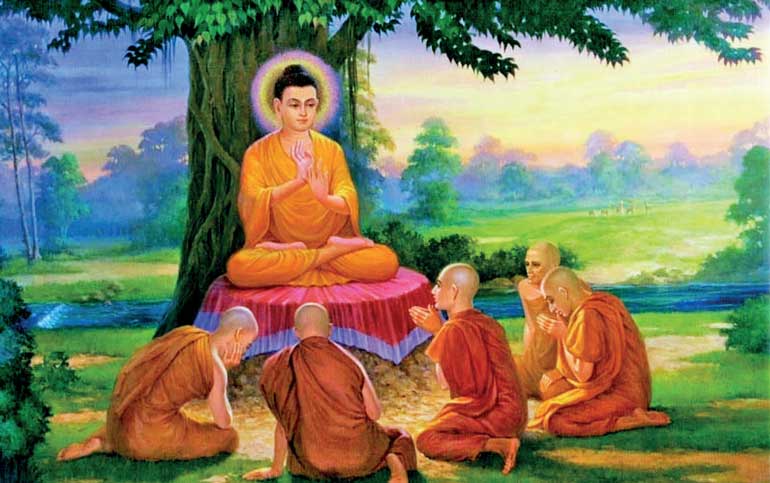
The Buddha's first sermon
 My article, Beyond the Robe: Sangha, Rule of Law and Monastic Accountability, (https://www.ft.lk/columns/Beyond-the-robe-Sangha-rule-of-law-and-monastic-accountability/4-799100), published on Saturday, 24 October examined the relationship between Buddhist monastic discipline, institutional responsibility and the rule of law. Subsequently the Daily FT reported that the United National Party (UNP) has "demanded" an immediate Presidential pardon for Ven. Galagodaaththe Gnanasara Thera (https://www.ft.lk/news/UNP-demands-immediate-presidential-pardon-for-Gnanasara-Thera/56-799219). This would be the second Presidential pardon, that the UNP will be associated with. However, it is about a previous pardon that has been invalidated by the Supreme Court. This presents a further opportunity to elaborate upon what I referred to in the previous article. That is: How might the ethical principles of Buddhism guide political advocacy and the exercise of public power?
Respect for judiciary, principle and BASL
The issue is not whether compassion should be extended to an individual who has been imprisoned. It is whether compassion, accountability, constitutional governance and respect for the judiciary can be pursued together, without allowing political allegiance or religious identity to displace principle. I have not seen any audio or video podcast, Youtube interview, a speech, or statement, from the Bar Association (BASL), to guide political parties, in much the same manner they did with regard to the 22nd Amendment, even writing to urge Parliamentarians to vote with their conscience.
As for my thoughts of Saturday, 24 October, while I did not think they required further elaboration, perhaps they do. Thus this writing. But first let me reproduce several key points I articulated in my previous article. These were that:
The issue is bigger than one monk: The controversy is not merely about one individual, one prison decision or one robe; it concerns the relationship between the State, the Sangha, the Constitution and the administration of justice.
The robe deserves respect, but it does not confer immunity: The robe represents renunciation, discipline and commitment. Its significance calls for sensitivity, not exemption from the law.
Criminal liability and monastic status are different matters: A criminal court determines guilt and imposes punishment; the appropriate ecclesiastical authority determines questions of monastic discipline and status.
The State must act lawfully, even with religious institutions: Neither religious identity nor the authority of the State should be used to bypass the Constitution, applicable laws or fair procedures.
The autonomy of the Sangha must be respected: Questions of monastic discipline and status belong within the appropriate ecclesiastical processes, not automatically to political authorities or prison administrators.
Autonomy must go hand in hand with accountability: Religious institutions, like professional bodies and other institutions exercising authority, need credible procedures to investigate allegations, consider evidence and reach fair decisions.
Allegations must be investigated, not presumed: A monk should not be prejudged, but neither should serious allegations of misconduct through words or deeds be dismissed merely because the person wears the robe.
Advocacy must not become intimidation or interference: Religious leaders and public officials may make representations and express reasoned views, but public pressure should never become a substitute for lawful processes or judicial proceedings.
Institutional independence requires safeguards: Intimidation, improper influence and conflicts of interest are legitimate governance risks to examine. Their existence, however, must be established by evidence, not assumed.
Respect and accountability strengthen each other: The dignity of the Sangha is best protected through integrity, compassion, restraint and credible self-discipline—not by placing individuals or institutions beyond scrutiny.
The Noble Eightfold Path - a guide to public conduct
The Noble Eightfold Path is the Buddha's framework for the development of wisdom, ethical conduct and mental discipline. Although traditionally directed towards the cessation of suffering and spiritual development, its ethical principles also offer a valuable framework for reflection on public conduct. Applied thoughtfully to public life, it invites us to examine not only what we seek to achieve, but also our intentions, words and actions.
Right Understanding -
Traditionally, this means understanding the Four Noble Truths. In public life, it also calls for an informed and considered appreciation of the facts, the law and the likely consequences of a demand or decision.
Right Intention – Traditionally, this encompasses renunciation, freedom from ill will and harmlessness. Applied to public conduct, it requires principled motives guided by compassion, fairness and goodwill rather than vengeance, self-interest, political bias or the pursuit of partisan advantage.
Right Speech – This requires abstaining from false, divisive and harsh speech, as well as irresponsible or idle talk. In public life, it calls for truthfulness, restraint and care over the consequences of our words.
Right Action – Traditionally, this requires abstaining from taking life, taking what is not given and sexual misconduct. More broadly, it reminds us that our conduct must be ethically responsible and respectful of the rights of others.
Right Livelihood – This calls for earning one's living through honest and ethical means. Applied to public life, it reminds us that professional and public responsibilities should be exercised with integrity.
Right Effort – This involves preventing unwholesome qualities from arising, abandoning those that have arisen, cultivating wholesome qualities and sustaining their development. In public life, it encourages the consistent practice of ethical conduct and the correction of harmful behaviour.
Right Mindfulness –
Traditionally, this involves mindful awareness of the body, feelings, mind and mental phenomena. In public conduct, it also encourages awareness of our emotions, prejudices and impulses before they influence our decisions and actions.
Right Concentration – This concerns the cultivation of a disciplined and focused mind through meditation. Its wider application to public life may be seen in the value of disciplined, considered judgement and the ability to withstand pressure, and distractions, leading to impulsive reactions, provocation and political expediency.
These are contemporary explanations intended to make the principles accessible to public discussion, not substitutes for their traditional Buddhist meanings. Their application to politics is nevertheless instructive: ethical consistency must be judged not merely by the cause one supports, but also by the motives, words and methods through which that cause is pursued.
Monastic discipline: Conduct through word and deed
As I mentioned in my previous writing, the robe carries moral significance because of the religious vocation and discipline it represents. That significance is sustained by conduct, not by appearance alone. The relevant Nikaya and its governing authorities have an important responsibility to address allegations of monastic misconduct, whether arising from words or deeds, through appropriate, impartial and credible procedures consistent with applicable Vinaya principles and institutional rules.
Responsible advocacy and right intentions
I referred also to the importance of responsible advocacy in my article of Saturday, 24 October. Let me now expand on this. In a democracy, political parties are entitled to advocate clemency, make representations to the President and question decisions they consider unjust. Demands for a further presidential pardon should therefore be assessed with care and without assuming, in the absence of evidence, that the demand itself constitutes unlawful interference or establishes an improper motive.
Compassion or pursuit of partisan advantage
The Noble Eightfold Path nevertheless invites political leaders to examine the principles underlying their advocacy. Is the position grounded in compassion, fairness and the public interest? Is it consistent with principles applied in comparable cases? Does it acknowledge the interests of justice and the authority of the courts? Or might it be influenced by self-interest, political bias or the pursuit of partisan advantage?
Advocacy should inform rather than inflame
Right Speech is equally relevant. The medium, tone and methods of advocacy should be consistent with the Buddhist values being invoked: truthfulness, restraint, non-harm, compassion and respect for lawful institutions. Advocacy should inform rather than inflame, persuade rather than intimidate, and challenge decisions through responsible argument rather than personal vilification. These standards apply equally to political parties, religious authorities, public officials and citizens. They do not prohibit disagreement or compassionate appeals. They ask that the means adopted should be ethically consistent with the ends sought.
Constitutional responsibility
The demand for a second pardon also raises a question distinct from the ethical merits of political advocacy: what does the Constitution and the relevant judicial determination permit?
The Supreme Court’s decision invalidating the earlier pardon has made the constitutional context especially important. The UNP has stated that the ruling does not necessarily preclude a further pardon. That proposition must be considered in the light of the actual judgment and applicable constitutional requirements; it should not be accepted or rejected merely on the strength of a political statement. The distinction matters. A demand for clemency is not itself proof of illegality. Equally, compassion for an individual does not remove the need for a lawful and properly considered exercise of constitutional power. The legitimacy of any further decision depends on the governing law and the relevant facts, not simply on the strength of public pressure or the status of the person concerned.
World Buddhist Sangha Council’s 60th Anniversary
Here is an opportunity for wider Buddhist reflection, I thought. I noticed a news item about a preparatory meeting being held at the Presidential Secretariat on 26 October, chaired by senior representatives of the World Buddhist Sangha Council and the Secretary to the President, to review arrangements for its 60th anniversary celebrations and 11th General Conference, to be hosted in Sri-Lanka. The conference will take place from 28 November to 2 December 2026, commencing at the Nagananda International Institute for Buddhist Studies in Kelaniya, under the patronage of President Anura Kumara Dissanayake. Events are also planned for Anuradhapura and Kandy. More than 600 delegates are expected, including Buddhist monks from around the world, approximately 250 Sri Lankans living overseas and 250 Sri Lankan Buddhist monks.
A comparative discussion
Sri Lanka’s Buddhist institutions and political leaders could use the controversy about the robe, the demands for pardon, as an opportunity for broader reflection at this conference. If its program and arrangements permit, a comparative discussion could examine how different Buddhist traditions address allegations of misconduct, disciplinary inquiries, institutional independence and the relationship between monastic status and criminal accountability. Such a discussion should not seek to adjudicate an individual Sri Lankan case or impose a uniform disciplinary code on diverse traditions. Its purpose would be to exchange experience, identify sound practices and explore how the Sangha can preserve both its legitimate autonomy and the public trust on which its moral authority depends.
The test is consistency of principle
The Noble Eightfold Path does not provide a shortcut to resolving constitutional disputes, nor should Buddhist teaching be used selectively to legitimise a preferred political outcome. Its contribution is more fundamental: it asks individuals and institutions to examine their intentions, conduct and responsibilities with honesty. A monk’s robe should not confer immunity from accountability. Equally, a monk’s conviction should not justify hostility towards Buddhism or the Sangha as a whole. Political advocacy for clemency is legitimate within the democratic process, but its ethical quality depends on the principles and methods employed. Any Presidential decision must, in turn, satisfy the applicable constitutional requirements.
Ultimately, the question is not simply whether we support or oppose a particular pardon. It is whether we apply the same standards of compassion, fairness, accountability and lawful conduct when the individual concerned is someone we admire, someone we oppose, or someone whose cause offers political advantage. That is a test not only for the monk or the politician, but for all of us. It is also an opportunity to demonstrate that Buddhist ethical principles can inform public life without displacing the rule of law.



