Tuesday Sep 29, 2026
Tuesday Sep 29, 2026
Tuesday, 29 September 2026 02:36 - - {{hitsCtrl.values.hits}}
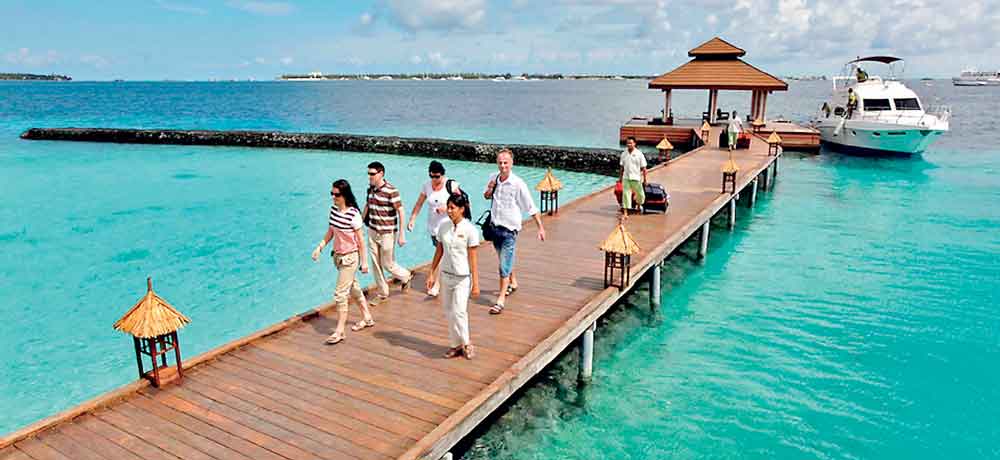
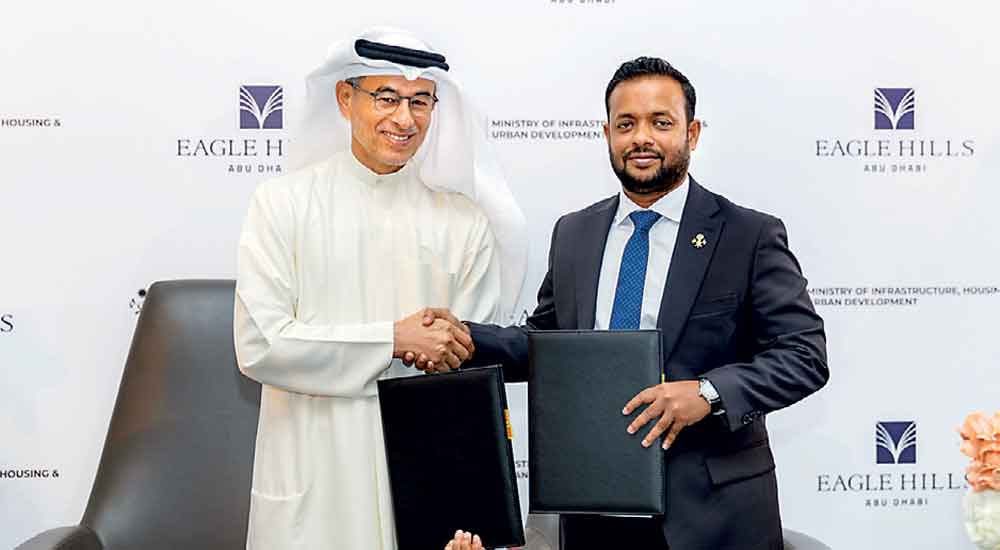
Abu Dhabi-based developer Eagle Hills recently signed a commercial terms agreement with the Maldives Government for a waterfront and marina development valued at around $12 billion across multiple phases. Here Eagle Hills Chairman Mohamed Alabbar and Maldives Infrastructure, Housing and Urban Development Minister Abdulla Muththalib exchange the agreements signed
 If a nation of barely half a million people can contemplate development on this scale, Colombo should ask why a much larger and more diversified economy struggles to attract comparable ambition
 There is a number that policymakers in Colombo should contemplate carefully: $ 20 billion. The Government of the Maldives has agreed commercial terms with Eagle Hills, the UAE based real estate investment and development company, for the proposed Maldives Waterfront and Marina at Ras Malé. The project has an indicative development value of approximately $ 20 billion across its planned phases. That number requires an important qualification. It is not $ 20 billion of committed foreign direct investment arriving in the Maldives tomorrow. Nor is it a disclosed upfront capital commitment by Eagle Hills. It is the indicative development value of a project whose eventual scale will depend on master-planning, financing, approvals and execution. But dismissing the announcement on those grounds would miss the much more interesting point. A country with barely half a million people is attempting to conceive, package and deliver an urban development proposition measured in tens of billions of dollars.
Lesson Colombo most needs to study
Sri Lanka should be asking why it finds this so difficult. The comparison is uncomfortable because Sri Lanka does not lack assets. If anything, it possesses them in abundance. It has more than 20 million people, a substantial educated workforce, a position beside one of the world’s busiest maritime corridors, major ports, established manufacturing capabilities, extraordinary tourism assets and proximity to India, one of the world’s largest and fastest growing major economies. The Maldives has far less land, a tiny domestic market, acute climate vulnerability and an economy unusually dependent on tourism. Yet the Maldives has repeatedly demonstrated an ability to turn scarcity itself into an investment proposition. That may be the lesson Colombo most needs to study.
Ras Malé is not simply being presented as another luxury resort. The country’s largest land reclamation initiative is intended to become an extension of the capital region and part of the answer to one of the Maldives’ most persistent social problems: overcrowding and housing scarcity around Malé. The Government has set out a zero carbon, safe island vision for the new city. Its 2026 Family Housing program provides for 15,000 land plots at Ras Malé.
 The Government of the Maldives has agreed commercial terms with Eagle Hills, the UAE based real estate investment and development company, for the proposed Maldives Waterfront and Marina at Ras Malé. The project has an indicative development value of approximately $ 20 billion across its planned phases
Maldives Waterfront and Marina at Ras Malé
The proposed waterfront development would sit within that larger urban plan, adding homes, hotels, a marina, retail, leisure, education, healthcare, public spaces and other community infrastructure. Preliminary project estimates point to more than 54,000 direct and indirect employment opportunities, more than one million annual visitors and more than $ 2 billion in annual tourism revenue at full maturity. Those numbers are projections, not outcomes, and should be treated accordingly. But the numbers are less interesting than the architecture behind them.
The Maldives is attempting to connect housing policy, climate adaptation, tourism, urban development, international capital and economic diversification within a single investable proposition. Sri Lanka too often treats these as separate Government files. That distinction matters enormously to international capital. Investors do not invest in potential in the abstract. They invest in propositions.
They need land, legal rights, infrastructure, approvals, commercial logic, credible counterparties and reasonable confidence that the rules governing an investment today will still exist tomorrow. An island is not an investment proposition. A port is not an investment proposition. A beach is not an investment proposition. Even a strategic location is not, by itself, an investment proposition. Each becomes economically valuable only when the State turns the underlying asset into something investors can understand, price, finance and execute. The Maldives has understood this for decades.
The Maldives is attempting to connect housing policy, climate adaptation, tourism, urban development, international capital and economic diversification within a single investable proposition. Sri Lanka too often treats these as separate Government files. That distinction matters enormously to international capital. Investors do not invest in potential in the abstract. They invest in propositions
Its resort economy was built by converting individual islands into clearly defined economic propositions. Investors could obtain long duration rights, develop internationally marketable resorts, bring in global brands and sell to a worldwide customer base. The model has its shortcomings, but international capital understood it. Ras Malé represents an attempt to apply a version of that logic on a much larger urban canvas. There is also an established economic machine behind the proposition. The Maldives welcomed its millionth tourist of 2026 in June and is targeting 2.5 million arrivals for the year. Tourism therefore provides an existing international customer base against which developers can model hotels, residences, restaurants, marinas, retail and leisure infrastructure.
Colombo Port City
Sri Lanka, intriguingly, has a substantial visitor economy of its own. It recorded about 2.36 million tourist arrivals in 2025. So, the explanation cannot simply be that the Maldives has tourism and Sri Lanka does not. Nor can it be that Sri Lanka is incapable of conceiving developments of comparable scale. Colombo Port City proves otherwise. The 269-hectare reclaimed development beside the capital has received roughly $ 1.4 billion in enabling investment and is envisaged as a much larger development over time. It now has dedicated legislation, a special economic zone framework and a single window mechanism intended to reduce the friction faced by investors. Indeed, the similarities between Port City and Ras Malé make the comparison more revealing. Both involve reclaimed land. Both seek international capital. Both envisage mixed use urban districts. Both seek to create economic activity beyond their countries’ traditional industries. And both depend ultimately on whether Governments can transform engineered land into functioning economic ecosystems. The question for Sri Lanka, therefore, is not whether it can produce a multibillion-dollar vision. It is whether it can repeatedly convert vision into transactions.
FDIs into Sri Lanka
There has been progress. Sri Lanka’s Board of Investment reported foreign direct investment inflows of $ 1.057 billion in 2025, an increase of 72% from the previous year. Manufacturing accounted for 46% of those inflows, port development 26% and tourism and leisure 11%.
That recovery deserves recognition, particularly after the extraordinary economic dislocation surrounding the country’s 2022 sovereign default.
An island is not an investment proposition. A port is not an investment proposition. A beach is not an investment proposition. Even a strategic location is not, by itself, an investment proposition. Each becomes economically valuable only when the State turns the underlying asset into something investors can understand, price, finance and execute. The Maldives has understood this for decades
Yet the composition of the number is revealing. Of the $ 1.057 billion received in 2025, only $ 134 million came from new projects contracted with the Board of Investment during the year. The remaining $ 923 million came from expansions and capital injections into existing operations. Existing investors committing more money to Sri Lanka is encouraging. It suggests that companies already familiar with the country continue to see opportunities. But an economy seeking structural transformation needs something more. It needs a continuous pipeline of new global companies willing to make large, long duration commitments involving capital, technology, management expertise and international networks. This is where the Maldives comparison becomes useful. Foreign capital does not necessarily choose the country with the greatest objective potential. It often chooses the country that makes its potential easiest to understand, price and execute.
Sri Lanka’s difficulty has rarely been imagining what it might become. For decades it has produced plans for tourism zones, industrial parks, logistics hubs, financial centres, technology cities, export zones, marinas and urban developments. Governments change. Ministries change. Regulations change. Tax regimes change. Project priorities change. Investors are then expected to rediscover the country and renegotiate the state. Capital remembers institutional inconsistency longer than politicians do.
Fundamental difference
Sri Lanka’s sovereign default inevitably compounded this problem. Rebuilding credibility after an economic crisis takes time. No serious comparison with the Maldives should pretend otherwise. But macroeconomic stabilisation alone will not produce transformational investment. There is a fundamental difference between becoming stable and becoming investable. Stability is the foundation. Investability is an institutional product. It requires predictable taxation, enforceable contracts, transparent procurement, credible land policy, efficient approvals, functioning infrastructure and Government institutions capable of making decisions within commercial timeframes. Most importantly, investors need confidence that an agreement reached with the state is an agreement with Sri Lanka, rather than merely with whichever administration happens to occupy office.
Sri Lanka's Board of Investment reported foreign direct investment inflows of $ 1.057 billion in 2025, an increase of 72% from the previous year. That recovery deserves recognition, particularly after the extraordinary economic dislocation surrounding the country's 2022 sovereign default. Yet the composition of the number is revealing. Of the $ 1.057 billion received in 2025, only $ 134 million came from new projects contracted with the Board of Investment during the year. The remaining $ 923 million came from expansions and capital injections into existing operations
Sri Lanka’s pivotal position
There is another lesson from the Maldives. Small states can sometimes move faster precisely because they are small. Malé cannot offer investors Sri Lanka’s domestic market, workforce or industrial depth. It therefore has to sell clarity, speed and scarcity. A parcel of reclaimed waterfront is not presented simply as land. It becomes part of a national growth proposition tied to tourism demand, housing requirements, infrastructure and international capital. Sri Lanka frequently does the reverse. It possesses genuinely scarce assets and then surrounds them with administrative complexity. Consider what an international investor sees. Sri Lanka sits immediately beside India. Colombo occupies a pivotal position on the main east west maritime route. The country has established apparel manufacturing, ports, tourism, renewable energy potential and a substantial professional workforce. It also possesses something increasingly valuable in crowded Asia; extraordinary physical diversity compressed into a relatively small territory. Few countries can plausibly offer global investors logistics, tourism, manufacturing, renewable energy, urban real estate, technology and professional services from the same island. Why, then, should Sri Lanka be satisfied with annual FDI of roughly $ 1 billion? That is the question the Maldives announcement should provoke. It should not provoke envy. Nor should Sri Lanka blindly imitate a project whose economics remain to be demonstrated.
A $ 20 billion indicative development value becomes meaningful only if financing arrives, infrastructure is built, homes and commercial districts are occupied, tourists materialise and businesses generate sustainable returns.
An economy seeking structural transformation needs something more. It needs a continuous pipeline of new global companies willing to make large, long duration commitments involving capital, technology, management expertise and international networks. This is where the Maldives comparison becomes useful. Foreign capital does not necessarily choose the country with the greatest objective potential. It often chooses the country that makes its potential easiest to understand, price and execute
The Maldives itself faces substantial fiscal and external vulnerabilities. Its dependence on tourism creates exposure to global shocks. Large infrastructure ambitions require careful financing. Reclamation also carries environmental consequences that deserve serious scrutiny in one of the world’s most climate vulnerable countries. Ras Malé should therefore be judged over years, not by the size of a headline. But ambition matters. More precisely, the ability to translate ambition into a proposition that serious international investors and developers are prepared to negotiate matters.
Sri Lanka should be capable of doing this at a considerably greater scale. Imagine the country not as a collection of individual investment applications, but as a portfolio of internationally investable platforms. Colombo could become a South Asian headquarters, financial and professional services centre anchored by Port City. Trincomalee could be structured around energy, industry, logistics and one of Asia’s finest natural harbours.
Hambantota could develop a deeper industrial and maritime ecosystem around its port rather than remaining trapped in an endless geopolitical argument about how it was financed. Tourism could move beyond counting arrivals towards attracting significantly more investment and expenditure per visitor through integrated resorts, wellness, marine tourism, high-quality urban hospitality and carefully planned destinations. Renewable energy could support both domestic competitiveness and new export-oriented industries. The north and east could be connected much more deliberately to India’s enormous economic hinterland. None of these ideas is particularly novel. That is precisely the problem. Sri Lanka has discussed versions of them for years. The missing ingredient is not another vision document. It is execution architecture.
The need for institutional capacity
The State needs the institutional capacity to identify a limited number of transformational opportunities, resolve land and regulatory questions in advance, establish bankable legal structures, appoint empowered transaction teams and take completed propositions directly to the world’s major infrastructure funds, sovereign investors, developers, hotel groups, logistics companies and technology businesses. Investment promotion should be less about conferences and more about transactions. Countries do not receive tens of billions of dollars because ministers give persuasive speeches about strategic location. They receive capital when investors can see clearly how money enters, how returns are generated, how disputes are resolved and how capital eventually exits.
Sri Lanka should also resist one tempting conclusion from the Maldives announcement. The objective is not to find someone willing to announce an even larger number. Development value is not the same as foreign capital received. FDI is not synonymous with national prosperity. A megaproject is valuable only insofar as it produces productive activity, employment, exports, tax revenues, skills and opportunities that extend beyond the development boundary. The better question is therefore not: where is Sri Lanka’s $ 20 billion deal? It is this: why does Sri Lanka not have a sufficiently deep pipeline of credible projects capable collectively of mobilising capital on that scale? That is a harder question because the answer cannot be outsourced to foreigners.
There is a fundamental difference between becoming stable and becoming investable. Stability is the foundation. Investability is an institutional product. It requires predictable taxation, enforceable contracts, transparent procurement, credible land policy, efficient approvals, functioning infrastructure and Government institutions capable of making decisions within commercial timeframes. Most importantly, investors need confidence that an agreement reached with the state is an agreement with Sri Lanka, rather than merely with whichever administration happens to occupy office
Sri Lanka has what it takes
Sri Lanka has spent much of its modern economic history explaining its potential. The Maldives, faced with far greater physical constraints, is attempting to monetise its own. Whether Ras Malé ultimately fulfils its enormous promise remains uncertain. Commercial terms are an opening chapter, not the conclusion.
Financing, approvals, construction and eventual demand will provide the real test. But the announcement should nevertheless travel the short distance across the Indian Ocean and land heavily on policymakers’ desks in Colombo. A neighbour with a fraction of Sri Lanka’s population is asking international capital to participate in building an entirely new piece of a city. Sri Lanka already has the cities, ports, land, people, location, industrial capabilities and market access. Its great economic puzzle is why the whole continues to attract less international capital than the sum of those parts suggests. The most consequential investment question facing Sri Lanka may therefore no longer be whether the world is interested in the country. It is whether Sri Lanka has made itself sufficiently investable for the world to act on that interest.




