Friday Nov 13, 2026
Friday Nov 13, 2026
Friday, 13 November 2026 04:45 - - {{hitsCtrl.values.hits}}
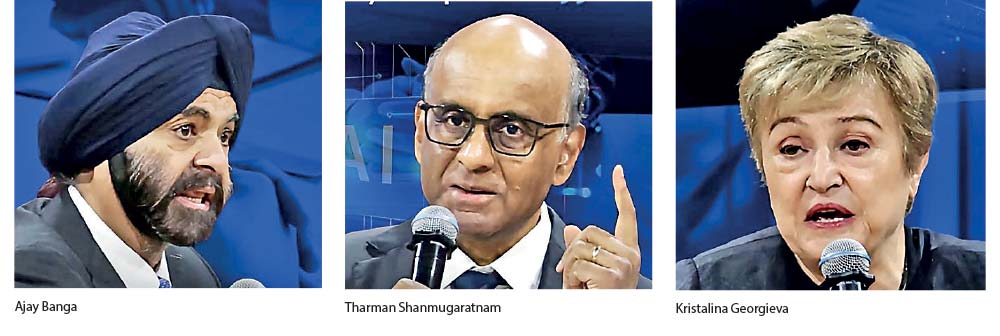
 As highlighted recently at a webinar organised by the International Chamber of Commerce Sri Lanka and Daily FT , the world is changing at a pace that would have been difficult to imagine even a decade ago. By 2030, the global economic landscape could look fundamentally different, shaped by the emergence of new economic superpowers, shifting geopolitical alliances, wars, technological disruption and an unprecedented concentration of private wealth among a handful of entrepreneurs.
Against this backdrop, three of the most influential institutions in modern economic history — the International Monetary Fund (IMF), the World Bank and the Asian Development Bank (ADB) — must seriously rethink their purpose, priorities and modus operandi.
For decades, these institutions have played a pivotal role in shaping the economic destinies and livelihoods of billions of people. They have provided financial assistance during crises, supported infrastructure development, strengthened institutions and helped countries navigate economic transitions. Their contribution to global development cannot be understated. However, past achievements cannot be a substitute for future relevance. The fundamental question is whether their traditional operating models are equipped to deal with a world that is rapidly moving beyond the economic and geopolitical assumptions on which these institutions were originally built.
The shifting balance of global power
By 2030, countries such as India, China, Indonesia and other emerging economies are likely to exercise considerably greater economic influence. The balance of global economic power is shifting, with Asia and the Global South demanding a stronger voice in international decision-making. Yet the governance structures, voting rights and leadership arrangements of these multilateral institutions have not always kept pace with these changes. Greater representation for emerging economies is no longer simply a question of fairness; it is essential for institutional legitimacy.
A new generation of world leaders and a changing geopolitical order
The geopolitical landscape is also changing, with a new generation of younger political leaders emerging across different regions. Their priorities and expectations are increasingly shaped by a different world order, where economic security, sustainability, climate resilience, poverty reduction, youth unemployment and social mobility are becoming central political concerns.
The IMF, World Bank and ADB must develop a much deeper understanding of these changing geopolitical realities. Geopolitics can no longer be viewed simply through the traditional lens of major-power rivalries, trade relationships and security alliances. It must also recognise the growing influence of the Global South, demographic change, resource security, technology and the aspirations of younger populations.
These emerging leaders will increasingly demand practical outcomes rather than policy prescriptions alone. They will want to know how international financing can create jobs, reduce poverty, protect the environment and improve education, support entrepreneurship and make their economies more resilient. Multilateral institutions that fail to understand these changing priorities risk losing their credibility and influence
The new development challenge: Jobs, youth, AI, wars and poverty
Perhaps the most compelling argument for reinvention emerged at the recent IMF–World Bank Annual Meetings in Bangkok. World Bank President Ajay Banga highlighted a staggering demographic challenge: approximately 1.2 billion young people in developing economies will reach working age over the next 10 to 15 years, while current projections suggest that only around 400 million jobs will be created. This leaves a potential gap of approximately 800 million jobs.
This is more than an economic statistic. It is a potential social and economic crisis. Youth unemployment, underemployment and persistent poverty threaten social stability, economic inclusion and confidence in institutions. A generation without meaningful employment is a generation at risk of losing hope, dignity and the opportunity to participate productively in society. Banga made a powerful observation: a job is not simply a statistic; it represents dignity and the ability to build a future.
IMF Managing Director Kristalina Georgieva also highlighted the disruptive implications of artificial intelligence, describing it as a slow-moving tsunami for the labour market. The IMF estimates that around 40% of jobs globally could be affected by AI through augmentation, transformation or displacement. Young people entering the workforce, particularly those seeking their first jobs, are especially exposed.
The implications are profound. Governments cannot continue to measure economic success solely through GDP growth, fiscal balances or debt sustainability. These remain essential, but growth that does not generate sufficient employment or reduce poverty risks becoming an increasingly fragile social contract.
The IMF, World Bank and ADB must therefore place job creation, human capital development, youth employability and poverty reduction much closer to the centre of their development strategies.
The growing influence of technology billionaires
Perhaps an even more profound development is the growing influence of technology billionaires and private capital. Individuals controlling global technology platforms, artificial intelligence ecosystems, digital payment networks and enormous pools of private wealth are increasingly capable of influencing global economic discussions.
Entrepreneurs such as Elon Musk and philanthropists such as Bill Gates demonstrate how individual wealth, technology and private initiatives can shape conversations on healthcare, education, energy, climate change and economic opportunity.
In some cases, these individuals command financial resources and technological capabilities that rival those of entire nations. Their ability to mobilise capital, make decisions and deploy solutions across borders can be considerably faster than the traditional processes of multilateral institutions. Will the future of development finance be determined as much by technology entrepreneurs and private philanthropists as by the IMF, World Bank and ADB?
The challenge for multilateral organisations is to engage these emerging centres of influence, mobilise their capital and technological capabilities, and ensure that development remains inclusive, transparent and accountable. Private wealth, with its ability to mobilise resources faster and deliver outcomes with less costs and bureaucracy, should complement — not replace — public institutions, democratic accountability and national sovereignty.
Technology: An opportunity and a threat
Artificial intelligence, automation, digital currencies, biotechnology and advances in healthcare will fundamentally change how economies function, how people work and how long they live.
At the recent Annual Meetings, Banga also emphasised the potential of practical, affordable AI applications to improve productivity in agriculture, healthcare, education and small businesses in developing economies. Georgieva highlighted the need for reliable electricity, digital infrastructure, appropriate skills and safeguards to ensure developing countries can participate in this transformation. However, technology also presents serious risks. Cyberattacks, digital vulnerabilities, data security and the concentration of technological power could expose governments, financial systems and multilateral institutions to new forms of systemic risk.
Digital platforms and financial technology could fundamentally change how development assistance reaches people. Instead of money passing through multiple layers of bureaucracy, technology could enable targeted funding, digital payments, healthcare services and educational opportunities to reach intended beneficiaries more directly. The institutions must help countries prepare for these transitions rather than simply respond after crises emerge. They must also ensure that AI becomes a tool for creating opportunities rather than widening the divide between those who possess technology and those who are left behind.
Gen Z
The next generation will bring different expectations. Gen Z is entering leadership positions across businesses, governments and institutions. They are digitally connected, globally aware and increasingly concerned about climate change, inequality, inclusion and economic opportunity. They will question traditional bureaucracies, slow decision-making and development models that fail to deliver tangible outcomes. Education systems must also move beyond qualifications towards practical skills, adaptability, entrepreneurship and lifelong learning. Public-private partnerships will be critical in creating pathways to first employment, particularly as AI changes traditional entry-level jobs.
Sri Lanka
For countries such as Sri Lanka, this transformation is particularly important. Assistance should go beyond stabilisation programs, debt restructuring and infrastructure financing. Countries need support in building competitive industries, attracting foreign direct investment, developing human capital, retaining talent and creating sustainable employment. Economic reforms must ultimately translate into better livelihoods, reduced poverty and improved living standards. Fiscal discipline and macroeconomic stability are indispensable, but they must create the foundation for productive investment and inclusive growth, not become ends in themselves.
The future
The IMF, World Bank and ADB should consider more agile financing mechanisms, faster project approvals, stronger private-sector partnerships and measurable development outcomes. They must become more proactive in anticipating sovereign debt risks, climate-related shocks, technological disruptions and demographic pressures. They should also collaborate more closely, reduce institutional duplication and leverage private capital, philanthropy and technology to deliver development outcomes at scale. The world of 2030 will not be the world of 1944, when the Bretton Woods institutions were conceived, or even 1966, when the ADB was established. With the US midterm elections now behind us, the world’s attention must return to these much bigger structural challenges. The institutions that helped shape the old world order must now help shape the new one. Their greatest challenge is no longer simply financing development. It is ensuring that economic growth creates jobs, that technology expands opportunity, countries have capacity to manage cyber risks, that poverty is reduced and that the next generation has a meaningful stake in the global economy. The next generation will not judge the IMF, World Bank and ADB by how effectively they manage debt crises or how much development finance they disburse, but by whether they can create jobs, reduce poverty, protect the planet and deliver a more equitable future. The ultimate measure of their success should not be how much money they lend, but how many lives they help transform and minimise world disasters and wars .
References
1. Ajay Banga, World Bank President – Remarks at the 2026 Annual Meetings Plenary, October 2026.
2. Kristalina Georgieva, IMF Managing Director – AI Will Transform the Global Economy. Let’s Make Sure It Benefits Humanity, IMF, January 2024.
3. World Bank Group – Small AI: More and Better Jobs, Annual Meetings 2026, Bangkok.
4. https://youtu.be/hIihN5By1C4?si=w3nId6CYhUgUc-
5.https://multilateralism.sipa.columbia.edu/news/multilateralism-not-dead-its-future-depends-how-knowledge-travels




