Monday Sep 14, 2026
Monday Sep 14, 2026
Friday, 13 March 2026 00:24 - - {{hitsCtrl.values.hits}}
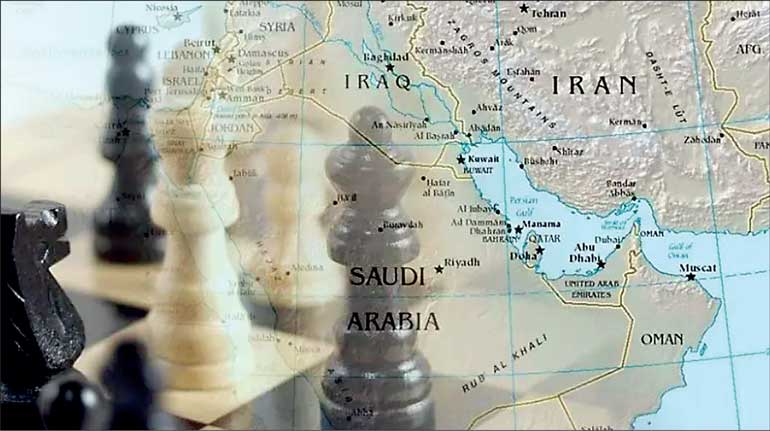
 Crossroads such as The Silk Route have their own legends about countries, characters and caravans. But it is chessboards that may have some elements that are far more relevant to the state of play in the Middle Eastern game that is going on today.
On a chessboard, every move looks deliberate, strategic and calculated – sometimes, even elegant. Pawns advance with a purpose that can terrify kings. Knights leap in elaborate corkscrews – often two at a time (ahem!) – to trap unwitting opponents. Queens stride across squares laterally and diagonally, with predatory confidence.
But seasoned players know the truth: sometimes the most decisive move in the game is the one that no one saw coming, and yet it sets the whole board on fire.
That, increasingly, is what the Middle East resembles today: not merely a red-stained battlefield, but a black and white board where the pieces are moving faster and more unpredictably than even the grandmasters expected.
Checkmate
The present conflagration between the US and Israel on one hand, and Iran on the other, began with what appeared to be a bold opening gambit. Israeli strikes reportedly dismantled missile launching sites, command centres and air defence bases across Iran, with clinical detachment and surgical precision.
By most accounts, and even allowing for Western media bias in favour of international Jewry and Hebrew interests in the Levant, Israel has – and claims – effective control of the skies above the deserts of West Asia.
In the calculus of warfare, that is the equivalent of placing the opponent’s king in early check. If we remember that the term ‘checkmate’ probably derives from the Persian ‘shah mat’ (“the king is dead”), it comes as little surprise that the Israeli-goaded, US-led strike on Tehran took out the Ayatollah as one of the first major moves in what now threatens to be a war of brutal retaliation.
But for all the US-Israeli initiative and apparent upper hand at present, seasoned chess players know that early checks are sometimes deadly traps that become evident only when the confrontation progresses into mid game.
 Washington appears to have assumed – and gambled on the premise – that eliminating top-tier leadership in Tehran would cause the Iranian state to crumble... that decapitating the command structure at its uppermost echelons, in the religious files over and above the military ranks, would scatter the pieces across the rest of the chessboard.
But Iran has played this game before, from the time it was the Persian empire perhaps. And the modern Islamic Republic has planned for precisely such contingencies long before this unnamed war.
For Iran has developed centralised command structures but with layered leadership precisely to survive shocks of the nature that its attackers would have inflicted on it with a view to precipitate paralysis.
In fact, the country’s strategic religio-military culture was shaped during the traumatic years following the Iran-Iraq conflict, when Tehran learned to absorb blows that could have toppled less prepared regimes.
Chokepoint
In counterintuitive chess terms, Iran has arranged its rank and file so that the ostensible demise of the king does not necessarily mean the end of the game. Shah mat. The king is dead.
But play on, because it’s not checkmate yet. And if the skies presently belong to Israel and the seas to the US’s Middle East groups – bar British warships that Trump summarily dismissed as being redundant now that the war was ‘won’ – the board itself may still belong to Iran.
The key square in the ongoing conflict is the chokepoint known as the Strait of Hormuz. Nearly a fifth of the world’s oil flows through that maritime corridor. Closing it – even threatening to by laying mines across the waters (Iran was doing so a day ago) – would be the geopolitical equivalent of overturning the board. India, China,  Japan, Saudi Arabia, Russia and then Europe – in that order – depend on the billions of barrels that float through and beyond it.
Such a move would not simply strike at Israel or the US but bring the rest of the world – kicking and screaming – into the game. The Great Game with a slight shift of locale, and the last twist of the knife being making Hormuz Iran’s Suez.
That tactic, perhaps, is the main point of the Persian game and the pivot of the present conflict. By threatening the main oil artery of the global economy, Tehran could compel reluctant players – from Western Europe to Far East Asia – to exert pressure on Washington and Tel Aviv.
Any closure or severe constriction of the strategic strait could transform a sporadic middle-eastern war on the level of sharp, short-lived skirmishes into a protracted global economic emergency.
A series of checks
Already, the markets – oil and financial – are twitching like spectators sensing a dangerous end game. Oil prices have surged beyond $ 114 per barrel amidst fears that tanker traffic could be seriously disrupted.
Should the Strait of Hormuz become contested territory, crude could move towards $ 150 – an eventuality that could send inflationary and recessionary fears skyrocketing across continents.
At that stage, the war would no longer resemble a duel between grandmasters. It would look like a multiplayer chess tournament gone spectacularly wrong.
This is why claims of absolute Israeli air dominance must be treated with analytical caution. And interrogating the jingoistic aspirations of the US to be the Western Hemisphere’s hegemonic superpower must be similarly interpreted with the hermeneutic of suspicion.
While air superiority confers enormous military advantage – the ability to strike targets with relative impunity and whittle away at the enemy’s infrastructure on the ground – tactical control of the skies does not automatically translate into strategic overall victory.
For sometimes, wars – like quirkier chess matches – are won not in the traditional centres of the game, but along its edges: in logistics, economics and the spirit of socio-political endurance.
 And it is along those edges that smaller nation states – and little island republics – begin to feel the tremors as the after-shocks of the bombing and counter-retaliation ripple outwards.
Place on the game board
Consider Sri Lanka. The island has no pieces in the Middle Eastern theatre, yet knights and rooks have ventured into its waters of late. And now, its strategic position on the game board itself is increasingly hard to ignore.
The recent episode involving the Iranian naval vessel IRIS Dena demonstrated how distant wars can drift so easily into Sri Lanka, no mere backwater even before this outbreak. The rescue of survivors and the diplomatic choreography that followed were reminders that non-alignment is not simply a policy stance – it is a legal obligation governed by international conventions, maritime treaties, and most importantly the law of the sea as regards sovereign states that opt for a principled neutrality shot through with humanitarian compassion.
The subsequent handling of the Iranian support vessel IRIS Bushehr further illustrated the treading of water Sri Lanka must do in a sea full of shark submarines.
nFact: Neutral states must assist sailors in distress while ensuring that their territory is not used by belligerents for military advantage.
nFact: At least one of the combatants is belligerent in private, applying not so subtle governmental pressure not to allow the other protagonist to court our favour by appeals to repatriate the sailors – contra the law of the sea at a time of war – while the other plays on our sense of humanity.
The balance is not merely juridical; it is diplomatic and relational. And to extend our metaphor, Sri Lanka’s moves are constrained by not merely geopolitics but international jurisprudence.
And then there is the economic dimension of the game that is in progress.
Sri Lanka imports nearly all of its petroleum. When global oil prices rise, the impact spreads across the local national economy like a cascade of forced moves, even enforced errors. If crude oil averages $ 110 this year, the country’s fuel import bill could increase by an estimated $ 400-500 million. At a projected $ 130 per barrel, the additional burden may exceed $ 700 million. Should a nightmarish scenario eventuate – namely, disruption of the Strait of Hormuz pushing prices over $ 200 – the shock could skyrocket to a thumping billion dollars.
For a nation still recovering from financial collapse tantamount to bankruptcy and struggling under an onerous fiscal reforms program, that is a series of checks our economy can scarcely afford.
IOR ramifications
Yet the implications extend beyond fuel invoices. Sri Lanka’s maritime location places it firmly on the Indian Ocean chessboard, where several larger players are quietly repositioning – and evidently stealthily moving around – and deploying their pieces.
One question increasingly being asked is whether India – traditionally, the first responder to geopolitical events in the eponymously named Indian Ocean Region  (IOR) and where Mahabharat typically acted as top dog – is being overshadowed by its tiny neighbour as a prime mover in a maritime rescue role... a part that Hindustan may have found itself hamstrung to play as the rapid escalation of tension farther west forced it to take a stand on the side of one of its sponsors and allies.
And China and Japan have their own stakes in the outcome. Beijing in particular relies heavily on Iranian oil imports and maintains strategic interests along the maritime routes linking the Persian Gulf to East Asia. Any disruption in those flows rattles the People’s Republic’s energy equations.
Thus the chessboard on which Sri Lanka is placed extends well beyond the Levantine theatre and surrounding Fertile Crescent, stretching like a swathe of diagonal dark and light squares across the world’s third largest ocean.
Add to this the broader ripple effects: shipping insurance premiums rising, airlines re-routing flights around conflict zones, tourism flows dwindling, and remittances corridors affected by instability across Gulf economies where many Sri Lankans work...
Each of these developments takes place across interstices of an already complexly connected board.
Game on
Which reminds me to float a theory: what if the most strategic chess player in this game of fire and oil is not Iran but the US? And it is simply allowing Israel to be the tail that wags the dog – the Epstein twist in the tale included – because its strategic interest is not destroying Iran (as Israel’s evidently is), but choking China and Russia? That would explain why Donald Trump had Delta Force violate Venezuela’s sovereignty and arrest Maduro while Europe kept stumm: it’s all the oil that would bolster Uncle Sam’s Middle-Eastern misadventures.
 What, then, is Sri Lanka’s most prudent position and moves on the game going ahead?
On the global chessboard, Sri Lanka is not a knight or a bishop. But neither is it merely a pawn. To invoke an adapted analogy, it is more akin to a promoted piece – say, a castle – on a strategically placed square. One through which many of the world’s most important sea, trade and shipping routes pass.
That makes our ongoing neutrality not only desirable but essential and non-negotiable.
Sri Lanka must, therefore, play its future moves cautiously, yet confidently, and be careful to assert and preserve its principled neutrality; respecting international maritime law, maintaining a fine and tense diplomatic balance, safeguarding its treasured sovereignty and insulating its fragile, recovering economy from external shocks.
In chess, as in geopolitics, the most dangerous moments occur when players become too confident of their advantage, complacent about their assumed safety from attack.
The game is on. What is our next best move? And how’s checkmate avoided?
(The writer is Editor-at-large of LMD, and has a Post-graduate Diploma in Politics and Governance)




