Saturday Oct 24, 2026
Saturday Oct 24, 2026
Saturday, 24 October 2026 00:00 - - {{hitsCtrl.values.hits}}
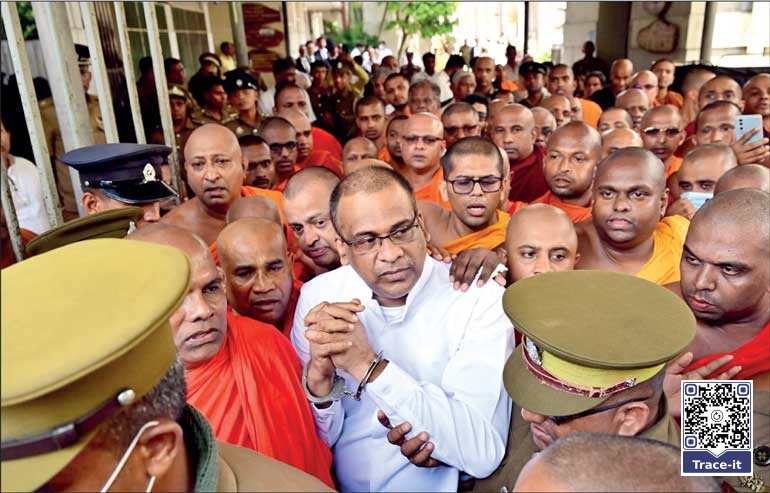
Ven. Galagoda Aththe Gnanasara Thera in prison dress
Of all contempts committed against the lawful authority of courts of law the most heinous are those which involve actual or threatened injury to the person of a judge with a view to intimidating him into revoking or altering an order or decision made by him in the discharge of his judicial duties. The outrageous nature of the acts committed by the respondent constitutes not only an affront to the dignity and authority of the court but also a direct challenge to the fundamental supremacy of the law itself. It is a type of contemptuous conduct which appeared to us to be unprecedented in the annals of the courts of this country. Viewed in this light the circumstances of this case call for very deterrent punishment on the respondent
 In a judgment delivered recently, a three-judge bench of the Supreme Court headed by Justice Janak de Silva, declared that the pardon granted to Ven. Galagoda Aththe Gnanasera Thera on 25 March 2019 by former President Maithripala Sirisena was null and void and was of no force or effect in law. The jurisdiction of the Court had been invoked in two fundamental rights applications filed by Dr. Paikiasothy Saravanamuttu and Sandhya Ekneligoda. The former President was reported to have apologised to the Maha Sangha for “a technical error in the documentation” relating to the presidential pardon he purported to grant. That technical error, he claimed, was “the failure to obtain the required approval from the Justice Ministry”. He explained that “as a result, only my signature was obtained without the approval of the Justice Ministry. That was a failure on my part”. He asserted that the Supreme Court had quashed the presidential pardon and committed the priest back into prison owing to that omission. President Sirisena has, either deliberately, inadvertently, or in ignorance, totally misinterpreted the judgment of the Supreme Court.
The constitutional requirement to seek the advice of the Justice Minister, and examine reports from the trial judge and the Attorney-General, arises only in the case of a prisoner who had been sentenced to death by a competent court. It is on a consideration of those documents that the President is required to determine whether to let the law take its course or to commute the sentence of death to one of life imprisonment. That procedural requirement did not exist in the case of Gnanasara Thero. Therefore, President Sirisena’s excuse of a “technical error” has no basis in law or fact.
Magistrate’s Court of Homagama
On 26 January 2016, the suspects in the case relating to the disappearance of journalist Prageeth Ekneligoda were produced in the Magistrate’s Court of Homagama. During the proceedings, Gnanasara Thero, who was not a party to the proceedings or a witness, had entered the courtroom and (i) obstructed the proceedings by beginning to address the Magistrate; (ii) declared that he would not accept the orders of the Magistrate; (iii) ordered the Magistrate to grant bail to the suspects; and (iv) described the Senior State Counsel who was appearing for the prosecution as “an impotent state officer”. This violent display of verbal threats or open defiance directed at the Magistrate constituted contempt of court.
Court of Appeal
In March 2016, in proceedings instituted in the Court of Appeal under Article 105 of the Constitution, upon a reference by the Magistrate, Gnanasara Thero was convicted on all four counts of contempt. He was sentenced to serve four years of imprisonment in respect of (i) and (ii); six years in respect of (iii), and five years in respect of (iv), the sentences to run concurrently.
The pardon
On 23 May 2019, President Sirisena granted a pardon to Gnanasara Thera, who was thereupon released from prison. Shortly thereafter, the Centre for Policy Alternatives and Dr. Paikiasothy Saravanamuttu, and Mrs. Sandhya Ekneligoda, filed applications in the Supreme Court under Articles 17 and 126, asserting the grant of pardon to be an infringement of their fundamental right to equality and the equal protection of the law. It was six years later, in August 2005 that the two applications were listed for hearing before a Bench of the Supreme Court comprising Justices Janak de Silva, Sobhitha Rajakaruna and Sampath Abayakoon.
Supreme Court
According to the documentary trail placed before the Supreme Court, it appeared that a pardon had been requested by the Mahanayake Theros of the Malwatte, Asgiriya and Kotte Chapters of the Siyam Nikaya, as well as by the Diyawadana Nilame. There was also a letter bearing several names requesting President Sirisena not to grant a pardon. While President Sirisena had been made aware of these requests from time to time, the pardon was eventually granted by him on the basis of a minute submitted to him by the Additional Secretary (Legal) in the Presidential Secretariat, Lakshmi Jayawickrema.
That minute did not disclose any reason why the President should consider granting a pardon. Nevertheless, he approved the granting of a pardon. No reasons for the grant of the pardon were recorded by the President. As the Supreme Court noted, “it is apparent that the President, by simply approving the recommendation of the Additional Secretary (Legal), acted mechanically and abdicated the exercise of the power and responsibilities vested in him”. Accordingly, the Court held that the pardon granted to Gnanasara Thero was “arbitrary, in violation of the public trust and the rules of natural justice, ultra vires the powers of the President, and was an infringement of the fundamental rights guaranteed by Article 12(1) of the Constitution. It had no force or effect in law.
In his judgment, Justice Janak de Silva noted that under the Constitution,
“The President exercises the executive power of the People. As the repository of that executive power, the President holds such power in trust for and on behalf of the People. It follows that the exercise of such power must be directed towards the public interest and cannot be permitted to be exercised for any personal, political or other self-serving interest. . . A pardon is not a private act of grace exercised for the benefit of the President . . . It is an exercise of a constitutional power derived from the sovereignty of the People and must, therefore, be directed to an end which is consistent with the public interest.”
The Court held that the President is under a duty to make a contemporaneous record of the reasons for the grant of a pardon, and to make such reasons available to any aggrieved party when requested, and to the Court when the decision is impugned. In this case, the former President had failed to state in his affidavit the reasons for the grant of the pardon. He had merely stated that the grant of pardon was preceded by requests from several distinguished members of the Buddhist clergy and other religious denominations, and by representatives of civil society.
Justice Janak de Silva cited with approval the following observations made by the late Justice Atukorale to explain the nature of the offence of contempt committed in a Magistrate’s Court:
“A Magistrate’s Court is one of the institutions created and established for the administration of justice in this country. For this purpose, a Magistrate is entrusted with the performance of important judicial functions and duties. In the course of the performance of such functions and duties he is called upon to make various decisions and orders. There is no decision or order he can make which cannot be challenged. But the challenge must be by an appropriate application or proceeding made to this court in accordance with law. It cannot be challenged by a violent display of verbal threats or open defiance directed at the Magistrate himself.
Of all contempts committed against the lawful authority of courts of law the most heinous are those which involve actual or threatened injury to the person of a judge with a view to intimidating him into revoking or altering an order or decision made by him in the discharge of his judicial duties. The outrageous nature of the acts committed by the respondent constitutes not only an affront to the dignity and authority of the court but also a direct challenge to the fundamental supremacy of the law itself. It is a type of contemptuous conduct which appeared to us to be unprecedented in the annals of the courts of this country. . . .Viewed in this light the circumstances of this case call for very deterrent punishment on the respondent.”




