Monday Oct 12, 2026
Monday Oct 12, 2026
Saturday, 23 May 2026 04:01 - - {{hitsCtrl.values.hits}}
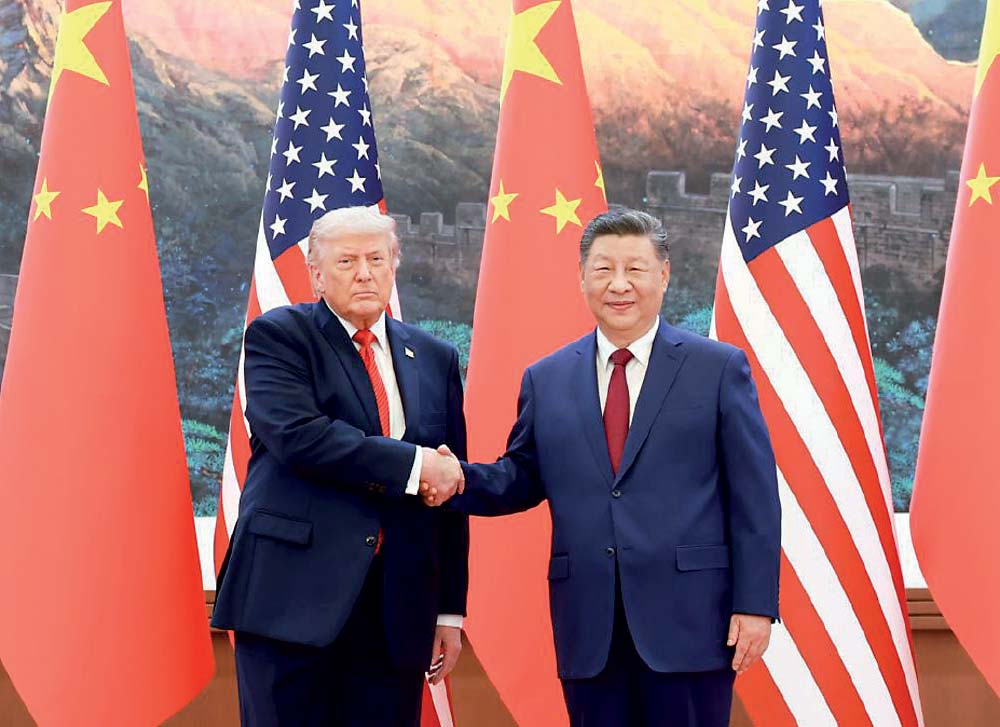
 The recent high-level engagement between China and the United States is more than routine diplomacy - it marks a moment of recalibration the world has been waiting for. After years of tariffs, tech rivalry, and heated rhetoric, it signals something rare: the possibility of a reset.
Headlines may still emphasise competition, but the real issue runs deeper. Across the Global South, there is growing expectation that Beijing and Washington can move beyond rivalry and deliver collaboration with shared benefits. The central question is whether the two powers can work together to address global challenges and provide greater stability.
China and the United States have the capacity to build a more constructive relationship one that serves the well-being of their peoples and the broader interests of humanity. That is what the world is watching for.
This latest engagement suggests a meaningful shift. It points toward a more stable and predictable relationship, moving beyond cycles of escalation toward a steadier footing. Such a relationship would not eliminate competition but redefine it. Cooperation could expand in areas of shared interest, from climate change to global economic stability. Competition, while inevitable, would be moderated by clear rules and mutual restraint. Differences over trade, technology, or geopolitics would be managed rather than allowed to spiral into confrontation.
This framework - cooperation where possible, competition where necessary, and dialogue at all times offers a pathway to enduring stability. It reflects a simple reality: neither side can afford prolonged conflict, not only for their own societies, but for a deeply interconnected world.
China-U.S. economic ties remain fundamentally mutually beneficial and deeply interdependent. Over decades, trade and investment have driven growth, innovation, and job creation on both sides, while underpinning global economic stability. Despite political tensions, the logic of cooperation endures: the two economies are too large, too intertwined, and too complementary to disengage without significant cost.
At the same time, tensions are inevitable in a relationship of this scale. Disputes over trade, technology, and market access will persist - the real challenge lies in how they are managed.
Here, equal-footed consultation is essential. Durable solutions cannot be imposed unilaterally; they must be negotiated through dialogue grounded in mutual respect and reciprocity. Efforts to contain or pressure the other side risk deepening mistrust and undermine the very stability both countries and the world depend on.
Yet the most important audience for this relationship lies beyond Washington and Beijing. Across the Global South, the priority is not rivalry, but development. Countries are not interested in choosing sides; they are interested in building roads, hospitals, digital infrastructure, and climate resilience. Too often, China-U.S. tensions have obstructed progress - stalling multilateral cooperation, complicating debt relief, and turning critical resources into arenas of geopolitical competition.
The world has grown tired of zero-sum thinking. The notion that one power’s gain must come at another’s expense no longer reflects the realities of an interconnected global economy. In today’s system, growth is not a fixed pie to be divided, but something that can be expanded through cooperation, trade, and shared innovation.
Nowhere is this shift more evident than in the Global South. For developing countries, prosperity is not tied to the rise or fall of a single power, but to their ability to engage with multiple partners. Access to diverse markets, technologies, and sources of investment is what drives development - not alignment with one block at the expense of another.
This is why binary frameworks of competition fall short. They overlook the practical needs of countries seeking infrastructure, industrial growth, and economic resilience. For much of the Global South, the goal is not to choose sides, but to maximise opportunity - drawing on the strengths of all partners to support long-term development.
In this context, zero-sum thinking is not just outdated - it is counterproductive. It risks fragmenting the very systems that have enabled growth and cooperation and imposes unnecessary constraints on countries that depend on openness and connectivity to thrive.
Leaders across the developing world are not hoping for winners and losers - they need both sides to succeed. Their economies depend on Chinese and American strengths alike: manufacturing, infrastructure finance, and supply chains on one hand; markets, capital, innovation, and security partnerships on the other. These relationships are not interchangeable, they are complementary.
This is not neutrality for its own sake; it is necessity. Forced alignment imposes real costs on countries that can least afford them. Choosing one partner over another risks narrowing access to investment, technology, and markets, while undermining development goals.
As a result, the Global South is increasingly rejecting binary choices. It is pursuing flexibility, diversification, and pragmatic engagement with all major powers. The aim is not to navigate rivalry, but to move beyond ensuring that great-power competition does not come at the expense of global progress.
The message is clear: the world does not need deeper division, it needs coexistence.
There is room for both the United States and China to prosper - not in isolation, but in a shared, complex, and interdependent system. The Global South is not asking for friendship between Washington and Beijing. It is asking for functionality.
This new chapter, however fragile, offers a glimpse of that possibility.
It should not be wasted.
(The author is the Founding Director of the Belt and Road Initiative Sri Lanka (BRISL), a pioneering organisation dedicated to research, dialogue, and engagement on China’s Belt and Road Initiative (BRI). Alongside his leadership role, he is a researcher and commentator on international relations, economics, and geopolitics)




