Saturday Oct 17, 2026
Saturday Oct 17, 2026
Saturday, 17 October 2026 00:00 - - {{hitsCtrl.values.hits}}
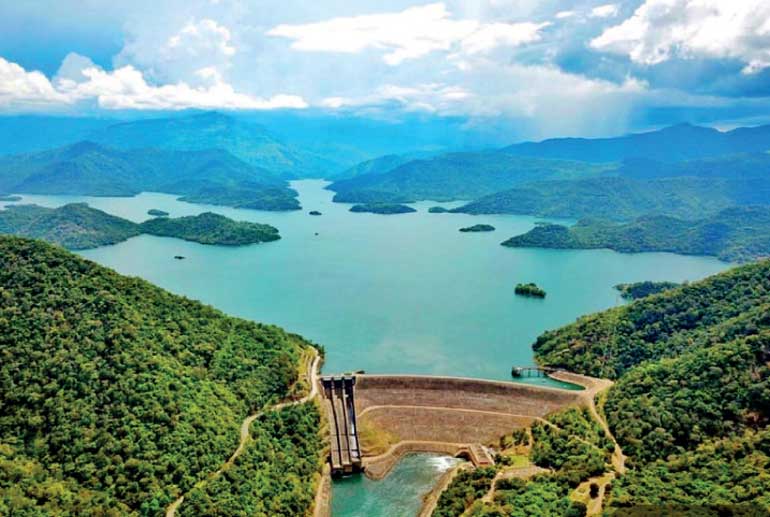
German cooperation extended into infrastructure and development, including projects associated with the Embilipitiya paper mill, the Randenigala (pictured) and Rantambe dams, the Sapugaskanda power project and sundry water-supply schemes
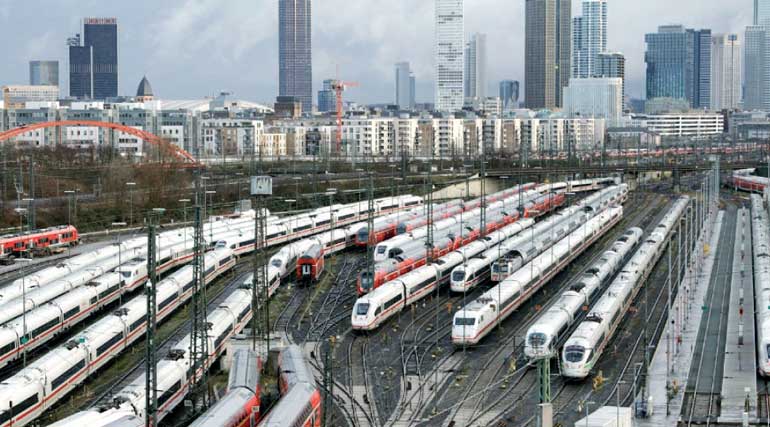
German trains, as opposed to Sri Lankan ones, are expected to arrive and depart when the timetable says they will
Germany can help Sri Lanka turn its latent potential into a performance befitting a nation of its lineage and heritage. Sri Lanka can remind even a European powerhouse such as Germany that performance alone is not the same thing as peace and purpose. Between the German ‘pünktlichtkeit’ (punctuality) and the Sri Lankan latitude (“pramaada-vee daavanaya-vey”) lies not merely a cultural joke, but the possibility of a genuinely reciprocal partnership. Perhaps our shared future lies somewhere between the punctual train and the late piece?
 A few days after German Unity Day, it is still not late (island-style) to reflect on the nexus between the Federal Republic of Germany and the Democratic Socialist Republic of Sri Lanka.
It is late in terms of the date (3 October), yet remains timely to consider the thesis that our two countries – though they may have nothing in common as regards their national characters – are connected in an interesting enough way.
And some irony: there is, after all, an apparent absurdity in placing Sri Lanka and Germany together. More appropriate would be a felicitous (if somewhat forced) juxtaposition.
Take Sri Lanka, at least in the uncharitable caricature of some of us, which is a country often characterised by latitude, lateness and lethargy. Time is flexible and negotiable, improvisation is a national survival skill to bolster our natural resilience, personal relationships can detour around procedures, and an appointment scheduled for nine o’clock may be understood as starting at some point in the general vicinity of noon…
Germany to my mind represents almost the opposite cultural ideal of precision, punctuality and productivity. It proactively plans, calibrates and measures, duly standardises, diligently engineers, painstakingly documents and then flawlessly executes. A German train, as opposed to a Sri Lankan one, is expected to arrive and depart when the timetable says it will. Now don’t throw current Deutsche Bahn (DB) stats at me – they used to, in my long-ago time there, at least!
Yet, this apparent incompatibility conceals a rather important truth or a reality that is rarely if ever grasped. Sri Lanka and Germany are not natural partners because they are alike. They are somehow connected, rather, because they are so obviously different.
Germany possesses many of the institutional, technological and supremely industrial capabilities Sri Lanka needs to strengthen. Sri Lanka harbours geographical, human, cultural and civilisational assets that Germany increasingly seeks in a bewilderingly VUCA world. Their differences are therefore not an obstacle to cooperation. They are the basis of it.
Sri Lanka and Germany do not need to be even remotely alike each other to be natural partners. They do need, however, to be reasonably complementary. Indeed, their differences may be precisely what make the unlikely partnership even more valuable.
The Federal Republic possesses many of the things Sri Lanka needs to strengthen: technological capability, industrial know-how, vocational expertise, institutional discipline, engineering excellence, substantial capital and easy access to sophisticated markets.
Be that as it may, Germany’s bilateral investment portfolio in Sri Lanka is not massive by any means. Germany Trade and Invest reports a modest if marginally enlarging footprint of $ 189 million (2022), $ 222 million (2023) and $ 243 million (2024) in terms of the Federal Republic’s FDI stock in Sri Lanka.
Our island-nation on the other hand is a repository of many things that Germany may increasingly value: An educated and adaptable population, a strategically located position in the Indian Ocean, a base from which to secure access to South Asian and Indian Ocean markets, maritime potential, abundant biodiversity and sublime cultural depth.
There is also a marvellous if mercurial hospitality offering, whereby despite the challenges (war/tsunami/political upheaval) over the years, tourism is a great example of German-Sri Lankan reciprocity.
Also a kaleidoscope of human talent, and an ancient civilisation struggling to coexist with plurality and uncertainty, as well as live (not always peacefully, to be honest) a peculiar island-life shaped by layers of ethnic, religious and cultural interaction…
Therefore, my proposition is not that Sri Lanka should become more German. Nor that Germany should somehow become more Sri Lankan. It is that each country can supply some of what the other seems to lack. That is the real pivot of the relationship between our republics. And interestingly, it is a nexus that has been unfolding for more than a century.
A relationship that predates diplomacy
Sri Lanka has maintained diplomatic relations with the Federal Republic of Germany (FDR), or the former West Germany, since 1953; and with East Germany – the former German Democratic Republic (DDR) – since 1970. The relationship has survived the Cold War, the division and reunification of Germany, Sri Lanka’s civil war and our beleaguered land’s recent political turmoil and economic crisis. German cooperation today encompasses vocational education, health, climate adaptation, environmental protection, reconciliation, social cohesion and maritime security.
But the soul or intellectual connection between the two nation states goes back considerably further. Long before the modern Federal Republic’s development agencies arrived in Colombo, German scholars were travelling to Ceylon to study its language, history and religious traditions.
Wilhelm Geiger, one of the foremost German scholars of Pali and Sinhala, first came to Ceylon in 1895. He visited twice more (in 1925/6 and 1931/2), and subsequently made major contributions to the study of Sinhala, Pali and the Mahavamsa chronicle, becoming one of the most important European authorities on our blessed isle’s linguistic and historical traditions.
And then there is Hermann Hesse. He travelled through South Asia in 1911, including Ceylon. Hesse’s encounter with the East became part of a much larger European fascination with Indian and Buddhist thought. The Goethe-Institut notes that this engagement was connected partly to a European search for something that modern industrial civilisation appeared to have lost: spirituality, wholeness, and a deeper alternative understanding of human existence. And although Hesse didn’t find the spiritually pristine civilisation he was looking for, Germany’s intellectual encounter with the South Asian hemisphere profoundly shaped parts of its modern literary and philosophical imagination.
The delicious irony is almost too good to waste on dilettantes like yours truly. Sri Lanka can look to Germany for some of the machinery of modernity. Germany once looked towards South Asia for some of the answers to the problems created by modernity. That is the first clue to a deeper symbiosis.
From lofty philosophy to plebeian buses
After Sri Lanka’s independence from European colonialism, the relationship became increasingly practical. German development cooperation in Sri Lanka dates back to 1956, according to GIZ. Its most enduring symbol is perhaps the Ceylon-German Technical Training Institute (CGTTI) in Moratuwa, better known as ‘German Tech’.
Instituted in 1959 following an agreement the previous year between Sri Lanka and West Germany, the CGTTI was originally established in Werahera, to train technicians capable of maintaining the country’s bus fleet. German personnel initially managed the institute (later, in Moratuwa, in 1974) until Sri Lankan management eventually took over in 1976. That history deserves to be read as more than a footnote, because Germany did not simply supply Sri Lanka with equipment. Rather, it helped teach Sri Lankans how to maintain, repair and operate equipment.
And many locomotives in the Ceylon Government Railway (CGR) and now Sri Lanka Railway (SLR) ageing fleet are operational thanks to acumen supplied by the Sri Lanka German Railway Technical Training Centre at Ratmalana which helped repair, service, maintain and re-engine those machines.
The most useful foreign assistance does not create permanent dependence. Instead, it creates domestic capability. The German contribution was therefore not merely technological. Rather, it was institutional: standards, discipline, technical education, apprenticeship and a culture of maintenance.
Over the decades, German cooperation extended into infrastructure and development, including projects associated with the Embilipitiya paper mill, the Randenigala and Rantambe dams, the Sapugaskanda power project and sundry water-supply schemes. German assistance also supported SME development and post-tsunami reconstruction.
The pattern could be instructive. Germany brought in technological and organisational capability; Sri Lanka supplied the people, locale, local knowledge and ultimately the institutions that absorbed it. That is not a one-way relationship but complementarity in action.
In terms of trade too, the relationship is no longer simply about aid. German-Sri Lankan merchandise trade is now worth well over a billion dollars annually. In 2024, German exports to Sri Lanka exceeded $ 229 million, while German imports from Sri Lanka surpassed $ 1 billion. German exports included machinery and chemical products. Sri Lankan exports entailed substantial quantities of clothing and food. In 2025, German exports to Sri Lanka increased further, to $ 257 million, while German imports from Sri Lanka also reached a new high at $ 1.216 billion. Thus the relationship is heavily asymmetric in Sri Lanka’s favour in terms of merchandise trade, as Germany is becoming a major net importer from our land.
This is significant because it changes the psychological nature of the relationship. Sri Lanka is not merely a recipient of German assistance but also a supplier to consumers in Germany. The Federal Republic is not merely a donor but also a customer, investor, technology provider, training partner and potential gateway to European markets.
There is institutional architecture supporting this relationship too. A double-taxation agreement has been in place since FY 1982/3, an investment-protection agreement signed by bilateral treaty in 2000 has been in force since 2004, and the Sri Lanka-Germany Business Council was established in 1999.
The challenge now is to move the relationship from trade in goods towards cooperation in capabilities. That is where the next phase could become transformative.
What Germany can give Sri Lanka
The first priority should be skills. Sri Lanka has educated people but does not always connect education effectively to employment and industrial productivity. Germany’s dual vocational education system offers an unusually relevant model because it combines classroom education with practical workplace training and employer participation. Sri Lanka should therefore be asking Germany not merely for more vocational schools, but for help in building an entire skills-to-industry ecosystem.
Training could focus on mechatronics, industrial automation, robotics, electrical engineering, refrigeration, renewable energy, precision manufacturing, medical technology, maritime engineering, logistics and industrial maintenance. The principle should be brutally simple: train people for jobs that exist, and for industries that Sri Lanka intends to build. The German Tech experience provides a historical foundation for doing precisely this.
A second opportunity is the creation of a Sri Lankan equivalent of the German Mittelstand (the SMEs and family-owned businesses which major on patient capital, technical education, export orientation, vocational training, specialist manufacturing, institutional finance and regional industrial clusters that form the core of its economy).
Germany’s economic strength does not rest exclusively on enormous corporations. It also hinges on technically sophisticated medium-sized enterprises that dominate specialised global niches. Sri Lanka has many thousands of SMEs, but what it lacks is a sufficiently large population of small and medium-sized enterprises that have successfully travelled the road from local business to globally competitive specialist manufacturer or service provider. German-Sri Lankan cooperation could help change that.
Technology plus skills plus standards plus finance plus export-market access could turn selected Sri Lankan SMEs into internationally competitive companies. The objective should not be to make Sri Lanka a cheaper version Germany, but enhance Sri Lankan enterprises sufficiently to compete with German companies. That is a very different ambition and perhaps runs parallel to the Federal Republic’s manifold people-to-people academic infrastructure already in place.
These are many and varied, running the gamut from sundry scholarships and academic exchanges with German universities, German-language education and research collaboration. In fact, the German Foreign Office specifically identifies the Goethe-Institut, DAAD (a two-way street with mutual traffic for study, teaching and research), GIZ, AHK, and other socio-political foundations as being active in Sri Lanka.
The Indian Ocean equation
There is another asset Sri Lanka possesses that Germany simply cannot acquire through technology: its unique geographic positioning. Our jewel in the Indian Ocean sits astride one of the world’s great maritime arches. Germany possesses industrial technology, engineering, logistics expertise, capital and businesses with global experience. Sri Lanka harbours ports, maritime location and proximity to India as well as the wider Indian Ocean.
Put those together and possibilities extend well beyond traditional development assistance that spans a spectrum from port technology, ship repair, maritime data, other maritime services, cold-chain and digital logistics through warehousing and green shipping to renewable energy and regional distribution.
The emerging cooperation agenda already recognises this. The Sri Lankan-German Business Forum held in Colombo in 2026 placed maritime logistics, investment and infrastructure, digitalisation, and sustainability prominently on the agenda.
This points towards a much more interesting proposition than aid. Sri Lanka could become a more significant Germany’s Indian Ocean partner than at present. That would give Germany something it cannot manufacture at home: a strategically located platform in one of the world’s most important maritime regions.
But of a necessity in any meaningful nexus, Sri Lanka must also give. This is where the equation could lose some of its equilibrium. We in the Global South often or usually or almost always ask: ‘What can Germany do for Sri Lanka?’ May I humbly submit that we should press the converse point: What does Sri Lanka bring to Germany?
First, and perhaps uniquely, its geographic location. Second, and not so far behind, its substantial talent pool.
Germany faces certain demographic challenges and needs skilled workers in a range of sectors. Sri Lanka has a wide and deep pool of educated, technically capable and English-speaking people. The two countries could therefore construct a system of managed skills mobility in which Sri Lankans train and work in Germany while retaining strong professional and commercial links with Sri Lanka.
But the objective should be circulation, not depletion. Sri Lanka should not become merely a reservoir from which Germany extracts its most capable young people. A successful model would see Sri Lankan professionals studying in Germany, working in the Federal Republic, acquiring advanced skills, establishing businesses, returning to Sri Lanka where possible, and maintaining commercial and intellectual connections between the two countries.
Third, Sri Lanka offers Germany proximity to Indian markets, preferential access to South Asia and connectivity to the Indian Ocean.
Fourth, it can offer ecological and scientific opportunities in tropical biodiversity, marine science, climate adaptation and renewable energy.
And fifth and finally, it offers something much harder to quantify: a ‘weltanschauung’, or different conception of life.
A dual crucible
Germany has developed outstanding institutional traditions for converting technical knowledge into efficient systems. Sri Lanka’s civilisational inheritance has wrestled for centuries with issues that systems alone cannot satisfy – such as suffering, impermanence, consciousness, community, spirituality, and the symbiotic relationship between human beings and nature. Neither ethos is sufficient for human happiness in and of itself, because efficiency without purpose becomes sterile and purpose without efficiency becomes impotent.
Sri Lanka’s problem, so to say, is not that it has too much humanity and too little Teutonic efficiency. Its challenge is that it has often failed to convert its considerable human and natural assets into properly functioning systems. Germany can help with that. For its part, Germany’s dilemma is not that it is too efficient; it is that no industrial society can live indefinitely by pure efficiency alone. Sri Lankan spirituality can contribute something to that too.
That is why the historical experience of Geiger, Hesse et al. matters. The German-Sri Lankan relationship began, in one sense, with Germans coming to Sri Lanka to understand one thing, and continued with Germans coming to Sri Lanka to build something else. The next phase of their mutual development could involve both countries coming together to create something neither can create alone.
The two countries have already demonstrated in some respects that such a partnership can work.
A German technical institute established to keep Sri Lankan buses running became a Sri Lankan institution. German scholars once travelled to Ceylon to study its civilisation, and enlightened a world walking in darkness at the time.
Sri Lankan manufacturers now sell goods to German consumers. Federal Republic businesses are again examining our sun- and rain-blessed island as an Indian Ocean investment and logistics platform. And both countries are now discussing cooperation in precisely those areas where their capabilities intersect: skills, technology, maritime infrastructure, logistics, sustainability, investment and innovation.
So even belatedly I’m suggesting that perhaps the central question is not why Germany and Sri Lanka get along despite being so different – it is whether they get along because they are so different.
If there is any good reason why the relationship isn’t stronger or more significant than it is already, consider Sri Lanka’s notorious policy instability, weak investment predictability, regulatory friction, skills mismatch, small domestic market, infrastructure constraints, political risk, German corporate risk aversion, Sri Lanka’s comparatively limited industrial depth, strong competition from our neighbours, bureaucratic inefficiency and the lack of a comprehensive Sri Lanka-EU trade agreement…
No doubt there is room for reflection on these realities on both sides of the border, so to speak. But if the further foundation is laid well, the ultimate payoff may be surprisingly simple. Germany can help Sri Lanka turn its latent potential into a performance befitting a nation of its lineage and heritage. Sri Lanka can remind even a European powerhouse such as Germany that performance alone is not the same thing as peace and purpose.
Between the German ‘pünktlichtkeit’ (punctuality) and the Sri Lankan latitude (“pramaada-vee daavanaya-vey”) lies not merely a cultural joke, but the possibility of a genuinely reciprocal partnership. Perhaps our shared future lies somewhere between the punctual train and the late piece?
(The writer is the Editor-at-large of LMD and is a senior journalist with a Post-graduate Diploma in Politics and Governance)




