Friday Oct 16, 2026
Friday Oct 16, 2026
Monday, 31 August 2026 00:20 - - {{hitsCtrl.values.hits}}
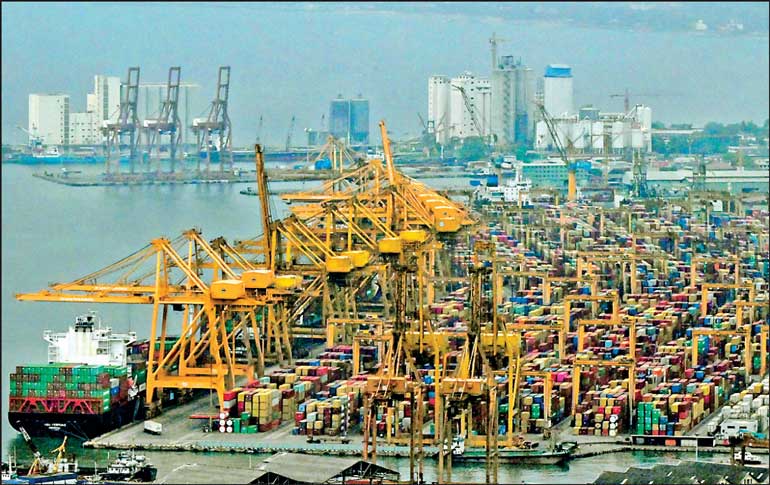
Colombo Port

For nearly three years now, the Red Sea has been effectively closed to routine commercial shipping. Since November 2023, Yemen's Houthi movement has launched more than 190 attacks on merchant vessels transiting the Bab el-Mandeb Strait, and what was once a corridor carrying 10-12% of world trade now sees daily transits collapse from a historical average of around 70 vessels to just 30-35. The result has been the near total diversion of Asia-Europe container traffic around the Cape of Good Hope — adding 10 to 15 days and 3,000 to 4,000 nautical miles to a typical voyage, pushing fuel consumption up by as much as 40%, and keeping freight rates 15 to 40% above pre-crisis levels even after the initial 2024 shock eased.
Sri Lankans following shipping news will already know this story from the demand side: Colombo has been one of the principal beneficiaries. But a second, less-discussed story has been developing in parallel, thousands of kilometres to the north — and it deserves Colombo's attention too.
A new lane opens in the ice
Russia's Northern Sea Route (NSR), running along its Arctic coast from the Bering Strait to Northern Europe, has quietly gone from a niche resource export corridor to a route now carrying scheduled international container services. On 10 August this year, Chinese carrier Haijie Shipping launched what it describes as the first regular weekly container service across the Arctic, sailing from Ningbo to the British port of Felixstowe in under 20 days — versus roughly 40 days by conventional routing. Russian operator Sea Legend and the Rosatom-backed Aurora Line have run comparable seasonal rotations, and South Korean interests have begun testing the corridor as well.
The numbers, while still small next to Suez, are moving in one direction.
Container transits on the NSR climbed from 7 voyages in 2023 to 24 in 2025, with more than 30 expected this year. Total NSR cargo — still dominated by Russian oil and LNG exports rather than transit containers — is on track to exceed 40 million tons in 2026, roughly 15% higher than the same period last year.
Behind this is real capital. Russia has now deployed its entire fleet of eight nuclear-powered icebreakers simultaneously for the first time, with three further vessels due by 2030 and a much larger Leader-class icebreaker, intended to enable genuine year-round navigation, already 30% complete.
Moscow has committed roughly $ 20-24 billion to Arctic port and communications infrastructure through 2035, and even India has entered the picture, negotiating construction of four ice-class vessels of its own with a first pilot voyage planned for 2027.
The commercial logic is straightforward on paper: the NSR can cut an Asia-Europe voyage by up to 40% in distance and around two weeks in time compared with Suez — and considerably more against the Cape of Good Hope detour that has become the default since 2023. One concrete example already in circulation: Chinese e-mobility firm Ninebot has reported shipping electric scooters to the Netherlands via the Arctic at roughly a third of the cost of overland China-Europe trucking.
Why it isn't Suez's replacement — yet
The caveats are substantial, and any assessment for Sri Lankan readers should be candid about them. The Arctic route remains strictly seasonal — this year's scheduled container service ran for barely seven weeks, from 15 August to 3 October. War-risk and polar-navigation insurance premiums run five to ten times normal levels, reflecting patchy satellite coverage at high latitudes as much as any conflict risk. High ice-class vessels are scarce and expensive, and Western sanctions on Russian shipping interests have already delayed icebreaker construction and left several completed ice-class LNG carriers stranded at a South Korean shipyard. Independent analysts remain sceptical of Moscow's own targets: cargo volumes on the NSR actually fell in 2025, well short of stated ambitions, before this year's rebound.
Longer-range climate projections suggest the picture will change substantially over coming decades — recent modelling gives roughly an 80% probability that the Arctic Ocean will be nearly ice-free in summer by the mid-2030s, and the IPCC projects a summer ice-free Arctic before 2050.
But even optimistic industry assessments suggest only around 2% of global shipping volume might shift to Arctic routes by 2030, rising to perhaps 5% by 2050. A more direct polar shortcut, the Transpolar Sea Route — which would bypass Russian waters entirely — is not expected to be commercially viable before the 2040s at the earliest.
In short: the Arctic route is a genuine and growing seasonal alternative for time-sensitive, high-value cargo, not a wholesale substitute for the Suez corridor. Its trajectory will depend as much on sanctions, Russia's relations with shipping nations, and the eventual resolution of the Red Sea crisis as on ice conditions themselves.
What this means for Colombo Harbour
This is where the story comes home. Colombo's current boom is a direct byproduct of the Middle East crisis rather than of any change in the port's own fundamentals. As mainline vessels bypass the Red Sea and swing around Africa, Colombo's position just off the main east-west trunk route through the Malacca Strait — requiring only about a day's deviation — has made it an increasingly attractive relay and waypoint hub, particularly for cargo bound to and from the Middle East and the Indian subcontinent.
Transhipment volumes rose roughly 30% year-on-year in early 2024 as the crisis took hold, and the Port of Colombo closed 2024 with a record 7.78 million TEUs in total throughput, a 12.1% increase on the previous year, with transhipment accounting for 81% of that volume. The surge has not been without strain: congestion and inter-terminal transfer delays have periodically resurfaced through 2025 and into 2026 as volumes have tested the port's capacity even as expansion works — the Adani-led West Container Terminal and the Sri Lanka Ports Authority's East Container Terminal extension — proceed to lift capacity toward a targeted 15 million TEUs by the end of this year.
An expanding Arctic route poses two distinct risks to that windfall, on two very different timelines.
In the near term, through the rest of this decade, the risk is modest. The NSR's seasonal window, insurance costs, and limited ice-class capacity mean it cannot yet absorb meaningful volumes of the Asia-Europe and Asia- Middle East trade that currently passes near Colombo via the Cape. If anything, the more immediate threat to Colombo's current volumes is a resolution of the Red Sea crisis itself: analysts expect that a normalisation of Suez transits would release roughly 6% of global vessel capacity currently tied up in the longer Cape routing back into the market, reducing the very rerouting traffic that has been filling Colombo's terminals.
Over the medium-to-long term, however, the calculus changes. Should Arctic ice retreat continue on the trajectory current science suggests, and should Russia's icebreaker and ice-class fleet investment continue at pace, the NSR could by the 2030s and beyond capture a growing share of container traffic that currently transits — or is diverted around — the Indian Ocean and Suez corridor. A structurally viable, faster Pacific-Atlantic link that bypasses the Indian Ocean altogether would, over time, reduce the volume of east-west mainline traffic passing Sri Lanka's shores in the first place, independent of whatever happens in the Middle East. That is a slower-moving and more structural risk than anything the Red Sea crisis poses, and it is one Colombo's planners would do well to start factoring into decade-scale capacity and investment decisions now, rather than treating current transhipment growth as a permanent feature of the trade map.
The takeaway
Colombo's present good fortune and the Arctic's slow emergence are, in a sense, two faces of the same underlying shift: global shipping is actively searching for ways to route around a Middle East that can no longer be assumed stable. For now, that search is filling Colombo's berths. It is worth remembering that the same search, extended far enough north and far enough into the future, could eventually route around Colombo too.
(The author holds a BSc Eng., MBA, and is a Chartered Engineer. He researches global trade and shipping developments. Views expressed are personal. He can be contacted via [email protected])




