Wednesday Sep 23, 2026
Wednesday Sep 23, 2026
Saturday, 13 June 2026 05:53 - - {{hitsCtrl.values.hits}}
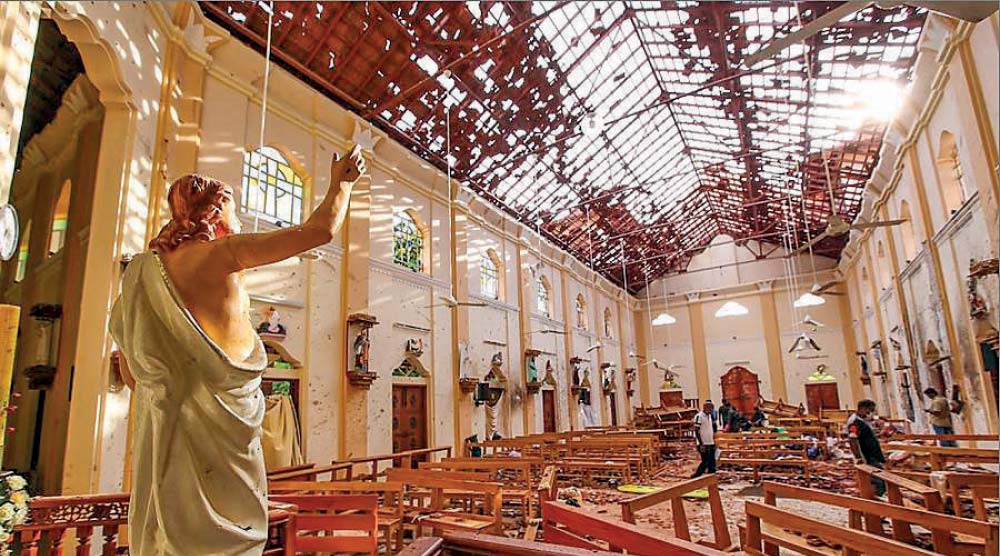
The Easter bombings were not merely a terrorist attack that scarred the face of the security establishment. They were the start of a national trauma that is yet to experience the late salve of closure
 Supporters argue that the scale and sensitivity of the Easter Sunday investigation require extraordinary investigative powers. Critics argue that due process cannot depend on the identity of the suspect. Allegations of mistreatment in detention and police denials, as well as later magisterial rapping of the long arm of the law over its knuckles, only intensifies the debate
This affair has become much larger than the fate of either retired Major General Suresh Sallay or CID Director Shani Abeysekara. It is now over competing narratives of the Sri Lankan State itself. And the book of the filmic drama being played out is A Tale of Two Citizenries indeed. Camps so deeply divided and equally vociferous as to stir the waters of the national peace.
The first thing to note is that the investigation remains inconclusive at the present time. Sallay has been arrested, detained under the PTA, named as a suspect, and questioned in connection with the Easter Sunday attacks of April 2019.
The CID says it possesses evidence warranting those steps. Sallay and his supporters deny wrongdoing and have challenged aspects of the investigation. Proof has yet to determine guilt or innocence in this emblematic – and dare I essay enigmatic – case.
‘4/21’
As far as the national psyche goes, no matter what the outcome transpires to be, this is tantamount to the reopening of a deep wound that has never healed. The Easter bombings were not merely a terrorist attack that scarred the face of the security establishment. They were the start of a national trauma that is yet to experience the late salve of closure – if ever it can come...
For many Sri Lankans, the attacks occupy a place similar to other defining moments in our shared (if contested) national history.
The 1983 pogroms; the IPKF intervention and the bloody years of 1987-9; the assassination of the country’s crème of political leaders during the protracted civil war (which was anything but civil); the tsunami of December 2004; and more recently, Cyclone Ditwah and its island-wide fallout; left indelible marks on our islanders’ collective psyche.
We won’t even mention the Aragalaya, those interminable queues, and even COVID-19. In the case of 4/21, the wound never fully healed because the question ‘Who really knew how, what, where, and when?’ was never satisfactorily answered.
Two camps
The Sallay affair, therefore, triggers two very different emotional reactions.
In one camp there is the ‘protect the State’ brigade. This camp fears the dismantling of institutions that defeated the LTTE and still stands as a bastion against real or imagined inroads into Sri Lanka’s sovereignty by diasporic and other forces inimical to our wellbeing.
In addition, they fear the retrospective criminalisation of State-led intelligence work, politically motivated persecutions, the weakening of military morale, plus possible foreign intrusion into our national security realms.
And to them, the spectacle of a former intelligence chief being detained under terrorism legislation looks too much like the State now turning against its erstwhile defenders.
The second camp takes the higher moral ground of ‘no one is above the law’. They see years of alleged obstruction into the probe of 4/21, unanswered questions from multiple inquiries, early warnings in 2019 that allegedly went unacted upon, political interests that may have benefited tremendously from the fallout of the attacks on the national psyche at the time – and perhaps most importantly, victims of Black Easter still seeking truth, justice and healing, seven years later.
To them, investigating a former intelligence chief demonstrates that the rule of law may finally be reaching previously untouchable echelons in the defence and security establishment.
Between these two camps, the overall result is once again a society that is yet sharply divided; not merely over politics, but by competing definitions of patriotism.
Away game
So much for affairs at home. While abroad, the international picture is almost paradoxical.
First, the positive interpretation is that foreign governments, human-rights organisations and democracy’s global observers may perceive this as evidence that Sri Lanka is finally willing to investigate powerful figures who were previously considered beyond reach, much less rigorous scrutiny.
That interpretation aligns with promises made by President Anura Kumara Dissanayake that his Government, once ensconced in power, would pursue accountability and prosecute malefactors as regards the Easter Sunday attacks.
At the same time, there is a negative interpretation. In which overseas observers see allegations of intelligence involvement in terrorism, ongoing detention under the PTA despite promises made, claims and counter-claims regarding the quality of treatment in detention, and fierce political polarisation.
Such developments reinforce a long-standing perception of our island-nation as a state struggling to reconcile national security imperatives with democratic accountability. So the question in the world at large becomes: ‘Is Sri Lanka uncovering the truth at last... or merely replacing one politically loaded narrative with another?’
Rules
Meanwhile, the security and intelligence apparatus itself may well be the most consequential aspect of the whole affair. Intelligence organisations depend on secrecy, trust, chain of command and the confidence that officers and operatives will be protected by their own as long as they operate lawfully.
An investigation into a former SIS chief inevitably creates anxiety among serving officers. Some may worry: ‘Will concerned governments prosecute us at some time in the future for decisions made now, in today’s difficult circumstances?’ And others might think: ‘Will today’s operational decisions become the day-after-tomorrow’s political liabilities?’
On the other hand, professional intelligence services ultimately benefit from accountability. If operatives believe senior officers can never be investigated, corruption and politicisation become more likely. The long-term effect depends entirely on whether the investigation is seen as evidence-based and legally rigorous rather than politically driven.
State stance
This is perhaps the greatest political gamble undertaken by the National People’s Power Government. The regime came to power promising stringent anticorruption measures, institutional reform, accountability for major national scandals of the past, and renewed investigation into the Easter Sunday attacks.
If the investigation eventually produces credible evidence and successful prosecutions, it could become one of the defining achievements of this administration.
If it collapses, ends inconclusively or appears politically selective, it could become one of the JVP-led NPP’s greatest liabilities on its path ahead.
The Government of the day, therefore, is trapped between two risks. Being accused of protecting powerful figures if it retreats. Or being accused of political vendettas if it presses ahead.
If the process is perceived as fair; transparent; process, policy, and principle-driven; and evidence based; it could strengthen democratic institutions and restore a modicum of public confidence. If it degenerates into factional warfare, Sri Lanka risks adding yet another ambivalent chapter to a history already crowded with unresolved national traumas. And that, more than the fate of any individual suspect or investigator or ex-intelligence chief, is what is truly at stake in this tale of two citizenries
Probe
Former officials also have a key part to play in the unfolding drama. Many figures associated with previous governments appear to view the investigation as extending beyond a single individual.
From their perspective, the probe potentially threatens reputations, latent legacies, military narratives developed after 2009, and decisions made before and after the 2019 attacks.
Consequently, resistance is not surprising. What may look like obstruction to one side may feel like self-preservation to the other side.
Law
We mustn’t omit mention of the justice system. At present, the courts occupy a uniquely delicate position.
Sri Lanka’s judiciary might effectively be asked to answer one of the most explosive questions in our long-beleaguered island-nation’s chequered history: ‘Were the Easter attacks after all only a catastrophic failure of state intelligence, or was there something far more sinister than fundamentalist terrorism at play on that fateful day?’
So every procedural decision now comes under the public lens, and is politically scrutinised.
For example, the court’s refusal to remove Shani Abeysekara from oversight of the investigation was interpreted very differently by opposing camps. Supporters saw judicial confidence; critics saw something else.
Thus we might respectfully venture that the judiciary’s greatest contemporary challenge is not minding its critics too much or even at all.
PTA
A sharp edge to proceedings is provided by the Prevention of Terrorism (Temporary Provisions) Act No 48 of 1979 (PTA) being pressed into service again. And this time as a tool against a formerly inveterate user of yon draconian piece of legislation.
The irony is striking. For years (or even decades), opposition politicians, activist lawyers, civil-society groups and human-rights organisations criticised the PTA as enabling prolonged detention at the executive’s pleasure, and sans the agency of a magistrate, and potential abuse by those with extra-judicial instrumentality such as the police’s many departments.
Now the same dread law is being used against a former senior intelligence official being accused in relation to an alleged terrorist atrocity. This creates an uncomfortable question. If the PTA was unacceptable when used against ordinary suspects, does it become acceptable when used against powerful ones?
Supporters argue that the scale and sensitivity of the Easter Sunday investigation require extraordinary investigative powers. Critics argue that due process cannot depend on the identity of the suspect. Allegations of mistreatment in detention and police denials, as well as later magisterial rapping of the long arm of the law over its knuckles, only intensifies the debate.
Mood
Civil society seems divided but not quite as evenly as expected perhaps.
For example, many liberals and rights-oriented groups face a genuine dilemma: they strongly support accountability for Easter 2017; but they also strongly oppose detention under the PTA.
So many advocate and occupy a position that is maybe best summed up as: ‘Investigate vigorously, prosecute if evidence exists, but do so through procedures consistent with human rights and the rule of law.’
And this is a more nuanced position than either political camp tends to acknowledge.
RCC
The Roman Catholic Church in Sri Lanka, by the way, remains arguably the most consistent institutional actor in the saga. Its Archdiocese has repeatedly emphasised the need for truth and non-interference in investigations. Following Sallay’s arrest, Church representatives publicly called for the investigation to proceed without obstruction.
For most Catholics, this is not fundamentally a political issue. It is a moral one. Their central question remains unchanged since 21 April 2019... ‘Who was responsible, directly or indirectly, for the deaths of our people?’ And the Church’s credibility in this issue derives from its outspoken perseverance across multiple administrations, not merely the present or immediately past one.
7++
The survivors’ and victims’ families perspective – and their pain – is often drowned out by political noise. Most of them have lived for over seven years with bereavement, disability, trauma or uncertainty.
Many have watched presidential commissions, parliamentary committees, house debates, media exposés, international documentaries and court proceedings – without reaching a definitive conclusion.
For them, the central concern is neither Sallay nor Shani. It is truth, justice, healing, and hopefully, eventually, a peace that can and must, mercifully, pass all other understanding.
Many if not most survivors would accept whatever conclusion emerges – provided it is demonstrably evidence-based, transparent and credible.
Their greatest fear is not any particular verdict. It is another endless cycle of accusation, counter-accusation, and political theatre that leaves the fundamental questions unanswered.
Test
The deeper issue is that the Easter attacks have become a sort of test of whether Sri Lanka can investigate itself. Not merely past politicians but also terrorists and even intelligence officers. In fact the State itself.
If the process is perceived as fair; transparent; process, policy, and principle-driven; and evidence based; it could strengthen democratic institutions and restore a modicum of public confidence.
If it degenerates into factional warfare, Sri Lanka risks adding yet another ambivalent chapter to a history already crowded with unresolved national traumas.
And that, more than the fate of any individual suspect or investigator or ex-intelligence chief, is what is truly at stake in this tale of two citizenries.
(The writer is the Editor-at-large of LMD and is a senior journalist with a Post-graduate Diploma in Politics and Governance)




