Wednesday Oct 07, 2026
Wednesday Oct 07, 2026
Wednesday, 31 December 2025 00:28 - - {{hitsCtrl.values.hits}}
 Risk is always a fact of life. Modern society made us think risks had been eliminated. But risks have only changed form. We have to understand risks and mitigate them to the extent possible.
What happened to the telecom networks is educative. Compared to the 1990s when bombs and strikes were commonplace, the electricity supply appears more reliable now. Back then the telcos invested in backup batteries and generators. After the war’s end, they gradually relaxed. But then came the floods and landslides. Different risks and bigger consequences. Now the networks are not just for talking. When they fail, even ATMs are affected. Credit cards and QR-based payments will not work. So, the risks are more, not less.
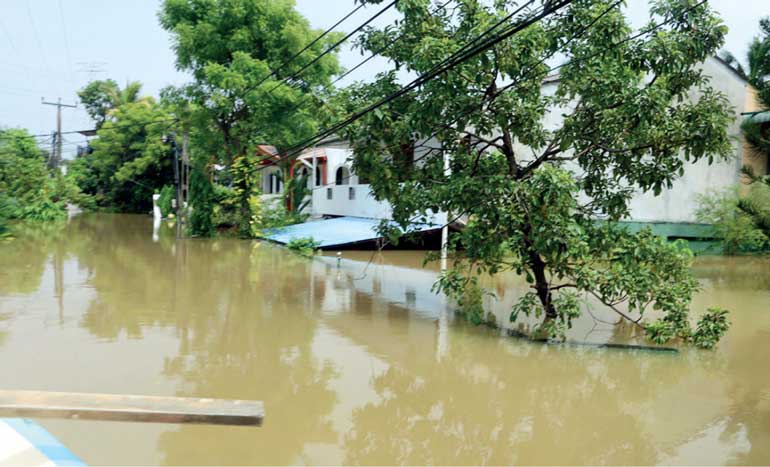
Too many people were unable to use telecom services during and after Ditwah. According to a recent news report, “at the peak of the crisis, over 2,000 telecom sites were impacted, leaving several districts without mobile and data services for two to five days. Network outages were primarily caused by prolonged grid power failures, fibre cut due to floods and landslides, site flooding in low-lying areas, and restricted access that delayed restoration efforts.”
Ditwah was climate change. Predictions were that weather would get extreme: droughts would be longer and floods would be bigger. We had the drought in 2016-2017. Then Ditwah.
Its origin was the unusually warm ocean that caused the cyclone to take up a heavy amount of moisture. For reasons not fully understood, it was also a slow-moving storm. The result was abnormal rainfall of over 300 mm within 24 hours in most of the Central Province, where annual rainfall is around 5,000 mm. The highest recorded was 540.6 mm in Gammaduwa, Matale. One tenth of annual rainfall in a day simply cannot be absorbed. Flooding is inevitable. As are landslides. Much of the talk of deforestation and construction being the causes of landslides is misinformed. Some of the largest landslides started in hill slopes untouched by humans.
Climate change is increasing the frequency and scale of hazards such as rain dumping storms like Ditwah. There is little that can be done to reduce global warming at this time (not that we should not change behaviours that add to it). What we can do is climate adaptation, including reducing the risks of harm when the hazards become disasters.
 Machine learning can help provide accurate predictions of when water will rise to what levels in particular locations. Cell broadcasting can disseminate location-specific warnings effectively in multiple languages. Use of the Common Alerting Protocol (CAP) can reduce ambiguity in the messages and enable automatic translations. We at LIRNEasia had studied each of these elements and communicated them to the relevant decision makers. Sadly, they were not used. We also communicated how digital could help in the relief and recovery phases, with emphasis on the Sahana software suite, developed for disaster management by Sri Lankan volunteers after the tsunami.
Were there any flaws in our recommendations? The big one is the failure of the telecom networks described above. That is the focus of this article.
Early warning/disaster risk reduction
Indian and Bangladeshi authorities have been using an AI-based flood-prediction model developed by Google for some time. We acted as intermediaries when Google offered it to the Department of Irrigation in 2020. Google wanted historical river-level data to train the model. They already had topological and hydrological data for our rivers and food plains. They would also need prompt data from upstream gauges to generate the site-specific water-level predictions that could be used by the Sri Lankan authorities (Irrigation or Disaster Warning Center) to issue warnings either using the capabilities of Android they offered or by other means such as cell broadcasting. The warning in the Hanwella area would not be same as that received by people in Kolonnawa.
 Even if the Irrigation Department had accepted the solution, would it have worked? Were there enough automatic river-level gauges? Would their data and the data from the manually operated stations have been communicated in real time to Google given the failures of the telecom networks? Assuming all that worked and the government sent out the warnings using cell broadcasting, how many would have received them in the absence of dysfunctional mobile networks? If the networks failed because of the flooding, the warnings could have been sent before the networks failed downstream.
Coordination/disaster risk management
Once the disaster occurs, the immediate requirements are to rescue people, house them, and provide them with food and other necessities. All these actions require coordination. Telecom is essential for coordination when roads are broken or flooded. During Ditwah, the networks failed in many places.
 We had recommended that various State and non-state agencies should deploy Sahana, a software suite with multiple modules, before the disaster. For example, the relevant database module should have been populated with data on the location of earth-moving equipment and boats, and the contact information of the owners/operators. The contact information of the coordinators of the camps that would house the displaced would also be in the relevant module. Once the disaster hit, it would facilitate the quick sourcing of rescue equipment. Once camps started filling up, the coordinators could populate the camp database module with data on the residents and the food and other requirements that they needed. We made no headway with these recommendations.
Even if they had been accepted and acted upon, would Sahana have helped? What use is a database, if it cannot be accessed because the telecom networks have failed?
Resilience/building back better
Sri Lankans are said to be resilient. Resilience is
getting back to where things were before the disaster. But then the same failures would recur with next disaster. Building back better remedies the causes of failure, reducing the likelihood of failure next time. Sri Lankans are not well known for building back better.
Network failures were caused by loss of power for the base transceiver stations (BTS) and fiber cuts. BTS are critical infrastructures. The telecom operators must assure adequate back up power in the event the electricity supply fails: x hours of battery backup; and in selected vulnerable sites, y hours of generator-based power. Or solar plus battery. As the major mobile operator will soon find out, networks that fail when most needed will cause customers to defect or at least get themselves backup connections. Providing adequate backup power makes good business sense, but the regulator can reinforce the requirement.
 In an ideal world, the electricity network will not fail as it did. But building back better in electricity is not easy where competitive pressures are absent. Keeping electricity substations away from water will be very costly anyway.
Fiber cuts such as those that deprived customers of one network in Jaffna of service are difficult to excuse. I used to grumble about the two fibers that are visible from the A9 highway saying the two companies should have worked out a sharing arrangement, instead of spending on two separate fiber lines supported by two separate sets of poles. No longer. Two lines are useful for reducing risk. But why was there no emergency sharing until the repair was completed? Why didn’t the regulator mandate that?
Building back better requires analysis of what went wrong in the Ditwah disaster and remedying those faults. Just getting back to where we were will mean digging more people out from the ground and donating cooked food and dry rations for the displaced, again and again. Unless we make our telecom infrastructure more robust, even those tasks will be difficult.