Wednesday Nov 11, 2026
Wednesday Nov 11, 2026
Wednesday, 11 November 2026 00:23 - - {{hitsCtrl.values.hits}}
 Tomorrow, President Anura Kumara Dissanayake, who is also the Minister of Finance, will present the 2027 Budget to Parliament. He will have impressive revenue figures to report. Tax revenue rose from Rs. 1.75 trillion in 2022 to Rs. 5.05 trillion in 2025, and collections grew by a further 25.9% in the first half of this year.
Stability deserves recognition, and no responsible person wants to return to the queues of 2022. Yet the Budget must answer a harder question, which is, who has paid for this recovery? In 2025, 77.4% of tax revenue came from indirect taxes and only 22.6% from income tax. For every rupee collected directly, about Rs. 3.40 was collected at the till, at the pump and at the port. In the first half of this year, the balance tilted further, to 79% indirect and 21% direct.
An indirect tax takes no account of means. A teacher, a three-wheeler driver and a company chairman pay the same VAT on the same item, but it takes a far larger share of the teacher’s income and the driver’s. Dr W. A. Wijewardena, a former Deputy Governor of the Central Bank, recently described the country’s tax burden as an “overdose”. That is the right word for what many households are now experiencing.
What it costs a family of four
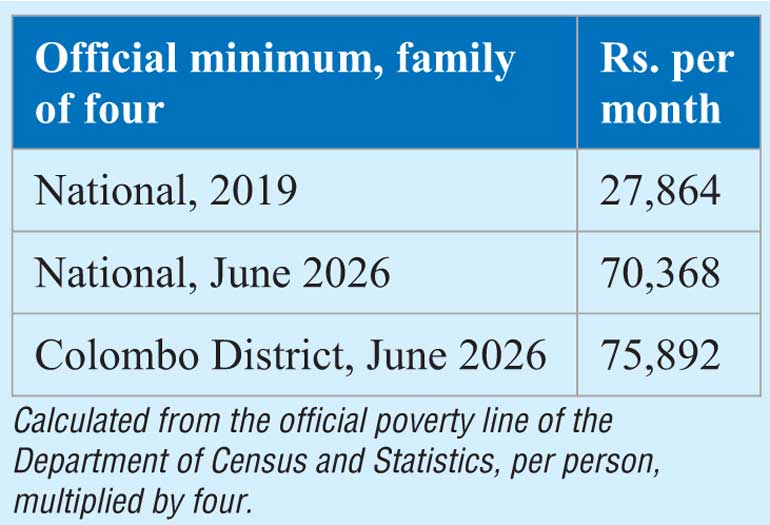
The Department of Census and Statistics has put the official poverty line at Rs. 17,592 per person per month in June 2026. That is about Rs. 586 a day. For a family of four, it comes to Rs. 70,368 a month, simply to meet basic needs.
This is a floor, not a comfortable standard of living. It is also one on which tax continues to bite. Suppose a family spends Rs. 30,000 of that monthly sum on goods and services carrying VAT at 18%. Some Rs. 4,576 of that spending is VAT alone, which is nearly two days of the family’s entire minimum budget. That is before we count the duties, excise and levies built into the prices it pays. Essential foods may be exempt, but fuel and cooking gas lost their exemptions in 2024, and every family feels those costs in its transport, its kitchen and its shopping bill.
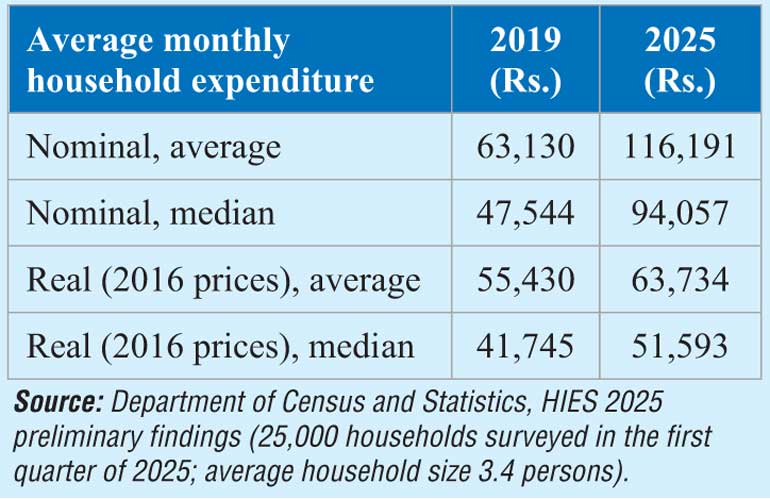
What households actually spend tells the same story. According to preliminary findings of the Department of Census and Statistics’ Household Income and Expenditure Survey (HIES) 2025, average monthly household expenditure reached Rs. 116,191 in early 2025, an increase of 84.1% on the Rs. 63,130 recorded in 2019. Median spending nearly doubled, from Rs. 47,544 to Rs. 94,057.
Yet, measured at 2016 prices, the picture is very different. Real average monthly spending rose only from Rs. 55,430 to Rs. 63,734, an increase of about 15%, and real median spending from Rs. 41,745 to Rs. 51,593. In plain terms, households are paying far more but consuming only modestly more. Most of the increase has gone on higher prices, not better living standards, and the taxes built into those prices are part of the reason.
The burden is not evenly spread. Urban households spend an average of Rs. 158,023 a month, about 36% above the national average; rural households spend Rs. 108,918, and estate households only Rs. 88,691. A tax levied on consumption takes no account of these differences. The same survey shows how thin the margins have become. Average household income was Rs. 120,266 a month, leaving the typical household only about Rs. 4,000 after its spending. Estate households, with an average income of Rs. 72,558, spent more than they earned. For these families, every rupee of tax on necessities bites hardest.
The HIES also gives the Government the evidence it needs to act. The survey divides household spending into 35 categories, 19 for food and 16 for other goods and services. It shows exactly where ordinary families spend their money, and therefore where relief from VAT and other indirect taxes would do the most good.
A pledge is a debt
In August 2024, at Tangalle, then presidential candidate, Dissanayake, said that an NPP Government would remove VAT on medicines, medical tests, school items and supplementary reading books, and that it would do so from its first budget. Voters were entitled to take him at his word.
Two budgets later, parents are still waiting on school books. In September, the President told a rally at Nochchiyagama that plans were being prepared to remove the tax. Last month, he spoke of reducing VAT rates over the next two to three years. These are welcome words, but a child cannot read a statement of intent, and a parent cannot pay for books with one. The 2027 Budget should remove this tax outright and from a fixed date.
Hospital equipment and IT services belong on the same list. Medical machinery and equipment lost their VAT exemption when the rate rose to 18% in January 2024, and the cost of taxing the tools of treatment falls, sooner or later, on the patient. Local IT services have also carried 18% VAT since that date, when an exemption introduced to support the sector was withdrawn. This was the previous administration’s decision, but it is now this Government’s to correct. A country that wants its schools, small firms and public services to go digital should not make the means of doing so more expensive.
From a motorbike to a small car
During the election campaign, people were encouraged to believe that a motorbike, and then a small car, would come within reach of ordinary families. For a young worker, a small trader or a parent on the school run, this was never a matter of status. Where public transport remains inadequate, a vehicle is how people get to work and earn a living.
The reality is sobering. By mid-October last year, according to Sri Lanka Customs, 142,524 imported motorcycles had yielded Rs. 30.37 billion in taxes, an average of more than Rs. 210,000 on each machine. For cars, analysts have put the cumulative tax burden at between about 120% and more than 300% of the import value, because VAT and the Social Security Contribution Levy are charged not only on the vehicle but also on the duties already levied on it. One analyst had estimated that the vehicle sector had supplied some Rs. 905 billion, or almost 18%, of last year’s tax revenue. A 50% surcharge on customs import duty for cars and other vehicles was added in May and has since been extended to the end of the year. The Government may argue that this protects the rupee. It should also explain to a family saving for a first motorbike when, if ever, that promise will be met.
Prudence brings money home
Good tax policy looks beyond the next collection target. Sri Lanka needs foreign exchange, investment and enterprise, and those who can provide them have choices. The professional earning abroad, the exporter and the investor each decide where their money will sit. If rates climb and rules keep shifting, the rational decision is to keep it outside.
Consider the recent signals. Income from the export of services now bears a 15% income tax. Withholding tax on interest has doubled to 10%. VAT on financial services was raised to 20.5% in July, absorbing the separate 2.5% levy. Each measure can be defended on its own, but together they tell those with money to bring home that the next increase may be only a gazette away.
The Government should send the opposite message that moderate rates, a tax schedule held stable for several years, simple rules and a clear reward for foreign earnings brought into Sri Lanka through our banks. Every dollar that comes home and is invested here supports the rupee without a surcharge, creates work and, in time, widens the tax base far more durably than another levy on consumption.
Simpler taxes, better aimed: lessons from the region
Relief on particular items is necessary, but it is not enough. Our tax system must also become simpler and better targeted. An imported car, for example, carries customs duty, a surcharge on that duty, excise duty, a luxury tax, VAT and the 2.5% Social Security Contribution Levy, and the last two are charged on the other taxes as well as on the car itself. The levy’s exemption for imported motor vehicles was withdrawn in May. Other imports carry their own mix of duties, cesses and port levies. Few citizens, and not many businesses, can say with confidence what tax they are paying, or why. Complexity of this kind is costly twice over as it burdens the honest trader with paperwork, and it offers the dishonest one places to hide. And a system that charges the same standard rate on a child’s school book as on a consumer luxury is not targeted at all.
Our nearest neighbour shows that it can be done. For eight years, India has levied its Goods and Services Tax (GST) at four main rates of 5, 12, 18 and 28%, with a compensation cess on top of the highest band. On 22 September 2025, following a unanimous decision of the GST Council, it collapsed these into two principal rates - 5% for essentials and 18% as the standard rate. A separate 40% rate is reserved for tobacco, aerated drinks, large cars and other sin and luxury goods. Fewer rates mean fewer arguments over which rate applies, and less room for disputes and evasion.
Simplification went hand in hand with targeting. It is instructive to see what India did with the very items our own Government promised to relieve.
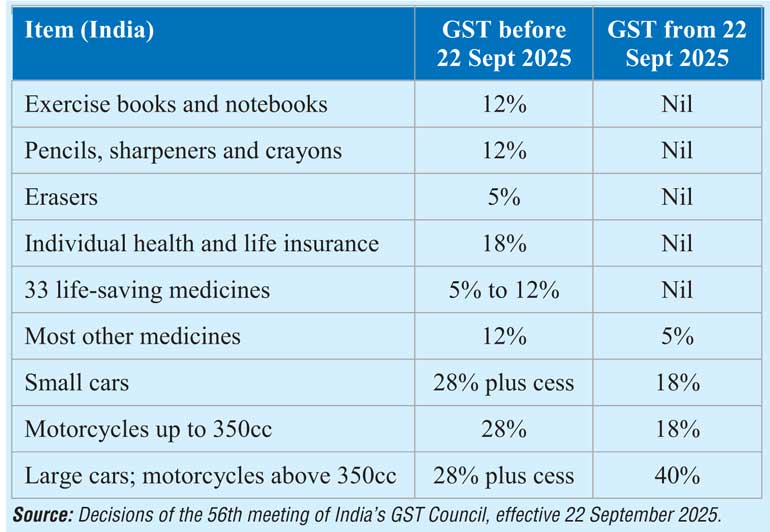
In a single reform, India took the tax off the school bag and the medicine cabinet, brought the family motorbike closer within reach, and asked those buying luxury vehicles to pay more. That is very close to what Sri Lankan voters were promised at Tangalle. Nor did India’s revenue collapse, although there was a cost. Gross GST collections grew by only 0.7% in November 2025, the first month to reflect a full month of the lower rates, and analysts have noted that higher spending had not, at first, made up for the cuts. Collections had then recovered, rising by 6.1% year on year in December, and reached a record ₹2.43 lakh crore in April 2026, although much of that growth came from tax on imports. Revenue held up even as rates came down.
India has applied the same thinking to direct taxes. Since its 2025 Budget, an individual under the new regime pays no income tax on income of up to ₹12 lakh (₹1.2 million) a year, and the rates above that rise in clear steps of five percentage points to a top rate of 30%. On 1 April 2026, the Income-tax Act, 2025 has replaced a law that had stood since 1961. The new Act has changed no rates; its purpose is to be understood. It roughly halves the length of the law, from about 512,000 words to 260,000, reduces the number of sections from 819 to 536, and replaces the confusing distinction between the “previous year” and the “assessment year” with a single “tax year”. Citizens should be able to read the law under which they are taxed.
Others in the region have chosen targeting over blanket increases. When Indonesia’s VAT was due to rise from 11 to 12% on 1 January 2025, President Prabowo Subianto confined the increase to luxury goods and services already subject to the luxury sales tax, such as private jets, yachts and luxury homes, and left ordinary goods at the old rate. Vietnam cut its standard VAT rate from 10 to 8% in 2022 and has extended the cut several times, currently to 31 December 2026, while excluding sectors such as banking, finance, telecommunications and real estate. Neither country abandoned fiscal discipline. Each simply decided, with care, who should carry the load.
The lesson for Sri Lanka is not to copy any one country, but to follow the same principles that a small number of clear VAT rates; a nil or low rate on books, medicines, medical equipment and other necessities; higher rates reserved for genuine luxuries, with relief aimed, using the HIES data, at what ordinary households actually buy; a single, transparent tax on vehicles in place of today’s stack of duties, levies and surcharges; and a tax law written so that an ordinary taxpayer can understand it. The Government has itself said that it plans to simplify the tax system from next year, and the 2027 Budget is the place to show how. It has also shown that consolidation is possible and that from July, VAT and the Social Security Contribution Levy on financial services were merged into a single rate of 20.5%. The same logic of one tax, one rate and one return should now be applied across the board and used to lower the burden rather than to raise it.
There is room to act
It will be said that there is no fiscal space and that our commitments to the International Monetary Fund (IMF) must be respected. They must. But as Dr Wijewardena has pointed out, revenue has already exceeded the program’s target of 15% of GDP. The IMF’s own figures show that last year’s primary surplus reached 5.4% of GDP, more than double the program’s target of 2.3%. Dr Wijewardena has also noted that only 28% of this year’s capital budget had been spent by the end of September. A Government collecting more than its program demands, while failing to spend what Parliament has already approved, can find room for relief on books and hospital equipment. Better compliance and a wider direct tax base can make up the difference over time.
The President has the mandate and the opportunity. On 12 November, he should remove VAT from school books, hospital equipment, medical services and IT services; commit to fewer, simpler tax rates, aimed at those most able to pay; set out a dated path to lower VAT and to a fair vehicle tax; and give those holding money abroad a stable reason to bring it home. Recovery will be real when a family of four can feel it, and not only when the Treasury can count it.
(The author is a President’s Counsel and a Member of Parliament)



