Saturday Oct 03, 2026
Saturday Oct 03, 2026
Thursday, 12 February 2026 02:43 - - {{hitsCtrl.values.hits}}
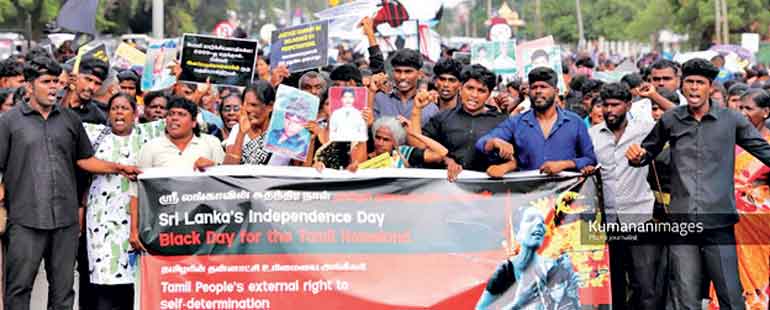
The slogans say it all: ‘Tamil People’s External Right to Self Determination’
 Sri Lanka has neither fared anywhere as well as it was expected to do at Independence in 1948, nor even after its spectacular military victory over the secessionist Tamil Tiger militia, the most powerful non-Sate army of its time, in 2009.
However, Sri Lanka has done much better than many post-colonial States or those much older. My generation has watched a superpower commit suicide without a shot fired, a progressive European country blown apart by NATO into non-existence, a secular Middle Eastern State invaded by the West on the basis of a lie, many post-colonial States break up and lose the borders they had at Independence, and many Latin American countries suffering dark decades of military dictatorship. Sri Lanka avoided, sometimes fought off and defeated, all those fates.
My country was born peacefully, democratically, without partition, eviction or occupation. Its Constitution was framed through extensive consultation by the Soulbury Commission appointed by the post-war Labour administration; the most progressive Government Britain has ever had. The first Cabinet of independent Ceylon was multiethnic.
Any mobilisation today which wears black and curses our country’s birth in 1948, hates us; wishes we weren’t born as a modern nation into the world. It is more than an adversary. It is an irrational, extremist, fanatical, evil force. It is para-LTTE or proto-LTTE Mk2.
Tamil Eelamism returns
Tamil Eelam as an ideological cause probably never went away, but with the destruction of the LTTE in 2009, the Tamil Eelam movement was decimated on the island, surviving only in the Diaspora. There was plenty of memorialisation of wartime Tamil Tiger martyrs and losses, and several of them could be said to be latently Tamil Eelamist, subliminally separatist—but not manifestly so.
The 4 February Black Day protest initiated last year (2025) was a small, localised affair which went unnoticed. This year, for the first time since 2009, there were separatist demonstrations involving a noticeable degree of public participation in Vavuniya, Kilinochchi, Mullaitivu and Batticaloa, i.e., in towns of both the Northern and Eastern provinces. Thus, under the Anura Dissanayake presidency, there’s been an indubitable surge or spike in de facto separatist politics.
The AKD administration has provided an enabling environment which has fostered the Independence Day surge of Tamil Eelamism through:
(a) The permissive security environment
(b) The vacuum of regional democratic Tamil political representation
I define the recent manifestation ‘Tamil Eelamism’ because, like millions of viewers, I saw the footage on TV news, and am unwilling to dispense with the evidence of my eyes and ears as well as my capacity for logical thinking.
The slogans on the banners read in English ‘External Self-Determination’. In contradistinction to federalism as manifestation of ‘internal self-determination’, ‘external self-determination’ denotes an independent country for the Tamils, ‘external’ to Sri Lanka.
In a typically deceitful move, some identical banners had wording in Sinhala which didn’t read ‘external self-determination’ but ‘self-representation’ (‘svayang niyojanaya’). Descendants of a political tradition which translated the ITAK as the Federal Party in English and the ‘Ceylon Tamil Kingdom Party’ (or ‘Ceylon Tamil State Party’) in Tamil, that’s hardly surprising.
On TV I heard and saw the black-shirted organisers chanting the old Tiger war-cry which ends “ThamilEela Thaayaham” – the “thirst for Tamil Eelam”.
Historically, Tamil politics legitimately resorted to direct action in the face of or in memory of a discriminatory act of policy or an event of repression: Sinhala Only 1956, the Constitution of 1972 etc. It would be quite understandable if there were demonstrations marking July 1983 or memorialising without militarist or secessionist symbolism, the dead of the defeated secessionist side in the long war.
However, there has never before been any mass demonstrations on the island on 4 February Independence day, protesting against the historical event. This year’s multi-town civic mobilisations were supposed to have been by families of the disappeared, but no one was disappeared on 4 February 1948. Unlike partition on the subcontinent, Ceylon’s Independence was entirely peaceful.
The JVP-NPP Government’s freeze on the Provincial Councils not only harms Sri Lanka by closing off a reformist option, thereby radicalising Tamil youth, it also harms the JVP-NPP itself. A PC election will witness a drastic drop in the pro-NPP vote of 2024, but (dialectically) has a positive flip-side: it will give the JVP-NPP a foothold that it has never had before; a foothold that will last beyond the next Presidential and Parliamentary elections
This was no Nakba, where Palestinians were driven out of their homes at the birth of the State of Israel, but the discourse and symbols of the 4 February demonstrations in the North and East mimicked (and thereby desecrated) Nakba commemorations.
The demonstrations in the North and East rejected the Independence of Ceylon/Sri Lanka as such. The demonstrators did not identify themselves as citizens of the state that came into being on 4 February, 1948; they rejected any such ‘belonging’.
The post-colonial State born on 4 February 1948 was not forced upon the Tamils, nor punctuated by their eviction, which is why there were no Tamil demonstrations against Independence on 4 February 1948 itself and there were important Tamil Ministers in the first Cabinet.
If the argument is that plenty of discrimination took place since then, it is those dates and events that must be protested against, not the birth of an independent Ceylon/Sri Lanka. Instead, it was precisely on 4 February Independence Day itself, and against it, that this year’s Eelamist protest took place.
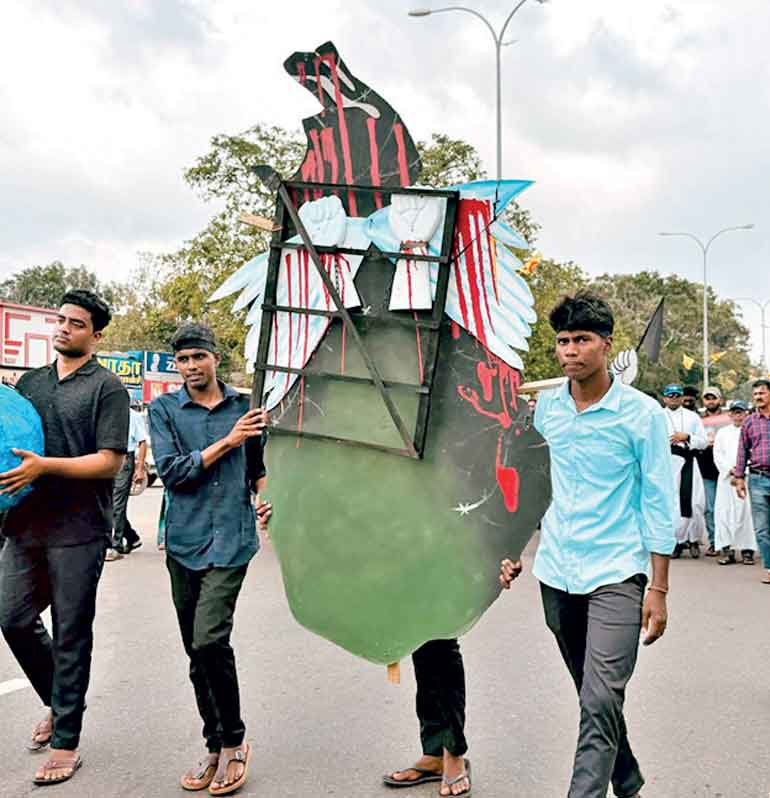
The post-war generation radicalised?
This was not a mere commemoration on the premises of Jaffna University. The numbers involved in the multi-town, double-province, ‘Independence rejectionist’ protest were hardly marginal. This makes the Tamil Eelam revivalist movement significant from a strategic and security perspective.
The last time I saw visuals of similar, though much larger, demonstrations were the Pongu Thamil and the Mahaveera Day events, and those were when Prabhakaran was alive.
If the demonstrations against Independence Day that were held in this island’s North and East were held in Indian-Occupied Kashmir, all the participants would have been locked up—and that’s to name just one such place on the world map where that would happen under similar circumstances.
I’m not advocating the same treatment here. However, President Dissanayake’s planned pullback of the Sri Lankan armed forces from the North and East and their reduction in numbers (a target of a 40,000 reduction of the Army alone) must be immediately reconsidered. It would be criminal folly verging on treachery to press ahead.
Political vacuum
There is one sense in which President Dissanayake and his Government are directly responsible for the unprecedented, open revival, at a mass level, of Tamil Eelamism and the Tamil Eelamist Movement. That is in the crucial political domain.
Except for the ultra-hawkish—and mercifully episodic—Gotabaya Rajapaksa Government, every previous Government in the post-July 1983 decades presented some variant of the decentralisation and devolution of political power to elected provincial units as an antidote to Tamil Eelamism. While this was no inoculation which guaranteed immunity, it provided a moderate alternative and counterweight.
Apart from Gotabaya, it is only Anura Kumara Dissanayake who has taken Sri Lanka back 40+ years to a situation in which we have neither a firm commitment to semi-autonomous Provincial Councils nor an ongoing process of political negotiation on an alternative.
Therefore, the moderate Tamil political elements who have proved their identification with Sri Lanka and as Sri Lankans (while seeking reform), and their willingness to function within Sri Lanka as a single country, have no political institution to sustain them. Their Parliamentary seats alone do not house them in an institution and gives them a mass base corresponding to their local, i.e., territorial, ethno-regional identity.
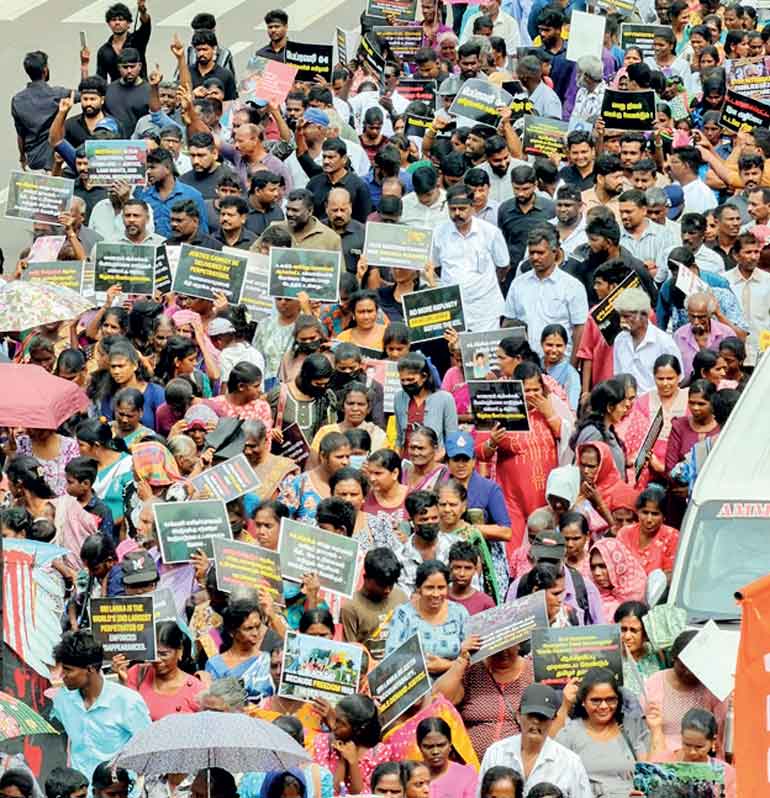
It isn’t just the youth
President Dissanayake doesn’t even have a Northern Tamil political figure in his Cabinet, which means he is more backward in that respect than DS Senanayake, Ceylon/Sri Lanka’s Founding Father.
Politicians and commentators should recollect or research the unarmed Tamil youth and student fronts of the early 1970s. This year’s 4 February demonstrations in the North and East looked an updated version of those, and any retired military or intelligence officer would recall how those movements metamorphosed in a few years as did the militant young Tamil political activists who emerged from those movements and were radicalised into the Tamil Eelam cause.
Whatever the JVP-NPP’s claims, the actual achievement of AKD policy in the North and East has been:
 The first ever postwar, anti-Sri Lanka, Tamil Eelamist demonstrations in multiple towns
The jailing of Douglas Devananda, who grew from a leftwing Tamil Eelam militant into a wounded hero who fought for Sri Lanka as an undivided, independent country with provincial semi-autonomy.
If Anura Dissanayake continues the unconscionable filibuster on Provincial Council elections, he and the JVP-NPP will face elections and almost certainly leave office in 2029 with a legacy of:
A revived Tamil Eelam movement in the North and East
Weakened Tamil political moderates
Imprisoned Tamil anti-separatists , e.g., Douglas Devananda
A weakened presence and configuration of the Sri Lankan armed forces in the island’s strategically vulnerable North-eastern cone
A smaller, weaker, demoralised military.
While the secessionist extremists of the North and East were shouting raucously on Independence Day, the democrats were silent in Parliament. The Government said nothing about the surge. The ITAK stayed mum. The Opposition Leader and the main Opposition party the SJB said nothing. Dilith Jayaweera said nothing on this subject in Parliament. Creditably, Namal Rajapaksa was something of an exception because he made mention of the demonstrations in his parliamentary speech, but it was insufficient.
While the secessionist extremists of the North and East were shouting raucously on Independence Day, the democrats were silent in Parliament. The Government said nothing about the surge. The ITAK stayed mum. The Opposition Leader and the main Opposition party the SJB said nothing. Dilith Jayaweera said nothing on this subject in Parliament. Creditably, Namal Rajapaksa was something of an exception because he made mention of the demonstrations in his parliamentary speech, but it was insufficient
India, Tamil moderates
Meanwhile, media reports of the meeting between Indian Foreign Minister Dr. Jaishankar and JVP General Secretary Tilvin Silva mentioned nothing about the 13th Amendment, Provincial Councils and the need to end the vacuum of Tamil political representation in the North and East.
Obviously, there was no joint communique here, nor could there be, but I can’t recall the last joint communique between India and Lanka in which the 13 Amendment and PCs were mentioned. India has mentioned these in its own remarks, but intermittently; increasingly infrequently.
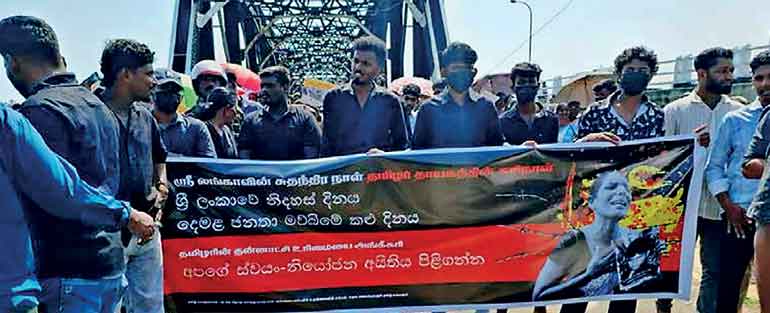
Note the difference in the Sinhala slogan: ‘self-representation’
Several alternative hypotheses are possible:
1. Hawks in the Indian system are allowing the 13th Amendment to stay frozen and the political vacuum prolonged for the purpose of eventual ‘Akhand Bharat’ annexation (‘Cyprusisation’)
2. Hardliners in Tamil Nadu have established their Tamil Eelamist proxy project in the island’s North and East
3. The pro-Tiger Diaspora in the West has made political ‘landfall’ and established itself as an autonomous force in the North and East
4. A Mossad or Mossad-RSS/Shiv Sena joint project in the North and East
5. Interplay of several of the hypotheses above
Isn’t there a moderate tendency among the Tamil political parties which would like to see the holding of PC elections? Why hasn’t there been a political movement in the North and East engaging in public pressure for the holding of long-deferred elections to the Provincial Councils.
Does the moderate ITAK have inadequate organisational strength, funds and popular support to mount a peaceful campaign for the reactivation of the 13th Amendment and the revival of elected Provincial Councils?
Is the moderate ITAK stuck in its collective subconscious, in the old groove of Constitutional change beyond the 13th Amendment and the existing structure of Provincial Councils, and therefore has no motivation still less passion to campaign for the revival of the 13th Amendment?
If so, it is a ‘bridge too far’: the ruling JVP is quite uncertain that there is a distinct, specific Tamil ethnonational question with a political aspect apart from the socioeconomic and developmental one, while it is quite certain that devolution of power to semiautonomous territorial units is not the solution.
Constitutional change
The revival of the openly anti-Sri Lanka Tamil Eelam movement in the North and East logically impacts the issue of political and conWstitutional reform.
The revival of ethno-political extremism at the island’s periphery makes it exceedingly unwise to weaken the political center by abolishing the nationally and popularly elected executive Presidency. It will be a difficult, polarising issue at a Referendum and utterly delegitimised without one
Without the directly-elected executive Presidency, it would be dangerously destabilising for Sri Lanka to maintain the desirable system of Proportional Representation. Though far more accurate a mirror and more democratic than a first-past-the post or mixed electoral system, a Parliament which can be manipulated by small ethnic extremist parties (as in Israel) would be far less stable than a system helmed by a nationally elected executive Presidency
AKD’s failure, JVP’s self-harm
The AKD administration’s current policy in the North and East has failed:
(a) To prevent the revival of Tamil secessionist ultranationalism
(b) To boost moderate Tamil nationalism
(c) To build either a progressive North-South integrationist sentiment or moderate (ITAK) nationalism that could pre-empt or countervail the anti-Sri Lankan protests on 4 February
(d) To avoid provoking a Sinhala-Buddhist backlash which is nudging beyond the fringe into the mainstream
The JVP-NPP Government’s freeze on the Provincial Councils not only harms Sri Lanka by closing off a reformist option, thereby radicalising Tamil youth, it also harms the JVP-NPP itself.
A PC election will witness a drastic drop in the pro-NPP vote of 2024, but (dialectically) has a positive flip-side: it will give the JVP-NPP a foothold that it has never had before; a foothold that will last beyond the next Presidential and Parliamentary elections.
The JVP has never won a Provincial Council and it may never win one this time, but then again, it might. In the worst case, it will form the Opposition in the Provincial Councils. That will give it a new base at a level of the political system, the provinces, which can help in 2029 while being fallback, seedbed and springboard after a defeat in 2029.
If the JVP-NPP does not reactivate the Provincial Council system soon through the holding of elections:
It will not be able to put a brake on the open radicalisation underway in the North and East
It will not be able to prevent the Southern public opinion backlash and electoral erosion in 2029, provoked by Northern and Eastern dynamics
It will turn the whole political game zero-sum because it will not have a PC buffer and safety-net against economically-driven decimation
Just as the LTTE, the JVP continues (1971, 1989) to lack the strategic sagacity for long-range thinking and planned, timely retreat.
Silver lining
This black cloud has a faint, wafer-thin silver lining: the sensibility of the leading English language publication in the North and East, the Jaffna Monitor. I conclude with the reproduction of Editor Arulinian’s reflection:
This Is Our Country Too.
Amid opportunistic calls to mark February 4th as a “Black Day,” we are republishing an editorial written last year by our Editor-in-Chief.
Yes, Independence Day carries pain for many Tamils — of land, loss, and denied rights. That truth cannot be erased.
But using this day to push permanent rejection of Sri Lanka is not justice. It is political theatre.
We did not lose this land because of the soil.
We suffered because of men and failed politics.
Our ancestors fought colonial powers on this land.
Our dead are buried here.
Our language and history are rooted here.
This is not a foreign country to us.
This is home.
The war is over. Separatism is an illusion.
The only path forward is to fight for dignity and rights within Sri Lanka — not outside it.
This is our land too.
And no one can take it from us.
(https://www.jaffnamonitor.com/this-is-our-soil-and-no-one-can-take-it-from-us/)
[ https://dayanjayatilleka.webflow.io/ ]



