Friday Oct 16, 2026
Friday Oct 16, 2026
Wednesday, 20 May 2026 04:15 - - {{hitsCtrl.values.hits}}
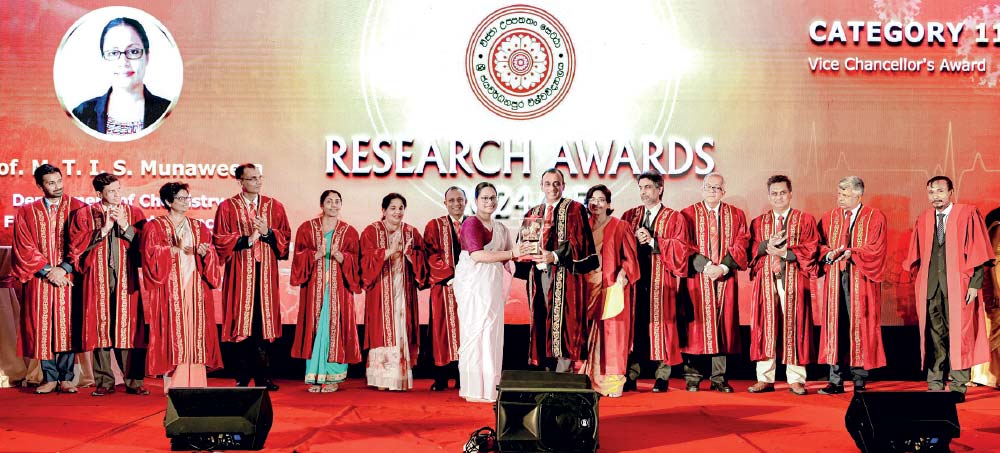
Prof. Imalka Ranaweera receiving her Research Award from Sri Jayewardenepura University Vice Chancellor Prof. Manage flanked by the Co-Chairpersons and the Deans of all eleven faculties of the University
 Introduction
Research in Sri Lanka continues to face significant and persistent challenges, largely due to chronic underfunding, inadequate infrastructure, and a shortage of trained personnel. Limited financial investment, combined with the relatively low prioritization of research within higher education institutions, has constrained academic productivity and innovation. Furthermore, the high cost of essential research resources exacerbates these limitations. National expenditure on research and development (R&D) remains markedly low, falling well below both regional and global benchmarks.
Key challenges in the research ecosystem
Several structural and systemic issues continue to impede the development of a robust research culture in Sri Lanka.
Research expenditure remains substantially below international standards. Available grants are limited in number, modest in scale, and often delayed, thereby restricting the conduct of high-quality research.
Collectively, these challenges contribute to what has been described as a “silent crisis” in university research, limiting Sri Lanka’s transition towards a knowledge-based economy. Universities are often perceived primarily as teaching-oriented institutions, with research occupying a secondary role due to both structural constraints and prevailing misconceptions.
Advancing research culture: The case of University of Sri Jayewardenepura
Despite widespread challenges, the University of Sri Jayewardenepura (USJP) has demonstrated notable progress in advancing high-quality research. This progress can be attributed to strong institutional leadership and a collective commitment to fostering a research-oriented culture.
The foundation for strengthening research at USJP was established in 2016 with the creation of the Research Council, under the guidance of then Vice Chancellor Sampath Amaratunga. The Council was envisioned to foster a sustainable, high-quality, and impactful research culture.
Currently, the Research Council operates under the leadership of Vice Chancellor Pathmalal Manage as Executive Chairperson, supported by Co-Chairpersons Pradeepa Jayewardane and Roshan Ajward, along with General Secretary Anushka Rajapaksha. The Council also includes faculty deans and key administrative officers such as the Registrar, Bursar, and Librarian. In alignment with national priorities, the University has established 23 research centres, significantly strengthening its research infrastructure and capacity.
Under the leadership of Pathmalal Manage, supported by the Deans of eleven faculties, the University has articulated a clear vision and strategic direction for promoting research excellence. This commitment was prominently reflected in the Research Awards Ceremony 2024/2025, held on 27 March, which showcased the breadth and depth of scholarly achievements across multiple disciplines.
USJP Research Awards Ceremony 2024/2025
Marking the tenth anniversary of the Research Council, the Research Awards Ceremony 2024/2025 commemorated a decade of academic excellence and the development of a vibrant research culture among both senior and early-career academics.
Through the provision of infrastructure, competitive funding opportunities, facilitation of knowledge dissemination, and promotion of national and international collaborations, the Research Council has created a conducive environment for high-quality research. Academic and administrative staff are supported through competitive research grants and a structured system of recognition.
Recognition and evaluation of research excellence
Since 2015, USJP has conducted annual Research Awards Ceremonies to recognize outstanding research achievements. These awards acknowledge:
Award recipients are selected through a rigorous evaluation process conducted by an eminent expert panel. For 2024 and 2025, a total of 883 awards were conferred across 11 categories, including the prestigious Vice Chancellor’s Award and Young Researcher Awards.
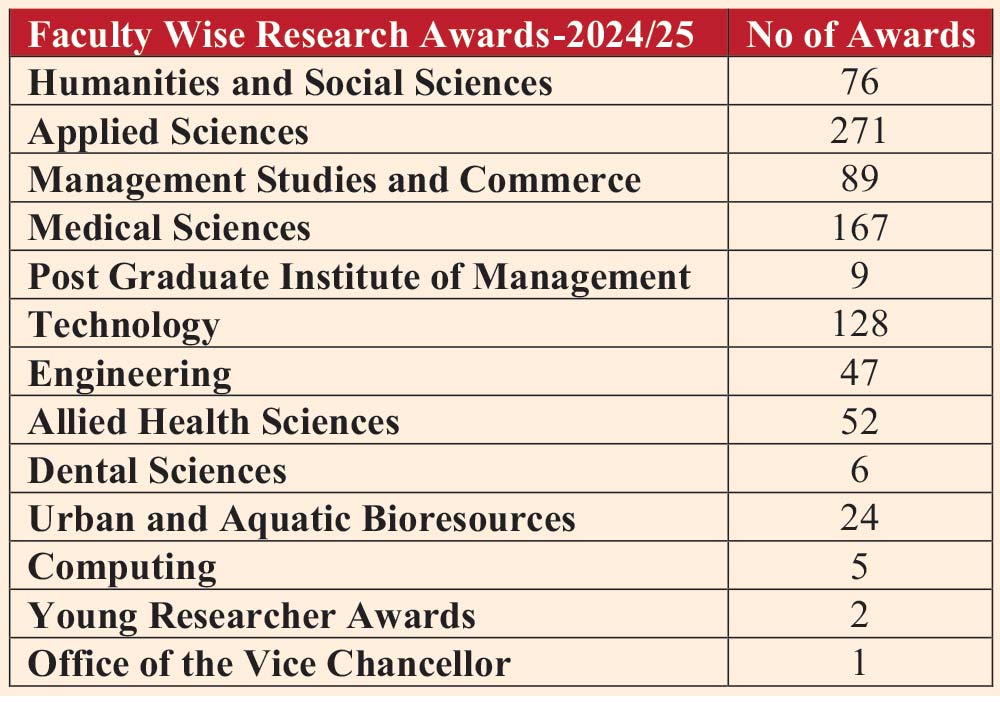
Among the distinguished recipients were Dr. Kasun Thambugala of the Genetics and Molecular Biology Unit, Faculty of Applied Sciences, and Dr. Saranga Diyabalanage of the Department of Forestry and Environmental Sciences, Faculty of Applied Sciences who captured Young Researcher Awards. Prof. Imalka Munaweera of the Department of Chemistry, Faculty of Applied Sciences clinched the Vice Chancellor’s Award. These accolades underscore the University’s commitment to fostering research excellence.
Research, policy, and national development
Research investment and outcomes
Over the past decade, USJP has invested more than Rs. 1.3 billion—combining funding from the University Grants Commission (UGC) and internally generated resources—into research initiatives. This investment has produced significant outcomes, including:
These achievements reflect sustained dedication to developing researchers and advancing knowledge production in Sri Lanka.
Research, policy, and national development
Development is often narrowly defined in terms of physical infrastructure. However, intellectual growth, cultural preservation, and social well-being are equally vital components. Despite substantial infrastructure investments, Sri Lanka continues to face challenges in achieving long-term growth due to weaknesses in institutional performance, poor coordination, and limited integration of research into policymaking.
Research and development form the intellectual foundation of modern economies. For a country like Sri Lanka—with a small domestic market and vulnerability to external shocks—knowledge generation is indispensable.
Sri Lankan universities produce a significant volume of social science research addressing pressing societal issues. However, there is no systematic mechanism to evaluate this output, and more critically, research findings are rarely integrated into public policy. This disconnect has resulted in missed opportunities for evidence-based decision-making and inclusive development.
Innovation and commercialization challenges
Emerging academics and postdoctoral researchers have contributed significantly to innovation through both collaborative and independent research. Their work spans prototypes, formulations, and process improvements with strong commercialization potential.
However, key challenges remain:
These barriers prevent the effective translation of academic research into economic and societal benefits.
Conclusion
The experience of the University of Sri Jayewardenepura demonstrates that, despite systemic challenges, a strong research culture can be cultivated through strategic leadership, institutional commitment, and sustained investment.
The University’s achievements provide a compelling model for strengthening research ecosystems in Sri Lanka. However, the responsibility now extends beyond individual institutions. The University Grants Commission, policymakers, and industry stakeholders must collaborate to enhance support systems, streamline administrative processes, and foster stronger academia–industry linkages.
By doing so, Sri Lanka can unlock the full potential of its research sector and position itself more competitively on the global stage—transforming research into a driving force for sustainable national development.
(The author is the former Secretary, Ministry of Plan Implementation. He can be reached on [email protected])




