Sunday Sep 13, 2026
Sunday Sep 13, 2026
Saturday, 11 July 2026 01:48 - - {{hitsCtrl.values.hits}}
 There is no evidence of Sri Lankans being maritime traders who took our products to the world, it was always a non Sri Lankan trader who took our products to the Middle East and the Far East. One of the greatest mysteries will be why our ancestors never looked at the sea as a source of resources other than the fish you can catch close to the shores by using a simple canoe and never left our shores to trade and explore for new products and technologies etc
 Hundreds of years before the term ‘strategic foresight’ was ever invented, Sri Lankan kings have demonstrated this concept to a level which is not seen in other parts of the world. One major factor is that this strategic foresight that they adopted is relevant even today and is being used by modern Sri Lankans. They were able to develop this complex system of integrated environmental management Commercial Activity and defense, which culminated in the concept “Wewai, Dagabai, Gamai, Pansalai” and lasted centuries, and continue to inspire modern urban designers off Sri Lanka.
Since we were children we have heard the Sinhala saying “Wewai, Dagabai, Gamai, Pansalai” (Tank, Pagoda, Village, and Temple) which in fact describes the ancient strategic blueprint used by our forefathers for survival and community structure in Sri Lanka’s dry zone. This interconnected strategy uses local ecology to harvest rainwater, manage agriculture, and temple networks resolve resource disputes. It is vital to note that this strategy was maintained (especially in the dry zone) by successive kings and kingdoms as a method of expanding settlements. Each king built on the success of the previous kings and we have no known record of a maverick king having a different or tangentially opposite strategy to this tried and tested method. When it came to the wet zone they simply diverted the many 100s of streams and rivers for cultivation replacing the river with the Wewa. The key takeaway is the use of terrain, resources and their availability to your advantage and not to fight against it.
|
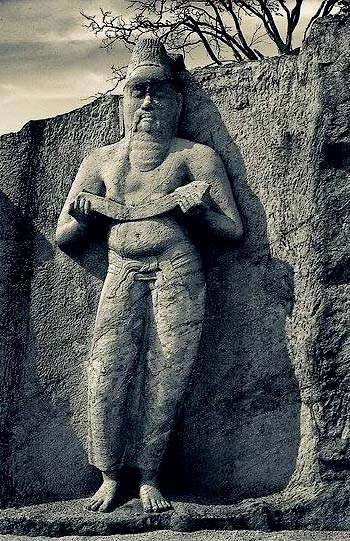
King Parakramabahu I
|
Asymmetric doctrines
Sri Lanka’s historical defence relied on asymmetric doctrines. While early rulers’ neutralised regional threats from South India, the Southeast Asian regions, and Ming China. Even when facing vastly superior firepower from Portuguese, Dutch and British forces Kandyan rulers avoided decisive, symmetric battles. The pinnacle of their powers could be seen during the unconventional warfare which occurred during the Kandyan Kingdom’s resistance against European empires. The Kandyan kings weaponised the rugged central highlands through scorched-earth tactics, disease exposure, and ambush-heavy guerrilla warfare. This disrupted foreign supply lines and neutralised Western technological advantages until 1815.
Sri Lanka’s military history reflects a profound evolution from ancient, land-based guerrilla tactics against colonial empires to groundbreaking, world-first naval innovations during the modern civil war. Over centuries, asymmetric Sri Lankan forces repeatedly adapted to overcome structurally superior, conventional armies. In the final stages of the recent conflict, the military fundamentally shifted its strategic doctrine, adopting a philosophy of “out-gruelling the guerrilla” to secure victory.
Sri Lanka’s culture of asymmetric strategic thinking is such a powerful ethos that it has even influenced global sports such as how Cricket is played to directly shape its business and commerce. This mindset—built on agility, cost-efficiency, and unconventional methods to outperform larger rivals—has deeply influenced how the nation competes on the global stage.
Rather than competing on sheer volume against massive economies, Sri Lankan businesses secure unique niches by redefining market rules. For instance, instead of rivaling countries like Bangladesh or China in low-cost, mass-market apparel production, Sri Lanka leverages an asymmetric strategy centered on high-value technology and rigorous ethical standards
The irony is that since independence in 1948 no Sri Lankan leader has looked to the sea as a source of food and nutrition for the population of Sri Lanka. Their vision sadly did not extend beyond the paddy fields, let alone it being a revenue and income generation source. Even today the vast untapped Indian Ocean can be harvested to develop our fishing industry to be a global number one or two
In the strategic footsteps of our forefathers
Some parts of Sri Lanka have been under the control and rule of colonial powers for nearly 445 years, from 1503 to 1948. Post 1948, it has struggled, like many colonial countries, to shed the effects of colonial policies and to rebuild the country for the benefit of all its citizens. Many may wonder about this hypothetical question, “what if” the colonial powers never arrived at our shores or what if we would have been successful in repelling them from our lands. What if the trade winds failed and they never came to Sri Lanka, where would the country be in its development cycle? A more fundamental question is “why did we not revert back to the way of our kings which is reliant on the physical attributes of our island nation? In order to do that, let’s do a simple extrapolation of four elements which our ancestors wanted to use to its full potential: Water (Sea, land based water bodies and rain) Wind, sun light.
Being an island the most abundant is the water (sea) around us, other than King Dhatusena and King Parakramabahu I, who built powerful naval ships, the tradition of sea going does not seem to be in our DNA. These kings demonstrated the ability to launch seaborne invasions before they hit the beaches, and even launched successful overseas military attacks on places like Myanmar and Southern India. Our history is filled with the island being a part of seaborne trade routes. Nevertheless, there is no evidence of Sri Lankans being maritime traders who took our products to the world, it was always a non Sri Lankan trader who took our products to the Middle East and the Far East. One of the greatest mysteries will be why our ancestors never looked at the sea as a source of resources other than the fish you can catch close to the shores by using a simple canoe and never left our shores to trade and explore for new products and technologies etc.
According to the Export Development Board Sri Lanka ranks in fish export are, Fish Fillets: Ranks 35th, Live Fish: Ranks 23rd, Ornamental Fish: Ranks 2nd. Given our access to the Indian and southern oceans Sri Lanka should be in the top 3 of fillet and live fish export categories. A fantastic hedge against other export products. The harvest of sea grasses and kelp as fertiliser and animal feed along with mining for rare earth metals and other minerals can raise the GDP significantly as well as broad base our economy.
The maximum use of the free resources we have at our disposal brings the cost of production down and makes products made in Sri Lanka more globally competitive
Harvesting the ocean
The irony is that since independence in 1948 no Sri Lankan leader has looked to the sea as a source of food and nutrition for the population of Sri Lanka. Their vision sadly did not extend beyond the paddy fields, let alone it being a revenue and income generation source. Even today the vast untapped Indian Ocean can be harvested to develop our fishing industry to be a global number one or two.
The second source of water in this island are the many rivers and the monsoons we get annually to wash our land with sweet fresh water. Sri Lanka has of course done very well in fits and bouts. Being able to restore and use almost all the tanks that were left behind by our great kings. Post-Colonial Sri Lankans have been able to add our share of dams and canals to ensure this tradition of taking maximum use of water before it flowed into the sea. Where terrain is conducive the canals ensure that the agricultural farmlands are supplied with the required water. The agricultural issues are two fold, manmade and the changes in the weather patterns which we don’t have any control over. In terms of manmade issues which can of course be reversed, the first being the regular maintenance or the canals and tanks. The second being the reduction of the plot size as a result of policy decisions taken to increase land ownership versus keeping food costs down and ensuring food security. This can be done by having new regulations to allow cultivation land consolidation to increase plot size to make it more viable to cultivate. Having a plan for cultivation variety and yield targets to ensure adequate food supply and keep the prices within affordable ranges.
The generation of hydropower is perhaps another matter, where we have not been able to get maximum benefit from our heritage. Grid connectivity to nearly 500 plus mini hydro stations which eventually fell into disuse in the 1940 to 1950 until in 1990 where there was a revival of mini hydro plants. The opportunity exists to connect these mini hydro power plants with the development of much more efficient generators which require a lot less potential energy. According to studies by the Ministry of Irrigation and Water Resources the overall total mini-hydro potential is estimated at 873 MW. Out of this potential, the country’s current installed capacity sits at approximately 422 MW. The Micro hydro capacity is estimated to have a potential of around 15 MW to 20 MW across Sri Lanka, with approximately 5 MW to 10 MW currently installed. Every day we delay bringing these on line we pay and get diesel fuel to generate this gap in power availability.
Our ancestors gained international reputation for Serendib steel in the 7th century (Perhaps Sri Lanka’s first Brand) by the use of wind power in smelting high quality steel. Today we can harness the same power to generate wind powered electricity.
This island nation is blessed with so much sunlight. We must try to generate 100% of our day time power needs from solar power. Any excess power stored in batteries or used to charge hydro batteries. The maximum use of the free resources we have at our disposal brings the cost of production down and makes products made in Sri Lanka more globally competitive. During bad weather periods and night time peak power requirements we can always be supplied by other sustainable and non-sustainable sources (Hydro and nuclear as well as thermal). Our aim must be the elimination of thermal power generation from fossil fuels to be sustainable as well as become more globally competitive.
It appears that Sri Lankans over the millennia have relied on strategic foresight and asymmetric strategy to overcome adversity and to continue to extend their civilisation. Let’s hope that going forward our modern leaders have the ability to juggle these two approaches and help guide the nation to the best possible future that we can achieve.
Sri Lankans over the millennia have relied on strategic foresight and asymmetric strategy to overcome adversity and to continue to extend their civilisation. Let’s hope that going forward our modern leaders have the ability to juggle these two approaches and help guide the nation to the best possible future that we can achieve
(The writer is the author of the book “How Small Countries Can Compete and Grow - A Case for Sri Lanka”. He is the founder of Think Tank Lanka Ltd., a Strategy think tank and R & R Associates Consulting, a sector-independent strategy consulting practice).