Wednesday Sep 16, 2026
Wednesday Sep 16, 2026
Saturday, 7 March 2026 00:04 - - {{hitsCtrl.values.hits}}
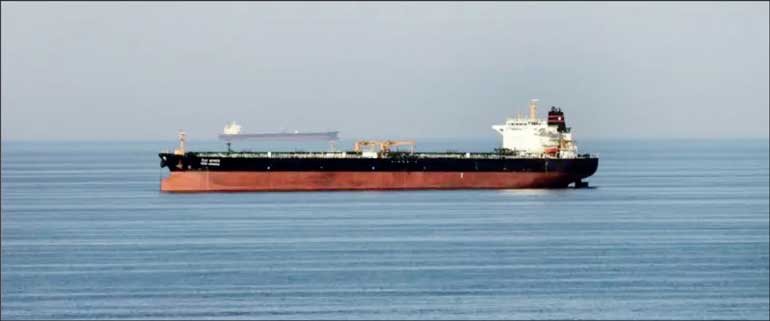
Oil tankers passing through the Strait of Hormuz/File photo
 In the latest escalation of the crisis in the Middle East, Iran has closed the Strait of Hormuz.
According to Science Direct, Sri Lanka imports nearly all of its oil and gas, relying heavily on the Middle East, with major suppliers being Oman, Iraq, the United Arab Emirates (UAE), and Bahrain. The country relies on imported crude for its single, aging refinery and imports refined products (diesel) via the spot market (https://www.sciencedirect.com/science/article/abs/pii/0360544286901416# :~:text= The%20country’s% 20single%20refinery%20operates, sources%20of%20oil%20or%20gas). A significant portion of these supplies must pass through the Strait of Hormuz making the country’s energy security highly vulnerable to any disruptions in that waterway. Significant volumes of jet fuel, diesel, and naphtha that fuel the global market also transit this chokepoint before reaching regional hubs. While Sri Lanka imports a large volume of refined petrol and diesel from India and Singapore these countries themselves are heavily dependent on crude oil that transits the Strait. If the Strait is blocked, the cost of refined fuel from these hubs spikes immediately due to global price surges.
While oil and gas price hikes will follow with the closure of the Strait of Hormuz and with it the cost of food and energy supplies irrespective of who supplies them, Sri Lanka is bound to face a seismic shock as a consequence of these developments, unless there is a resolution to the conflict soon, which unfortunately seems unlikely.
In this backdrop it is important to note the foreign reserves of the country now and its relevance to the country’s food and energy requirements. Sri Lanka’s current foreign reserves of USD 6.8 will be sufficient to fund food, oil, medicines, and gas imports for around 3.1 months according to CEIC data.
This is the current fragile situation that the country is facing.
The intensifying conflict involving the US, Israel, and Iran marked by direct strikes on Iranian targets, the death of Iran’s Supreme Leader, and retaliatory strikes on Gulf States, poses a serious system shock to Sri Lanka’s tenuous economic recovery. With over one million Sri Lankans in the Middle East (who remitted a major component of the total remittances of over $ 8 billion in 2025) and the country’s heavy reliance on the Middle Eastern region for energy, and exports (The major component of the 2025 annual export figure of $ 17.2 billion), the impact is expected to be profound across economic, political, and social sectors should conflict accelerate and becomes long lasting.
According to the Central Bank, both foreign exchange earners, worker remittances and exports, showed significant increases in 2025 compared to 2024, with the former showing an increase of 22/8% and the latter, an increase of 6.32%. This situation could change and the gains made negated by the conflict. Besides these, there are numerous other statistics that can be cited to show that the country was recovering economically, slowly but surely. The latest conflict in the Middle Eastern region is akin to a missile attack on the economy. The damage it has done, and may continue to do, introduces a new challenge to the country. It is important to recognise this challenge as a challenge to the country and not just to the Government.
As well articulated in Economy Next, the fuel and energy crisis could exacerbate with the blockage and disruption of the Strait of Hormuz, through which 20% of the world’s oil flows, Sri Lanka faces the prospect of soaring crude oil prices. While Sri Lanka has diversified its oil suppliers, the state-run Sapugaskanda refinery relies on Middle Eastern crude and could be forced to halt operations if supply lines are disrupted. The impact on remittances, export disruptions (Tea is a major export to the Middle East, particularly Iran and Arab nations), higher fuel and electricity costs that could spark inflation, and global economic uncertainty which may cause capital flight, and currency depreciation.
Possible immediate social impact, with the safety of over one million expatriate workers in the region, that could require the Government to organise massive repatriation, and should the conflict be framed along sectarian or religious lines, could pose risks to social cohesion in Sri Lanka. If all above eventuates, there will be a significant increase in cost of living due to increased transportation and food costs, drop in the country’s income, and with it, the likelihood of social unrest in the country.
The impact of these developments that are consequential to the current crisis, and due no fault of the Government, will provide Manna from heaven to the knit picking Sri Lankan political Opposition which has basically been operating as a reactive impediment to the development efforts of the Government rather performing the role of strategic minded constructive critics advancing the country’s interests.
At a broader level, the crisis will pose a foreign policy challenge requiring Sri Lanka to navigate a difficult balancing act, maintaining its traditional “non-aligned” foreign policy while managing cordial relations with both Iran and Israel. The direct involvement and global influence of the US, and the meekness and reluctance of powers like China, India and Russia to exert decisive pressure on all parties involved in the conflict to end the bombings and sit at a negotiating table, and the impotency of the UN have all added pressure on Sri Lanka to navigate a tight rope walk approach to diplomacy and much behind the scenes activity. In this context, this is not a time for neither the Government nor the Opposition to engage in point scoring but work together for a unified effort in the best interest of the country. Tsunamis do not differentiate between a Government and other political parties. The current crisis could well turn out to be an economic Tsunami for the country.
While security concerns have been highlighted as a fall out of the crisis, it can be argued that this will be a direct consequence of how the country’s foreign policy is handled. Events like joint Military and Naval exercises perhaps are not in the best interest of the country at this stage as political interpretations of such exercises may not be in the best interest of the country.
For the country to remain stable in the circumstances that are unfolding globally, the Sri Lankan State, not just the Government should navigate a “managed stability” phase by balancing foreign policy challenges and other economic and social challenges from the perspective of the State (country) and not that of any political grouping including the Government. Even prior to the current crisis, several independent think tanks like the Eurasia Review ( https: //www. eurasiareview.com/03022026-sri-lanka-managed-stability-analysis/), and ODI Global (https://odi.org/en /insights/sri-lanka-needs-a-growth-plan-to-avoid-anothercrisis/#:~:text=Improved% 20state%20planning %20for%20undertaking,future%20prosperity%20and%20donor%20support) have suggested some high level strategies as noted below.
Economic resilience and mitigation
Political stability and governance
Social protection and public trust
The current crisis and opportunities for the future
The immediate task for the country would be to assess the impact of the ongoing conflict on the country and devise a plan of action as to how best it could minimise the severity of the impact. While doing this, it also needs to lay groundwork to change/adjust its economic management model to ensure future shocks and impact is minimised. While all or some of the issues highlighted earlier are the priorities of the Government, the current crisis, and what has taught the country (the instability and fragility of the global order), should now extend approaches to these and other economic, and social challenges as National priorities. While democracy entails the ability and the right to exercise a choice and therefore the right to articulate choices, at a national level, the political establishment could agree on a framework for governance similar to the IMF framework, but where guidelines (in the case of the IMF, imperatives for economic support) for key governance areas could be included in a binding framework for them.
Such a framework, should it see the light of day, could of course be updated periodically, but its essence would be the consistency and stability of broad, high level governance policies of the country irrespective of which political party or grouping is in power. All political parties should be bound by such a framework so that the people of the country, and local and overseas investors will have the certainty they will require to invest in the country. As with the IMF framework agreement, a National Governance Framework will provide authority for political parties, should they be in power via elections, to operate within agreed parameters of the agreement, but adopt different strategies to achieve the outcomes noted and agreed upon in the framework.
Looking to the future and the fragility of the Global political order, a system change of this nature is essential for the country to progress and lay the groundwork for the next generation and those to come, to have confidence in the country and enjoy a good education, a good health system, a good social system, and economic opportunities. The lack of confidence in these are the drivers that lead to the exodus of the country’s talent to other countries to seek these basics elsewhere. As the debate today amongst Opposition political parties is about how best to destabilise the Government through strikes, work stoppages, work to rule campaigns etc., and who shouts the loudest in Parliament so that they will be shown as heroes in social media, constructive criticism and advancing the country’s economic and social interests have taken a back seat.
With a possible economic Tsunami heading towards the country, the basic high level governance policies could centre on some priorities like economic management, health and education, agriculture and food security, export development, water management, energy management etc. Some suggestions for strategic governance in economic management are noted here. As with these, similar strategic governance policies for the other areas mentioned too should be included in a National Governance Framework.
The economic management strategies should consider the following:
1. Increasing GDP and its per capita income well above the currently planned targets
Sri Lanka GDP projection for 2025 was around $ 87 billion and the projected per capita income was $ 3,799 - $ 3,939. These need to rise above 8% over 10 years to achieve a GDP of $ 200 million and a GDP per capita of $ 9,000 to qualify as an upper middle-class status. A high-income status requires a per capita of $ 13,846 or more. Can Sri Lanka achieve these targets? It is noteworthy that Singapore GDP in 2024 was $ 547.4 billion and per capita $ 90,674.07. Singapore’s projected GDP will be $ 900 billion in 10 years with a per capita of $ 130,000. Sri Lanka must decide where it wishes to be in ten years
2. Increasing country’s foreign reserves
Trading economics (https://tradingeconomics.com/sri-lanka/foreign-exchange-reserves) states that foreign exchange reserves in Sri Lanka was $ 6. 82 billion in January 2026, enough to fund imports of oil, gas, medicine, food etc., for a period of 3.1 months. This is not sufficient and Sri Lanka should have a foreign reserve and foreign assets equal to or more than its foreign debt as countries like Singapore do and make its debt a net zero debt. It is interesting to note that Singapore’s foreign exchange reserves were SGD 529.11 billion (approx. $ 416.97 billion) in January 2026, and the total reserves of Singapore based on publicly available data from Government of Singapore Investment Corporation (GIC), the Government of Singapore owned multinational investment firm Temasek Holdings Ltd., the Monetary Authority of Singapore (MAS), and Government’s Central Provident Fund (CPF), are conservatively estimated at SGD 2.5 trillion (2024) ($ 1.87 trillion). Singapore too has a substantial gross external debt, reportedly over SDG $ 2.4 trillion, but possesses zero net debt because of its substantial financial assets and foreign currency reserves that far exceed its liabilities.
3. Economic governance suggestions for inclusion in a framework agreement
The question from a national perspective is whether Sri Lanka will be able to withstand the potential impact of the current crisis and plan to minimise the impact of Global shocks. The following are suggested for discussion and inclusion in the National Governance Framework, besides the GDP, per capita income and foreign reserves and foreign assets as noted earlier.
Managing the country’s recurrent expenditure with its own income and not through internal or external debt.
Setting aside a minimum percentage of income for essential infrastructure project expenditure and meeting shortfalls with long term internal and external debt or grants
Personal income taxation structure should be aimed at total revenue targets and strategic approaches to achieve these targets including widening the tax net by reducing the tax rates, including lowering the highest tax rate. A high taxation rate and many tax evaders is not a logical approach to increase tax revenue. (There are questions raised about the number of high-income earners including many medical professionals, engineers, architects, lawyers, tuition teachers etc., who either do not pay tax or who somehow underpay their tax).
Doubling, if not trebling export income over 5 -10 years
A local currency reserve – A percentage of income to be set aside as local reserves that should be used only during an emergency.
4. A more defined role for the banking sector
The Boston Consulting Group noted that at the end of 2024, the total deposits in Sri Lankan banks amounted to around Rs. 16.16 trillion ($ 57.4 billion). The Group went on to say that this total reflected a significant increase throughout 2024, growing by 18.43% year-on-year from around Rs. 10.4 trillion in 2023.
Given this situation, the National Governance Framework should articulate how best these “sleeping” assets (which exceeds the Government foreign debt of $ 37.1 billion) could be put to yield better dividends in the longer term to the deposit holders and through the employment of such funds, allow the Banks to invest in more revenue generating projects.
A strategic system change is needed to change the historical role of banks functioning more as a funding arm for the Government than as a catalyst for private-sector production. Of course, deposit holders will require Government guaranteed higher interest rates for deposits that are “locked” in say for 5 or even 10 years. Banks will then have the freedom to invest in profit yielding ventures where the revenue will allow them to pay the higher interest rates to the deposit holders.
This proposal needs further elaboration, and the author intends presenting an argument to move Banks from being a funding arm for the Government onto profitable private sector ventures in a follow up article.
Conclusion
In conclusion, a strategic system change in governance policies is needed to move the country from a debt-servicing mind set to an asset-building one, where assets exceed debt. This will require a level of political willpower that spans decades, not just five-year election cycles. In Sri Lanka, the pressure to provide immediate relief (like subsidies or tax cuts) often interferes with the disciplined effort to have “primary surpluses” required to build a national asset pool (net foreign reserves, State owned overseas assets and State investments that provide better yields) that will exceed the country’s foreign debt.
No political party or grouping functioning as they are now in Sri Lanka’s democracy will be able to make this strategic change as short term, immediate relief measures will take precedence over long term strategic governance overhaul. It is for this reason that while democracy and democratic governance is maintained, an agreement on a National Governance Framework supported by all political parties and groupings is proposed as the way forward to achieve such a strategic change.
Will our political leaders have the foresight, wisdom and the guts to bury their short-term hatchets and look beyond their noses to see and understand that a seismic change to governance policies, goals and objectives is needed if the country is to withstand the impact of global shocks orchestrated by others? This remains to be seen.




