Monday Oct 12, 2026
Monday Oct 12, 2026
Friday, 21 August 2026 00:24 - - {{hitsCtrl.values.hits}}
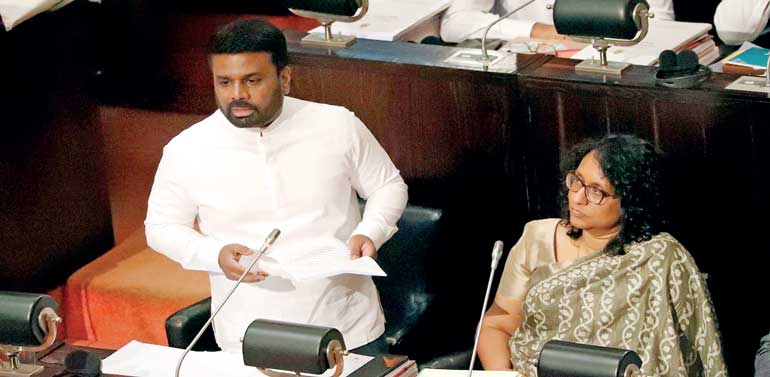
President and Finance Minister Anura Kumara Dissanayake
 Only a few months ago, Sri Lanka appeared to have regained something almost as important as macroeconomic stability: confidence in the future.
In February 2026, Verité Research's Mood of the Nation poll recorded Government approval at 65%, while 57% of respondents rated economic conditions as good or excellent, 64% believed the economy was getting better, and 59% expressed satisfaction with the country's direction.
By July, that optimism had weakened considerably.
Government approval had fallen to 50%. The share rating economic conditions as good or excellent declined to 38%, while those believing the economy was getting better dropped to 42%. Overall satisfaction also fell to 38%.
The significance lies not simply in one declining number, but in the fact that political approval, economic confidence, and general satisfaction have all moved in the same direction.
These figures should not be mistaken for a wholesale rejection of the Government. With approval still at 50%, a significant degree of public confidence remains. But the direction of sentiment carries an important message: public expectations may be moving faster than the country's economic transformation.
After the crisis, restoring stability was enough to generate hope. Now Sri Lankans increasingly want to know what that stability will deliver - better jobs, higher incomes, new investment, stronger businesses, and greater opportunities for the next generation.
Stability may have restored confidence. Development will determine whether the Government can sustain it.
Sri Lanka has achieved something important since the depths of its economic crisis. Macroeconomic stability has gradually returned, inflation has been brought under greater control, fiscal discipline has strengthened, and the immediate fear of economic breakdown has receded.
That progress matters. But it would be neither accurate nor fair to attribute the entire stabilisation process to the current Government. Important foundations were laid under the previous administration during the most difficult phase of the crisis, while the present Government inherited and continued that process.
The debate should therefore move beyond who deserves political credit for stabilisation. The more important question is who can turn that stability into development.
Macroeconomic stability is measured through inflation, fiscal balances, foreign reserves, and other indicators. Ordinary Sri Lankans experience recovery differently. They measure it by whether good jobs are being created, whether wages can cover household expenses, whether businesses are expanding, whether young people see opportunities at home, and whether parents can reasonably believe their children will enjoy a better future.
That is the difference between stabilising an economy and developing one.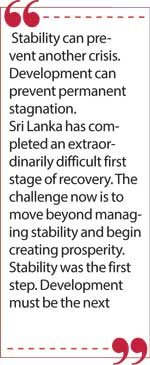
The latest Mood of the Nation findings should therefore be read as more than a political warning. They may be signalling a fundamental shift in what Sri Lankans now expect from economic recovery.
During the crisis, the immediate question was: Can the economy be stabilised?
Today, the question is increasingly: What will that stability deliver?
Will it create better jobs? Attract new investment? Generate new industries and exports? Raise incomes? Give businesses greater confidence? Create enough opportunities for young Sri Lankans to see their future at home?
That shift from demanding stability to demanding development may be the most important message in the poll.
Fiscal discipline without economic paralysis
Sri Lanka's debt crisis understandably made fiscal discipline a national priority. Unsustainable borrowing, persistent fiscal imbalances, and investments that failed to generate sufficient economic returns contributed to a crisis whose consequences were felt across society. No Government should forget those lessons.
But Sri Lanka must be equally careful not to learn the wrong lesson.
The lesson is not that borrowing is inherently bad. The lesson is that borrowing without adequate economic returns is dangerous.
There is a fundamental difference between financing recurrent expenditure and mobilising capital for infrastructure, energy, logistics, technology, research, industrial capacity, and export development that can expand the economy's future productive potential.
Sri Lanka has already experienced the consequences of borrowing without generating sufficient returns. That mistake must not be repeated. But there is an opposite danger: becoming so determined to avoid debt that the country underinvests in the foundations of future growth.
Infrastructure must be built. Energy systems must be modernised. Ports and logistics must become more competitive. Research and technology require capital. New industries need investment. Export capacity must expand.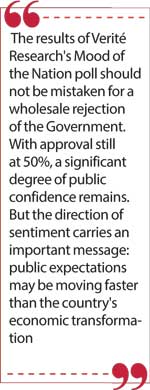
Without these, Sri Lanka risks achieving fiscal stability today only to inherit weak productivity and inadequate growth tomorrow.
The question is therefore not simply: Should Sri Lanka borrow?
The better question is: What investments will expand the country's productive capacity, how should they be financed, and will the economic returns justify the cost?
Fiscal responsibility should therefore be built around discipline and development rather than austerity alone. Sri Lanka cannot afford to repeat the mistakes that contributed to its crisis, but neither can it become so cautious that productive investment, infrastructure, innovation, and industrial expansion are sacrificed in pursuit of fiscal restraint.
Fiscal prudence should prevent the next crisis - not prevent the next phase of development.
Sri Lanka needs a new export engine
Sri Lanka's economic challenge is not simply how to stabilise the economy, but how to change its structure.
A relatively small domestic market cannot by itself generate the investment, productive employment, foreign exchange, and sustained growth required to transform living standards.
Sri Lanka therefore needs a much stronger export engine.
Apparel, tea, tourism, and remittances will remain important pillars of the economy, but tomorrow's prosperity cannot depend entirely on yesterday's strengths. The country must identify new products, develop higher-value industries and services, increase domestic value addition, and enter new markets capable of generating substantially greater foreign-exchange earnings.
Potential growth areas include higher-value manufacturing, electronics, IT, AI and digital services, pharmaceuticals, processed agriculture, logistics, maritime services, renewable-energy-related industries, and other sectors where Sri Lanka can develop genuine competitive advantages.
But Sri Lanka must answer two questions simultaneously: What will we export, and who will buy it?
The second question requires a much more ambitious trade strategy.
Asia, the Middle East, Africa, and other emerging regions are becoming increasingly important centers of global consumption. Sri Lanka should position its businesses to benefit from these markets while continuing to strengthen relationships with traditional export destinations.
That also means pursuing greater market access. Sri Lanka should make progress on its proposed free trade agreement with China while deepening and modernising its economic relationship with India and strengthening commercial links with other growing markets.
But trade agreements are doors, not destinations.
Opening a market achieves little unless Sri Lankan companies have competitive products capable of walking through it. Trade policy, industrial policy, investment, infrastructure, technology, skills, and export development therefore need to become components of the same national strategy.
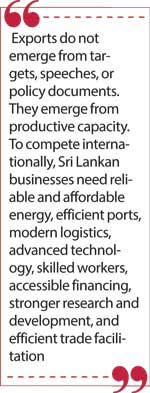
Exports do not emerge from targets, speeches, or policy documents. They emerge from productive capacity.
To compete internationally, Sri Lankan businesses need reliable and affordable energy, efficient ports, modern logistics, advanced technology, skilled workers, accessible financing, stronger research and development, and efficient trade facilitation. They must be able to produce at the quality, cost, reliability, and scale demanded by international markets.
All of this requires capital.
Sri Lanka cannot demand an export-led recovery while being reluctant to invest in the infrastructure, technology, skills, and industries that make exports possible.
Investment cannot wait forever
Sri Lanka therefore needs greater urgency not simply in attracting investment, but in converting credible proposals into productive economic activity.
Foreign direct investment is not merely money crossing a border. The right investment can bring technology, managerial expertise, skilled employment, international supply chains, export markets, research capabilities, and new industrial ecosystems. A major investment can sometimes become the anchor around which suppliers, services, skills, and entirely new industries develop.
Sri Lanka must, of course, scrutinise major proposals rigorously. Commercial terms must make sense. Environmental standards must be protected. Fiscal risks must be understood. Local economic benefits and strategic implications must be carefully assessed.
But scrutiny and speed are not opposites.
A bad investment can cost Sri Lanka dearly. But so can losing a good investment because the country took too long to decide.
The proposed Sinopec refinery illustrates the broader investment dilemma. A project of such scale should not be approved simply because it promises billions of dollars, nor should it be rejected because of geopolitical or ideological considerations. It should be judged on its commercial terms, environmental implications, fiscal risks, energy-security value, local economic benefits, and long-term strategic contribution.
If those conditions are satisfactory, Sri Lanka should be prepared to move decisively.
If a major investment meets the country's commercial, environmental, financial, and strategic requirements, delay becomes more than a bureaucratic inconvenience - it becomes an economic cost. Sri Lanka can lose capital, employment, tax revenue, technology transfer, supplier networks, and the confidence of investors considering future projects.
The country cannot simultaneously say that foreign investment is essential to its recovery while becoming known for taking years to decide whether credible investments should proceed.
The principle should therefore be straightforward:
Scrutinise carefully. Negotiate hard. Reject bad deals. But when a good investment serves the national interest, move decisively.
Development requires calculated risk
Sri Lanka's economic crisis understandably created a more cautious approach to investment, borrowing, and public expenditure.
That caution is necessary. But development itself requires calculated risk.
Infrastructure must often be financed before its economic benefits are fully realised. New industries require investment before they become competitive. Research and technology demand resources before innovation produces returns. New export markets must be entered before demand is guaranteed. Major manufacturers may require negotiations, skills development, supporting infrastructure, and sometimes incentives before the wider economic benefits emerge.
Sri Lanka therefore cannot pursue development with a zero-risk mentality.
The objective of economic governance is not to eliminate risk. It is to distinguish productive risk from reckless risk and to have the confidence to take the former while avoiding the latter.
The crisis should teach Sri Lanka to invest more intelligently, not to become afraid of investment.
Stability must now become development
Sri Lanka now needs to pursue two objectives simultaneously: protect the stability it has regained and build the productive economy it still needs.
That means maintaining fiscal discipline while aggressively attracting investment. It means protecting debt sustainability while responsibly financing infrastructure that raises productivity. It means expanding exports rather than relying predominantly on expenditure restraint and import management. And it means investing in research, innovation, technology, skills, and industrial upgrading.
These are not alternatives to stability.
They are what will make stability sustainable.
Without growth, jobs, investment, productivity, and stronger exports, fiscal stability itself will eventually become harder to maintain. And without expanding economic opportunities, public confidence will inevitably weaken.
Sri Lanka has already learned the consequences of reckless borrowing and poor economic management. Those mistakes should never be repeated.
But excessive caution carries costs of its own.
A country cannot save its way to prosperity. Nor can it simply manage existing resources more carefully and expect economic transformation to occur automatically.
Sri Lanka must produce more, export more, innovate more, attract more investment, create better jobs, and build the infrastructure, technology, and human capital required to compete.
The latest public sentiment numbers should therefore be treated not simply as a political warning, but as an economic message.
Stability can prevent another crisis. Development can prevent permanent stagnation.
Sri Lanka has completed an extraordinarily difficult first stage of recovery. The challenge now is to move beyond managing stability and begin creating prosperity.
Stability was the first step. Development must be the next.
(The author is the Founding Director of the Belt and Road Initiative Sri Lanka (BRISL), a pioneering organisation dedicated to research, dialogue, and engagement on China’s Belt and Road Initiative (BRI). Alongside his leadership role, the author is a researcher and commentator on international relations, economics, and geopolitics, with a particular focus on Asia and the Global South’s evolving role in world affairs. He is a committed advocate for a multi-polar world order and for strengthening the Global South’s voice in shaping international systems and advancing economic integration)