Thursday Oct 15, 2026
Thursday Oct 15, 2026
Friday, 15 May 2026 05:10 - - {{hitsCtrl.values.hits}}
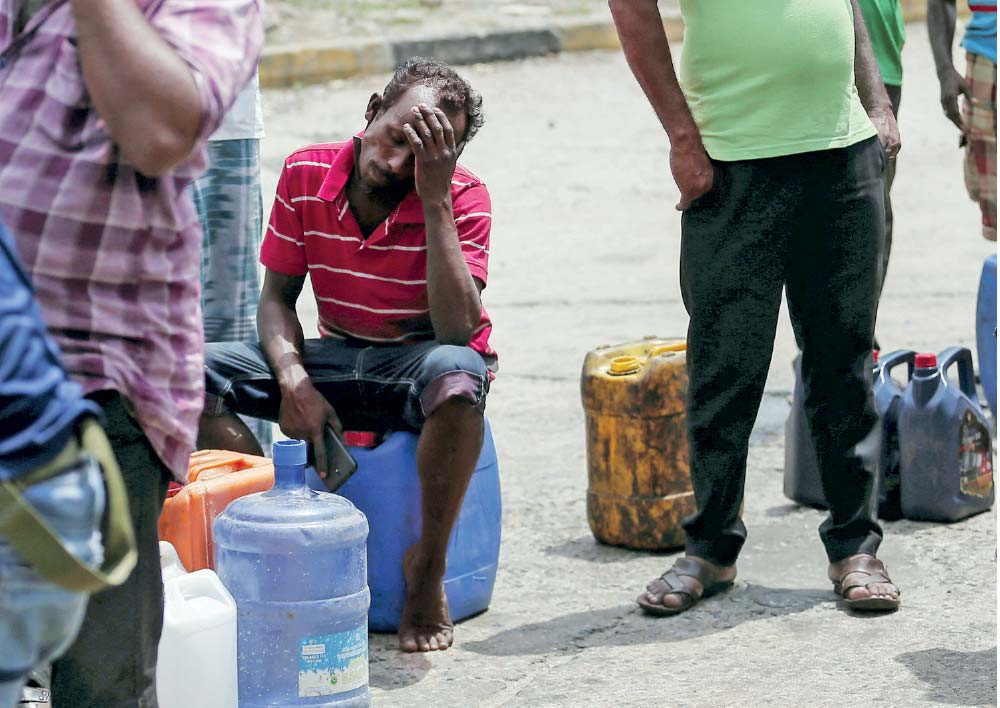
Taxes have risen sharply, disproportionately affecting salaried workers and the middle class. Subsidies have been cut, pushing the cost of basic necessities onto households
 For decades,
Sri Lanka embraced a model of liberalisation that promised growth through markets, foreign borrowing, and private capital. What it delivered instead was an economy dependent on debt, imports, and financial flows—where the majority produce value but cannot afford to consume it without borrowing
 Sri Lanka is told it is “recovering.” Inflation is down, the currency has stabilised, and fiscal discipline is being restored under the guidance of the International Monetary Fund. But beneath these headline gains lies a harder truth: what is being stabilised is not prosperity—it is inequality.
The crisis that exploded in 2022—the Sri Lankan economic crisis (2022)—was not an accident. It was the logical outcome of a system designed to extract value from labour while concentrating wealth in the hands of those who own capital and control finance.
For decades, Sri Lanka embraced a model of liberalisation that promised growth through markets, foreign borrowing, and private capital. What it delivered instead was an economy dependent on debt, imports, and financial flows—where the majority produce value but cannot afford to consume it without borrowing.
This is not inefficiency. It is design.
Workers are paid wages that lag far behind the value they create. The difference—what economists call surplus—is appropriated by capital. That surplus is not reinvested to raise living standards broadly. Instead, it accumulates as profit, assets, and financial power, increasingly detached from the real economy.
When wages cannot sustain consumption, debt steps in. Households borrow to survive. The state borrows to maintain growth. Eventually, the entire system rests on an expanding pyramid of debt—until it collapses, as it did in 2022.
Now, under IMF supervision, Sri Lanka is restructuring its economy. But restructuring for whom?
Taxes have risen sharply, disproportionately affecting salaried workers and the middle class. Subsidies have been cut, pushing the cost of basic necessities onto households. Interest rates have remained high, suppressing wages and small business activity. Public services are strained, forcing people further into private markets and deeper into debt.
Meanwhile, there has been no comparable restructuring of wealth.
There is no serious wealth tax. No meaningful redistribution of asset ownership. No structural challenge to the dominance of financial and corporate elites. The burden of adjustment falls, once again, on those least responsible for the crisis.
This is austerity in its purest form: socialising pain while protecting capital.
The defenders of this system argue that such measures are necessary for “stability.” But stability for whom? An economy where people cannot afford food, education, or healthcare without borrowing is not stable—it is controlled.
Sri Lanka today is not exiting a crisis. It is institutionalising it.
Multiple paths
A different path is possible—but it requires confronting the foundations of the current model.
First, the distribution of income must change. Wages must rise in line with productivity, not be suppressed in the name of competitiveness. Labour is not a cost to be minimised; it is the source of all value.
Second, wealth must be taxed and redistributed. Not symbolically, but structurally—through progressive taxation on property, capital gains, and large asset holdings.
Third, essential goods and services must be decommodified. Healthcare, education, transport, and energy cannot be left to market logic if the majority are to live with dignity.
Fourth, the economy must shift from debt-driven consumption to production rooted in domestic capacity. This requires industrial policy, public investment, and a break from the ideology that markets alone can allocate resources efficiently.
None of this will emerge from the current reform agenda because the system is working exactly as intended—for those who benefit from it.
The real question facing Sri Lanka is not how to restore growth within this model, but whether to continue accepting a model where growth itself depends on inequality. Until that question is answered honestly, every recovery will carry the seeds of the next collapse.
(The author is the former R&D Director at Ansell Ltd, a global leader in the manufacturing and marketing of barrier protection devices, with six patented inventions related to latex product technologies. He can be reached via email at [email protected])
The real question facing Sri Lanka is not how to restore growth within this model, but whether to continue accepting a model where growth itself depends on inequality. Until that question is answered honestly, every recovery will carry the seeds of the next collapse.




