Friday Oct 09, 2026
Friday Oct 09, 2026
Friday, 9 October 2026 00:22 - - {{hitsCtrl.values.hits}}
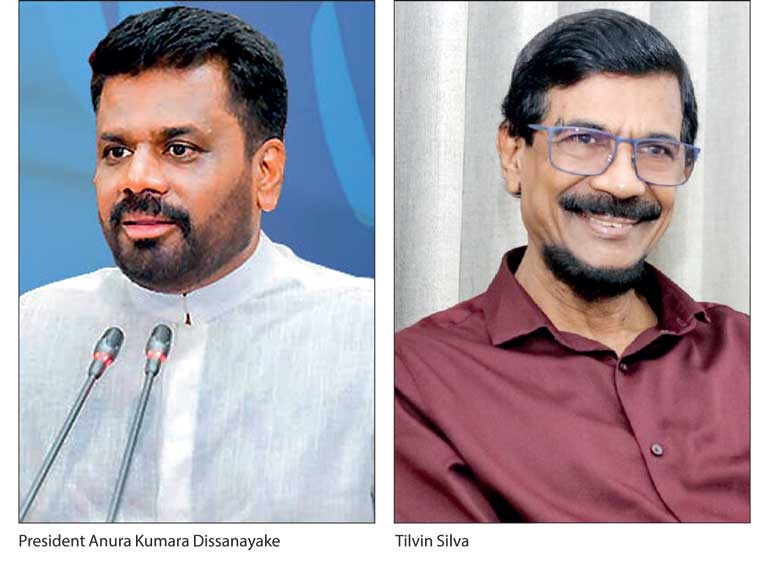
 The NPP came to office promising more than another change of government. It promised to break with the habits of Sri Lankan power. Two years into Anura Kumara Dissanayake’s presidency, there are genuine reforms to show for that mandate but also uncomfortable evidence that some of the country’s oldest political patterns remain remarkably resilient
Sri Lankan politics has never lacked extravagant promises. Political folklore still remembers Sirimavo Bandaranaike’s 1970 campaign pledge to restore the second measure of the rice ration and the famous claim associated with that election that the rice would be found even if it had to be brought “from the moon”. Whether remembered today as rhetorical excess or an artefact of another political era, the story survived because it captured something more enduring about democratic politics: opposition is where governments imagine possibilities; office is where they discover constraints.
The more consequential history, however, concerns promises about power itself. Chandrika Bandaranaike Kumaratunga entered the presidency in 1994 on an explicit reform mandate and vowed to abolish the executive presidency by July 1995. She pursued constitutional reform, but the presidency survived. Two decades later, Maithripala Sirisena won another mandate centred on democratic reform and curbing presidential authority. The 19th Amendment in 2015 did reduce presidential powers, restore independent commissions and reimpose a two-term limit, but parliament itself acknowledged that the executive presidency remained and that complete abolition would require further constitutional change. Between those two reform moments came Mahinda Rajapaksa’s 18th Amendment in 2010, which did something still more revealing about the attraction of executive authority: it removed the constitutional two-term limit on the presidency.
This is the political inheritance against which the National People’s Power must be judged. The NPP did not invent Sri Lanka’s habit of promising more outside government than can later be delivered from inside it. What distinguished the movement in 2024 was its insistence that it intended to break precisely that pattern.
When Anura Kumara Dissanayake entered the presidency on 23 September 2024, Sri Lanka was emerging from more than an economic catastrophe. Sovereign default, shortages and the upheaval of 2022 had become a broader crisis of political legitimacy, driven by the belief that patronage, impunity, concentrated executive authority and politically captured institutions had contributed to the country’s collapse. The NPP’s answer was not simply competent administration. It promised system change: constitutional reform, abolition of the executive presidency, stronger independent institutions, professional policing, anti-corruption enforcement, reduced political privilege and a state in which access to justice would not depend upon surname, ethnicity or proximity to government.
Sri Lankans responded by giving it exceptional democratic power. At the November 2024 parliamentary election the NPP won 159 of 225 seats, leaving its nearest rival with 40. In Jaffna district, hardly traditional JVP territory, it finished first with 80,830 votes, 24.85% of the total, and three seats. The significance of those numbers reaches beyond electoral arithmetic. A political movement whose organisational core, the Janatha Vimukthi Peramuna, had twice pursued revolutionary change through armed insurrection had been handed the state through a ballot box instead.
That should be understood as one of the most important democratic messages of 2024. Sri Lankan voters demonstrated that they did not need another revolution to dismantle an entrenched political establishment. They were prepared to hand even a movement with the JVP’s difficult history an opportunity to govern if it could persuade them that it offered a credible democratic alternative. The greater obligation created by that result was therefore never simply to complete a manifesto checklist; it was to justify the confidence that political transformation could occur through democratic institutions.
The oldest reform promise remains the hardest one
Nowhere is the tension between opposition principle and governing power clearer than in the executive presidency. The NPP explicitly campaigned on constitutional change and abolition of the executive presidential system. Yet two years into Dissanayake’s presidency, the institution remains intact, and in June 2026 Public Administration Minister Chandana Abayaratne acknowledged that abolition remained an election promise while saying it was “not a priority” for the government at that moment.
There are perfectly legitimate reasons not to rewrite a constitution according to an electoral stopwatch. Abolishing the presidency requires decisions about parliament, devolution, executive authority, electoral representation and the constitutional balance between institutions. Kumaratunga’s experience after 1994 and the partial reform achieved under Sirisena demonstrate that these difficulties are real. But they were not discovered after September 2024. They existed when the promise was made.
That history matters because abolition of the executive presidency has become almost a laboratory experiment in how Sri Lankan politicians behave around power. Governments repeatedly inherit an institution their predecessors condemned; reform becomes more complicated once its powers are available to the new occupant. The NPP claimed that it represented a break with this cycle, which means its obligation is greater than explaining why constitutional reform is difficult. It must eventually demonstrate whether an institution diagnosed as a structural problem while the movement was outside government remains a structural problem once the movement controls it.
This is not to say the NPP has done nothing. That would be contradicted by the record. Parliament enacted the Proceeds of Crime Act in April 2025, introduced new asset-and-liability declaration regulations, amended the National Audit Act, and in September 2025 repealed the statutory entitlement regime for former presidents. The latter reform abolished residences, monthly allowances, secretarial allowances, official transport and several other benefits previously provided under law to former presidents and their widows. These are tangible changes and should be counted as such.
But they also illuminate the distinction at the centre of the NPP’s first two years. Removing privileges from former holders of power is easier than surrendering powers available to the current holder. Passing accountability legislation is important; proving that accountability institutions can act independently when their work becomes politically inconvenient is harder. The smaller achievements cannot indefinitely substitute for the larger reforms from which the promise of system change derived much of its force.
Minority trust was won. Justice remains a much larger task
The NPP also deserves to be assessed differently from governments that built electoral legitimacy explicitly through ethnic majoritarianism. Its 2024 parliamentary breakthrough in Jaffna was evidence that at least a significant section of Tamil voters was prepared to test a national movement historically associated with Sinhala-majority southern politics. That was politically important in a country whose post-independence history has repeatedly demonstrated how difficult it is for national parties to acquire genuine confidence across ethnic divisions.
It would therefore be inaccurate to describe the NPP government as simply indifferent to minority concerns. Official figures say 615 acres of land had been released since the government took office through June 2026, on top of 9,480 acres released between the end of the war and December 2024. Nor has the government ignored the enormous unresolved caseload concerning the disappeared. Cabinet disclosed in September 2025 that the Office on Missing Persons had received 16,966 complaints, of which 10,517 remained pending investigation, and approved a special project intended to complete those investigations and related work by the end of 2027.
Those figures demonstrate both action and the scale of what remains. More than 10,000 unresolved complaints are not merely an administrative backlog. They represent families who have lived for years, and in many cases decades, without answers. Releasing land is meaningful, but it is not equivalent to resolving the deeper questions of disappearance, accountability, devolution and political representation that continue to shape relations between the state and communities in the north and east.
Human Rights Watch’s 2026 assessment was particularly critical, arguing that despite the government’s rhetoric of national reconciliation it had done too little to build confidence among Tamil and Muslim communities, while several promised legal reforms remained incomplete. That is an advocacy organisation’s assessment rather than an uncontested verdict, but it underscores a distinction the government cannot avoid: being less reliant on ethnonationalist politics than some predecessors is not itself the same as delivering justice.
Minority voters gave the NPP something difficult to obtain and easy to lose trust in the possibility that national politics could operate differently. The historical significance of that opportunity should make delivery, rather than rhetoric, the standard by which it is judged.
Judicial independence and the problem of unnecessary doubt
The same standard should apply to the judiciary. At a May Day rally in 2026, Dissanayake referred to a judicial decision due later that month and indicated that supporters would have reason to applaud when it was delivered. The Bar Association of Sri Lanka responded with “grave concern”, saying the tenor of the remarks was open to the suggestion of interference and could erode public confidence in the judiciary.
The limits of what can responsibly be claimed here are important. There is no evidence that the president privately communicated with the judges, knew the judgment in advance or determined its outcome. Those would be much more serious allegations and should not be inferred without evidence. But a government elected on a programme of depoliticisation should understand why even the perception of executive expectation around a pending judgment is damaging. Judicial independence depends not merely upon politicians refraining from issuing direct orders to judges; it depends upon maintaining sufficient institutional distance that judgments for the government do not appear compliant and judgments against it do not appear defiant.
That point becomes especially important when accountability is directed at members of previous administrations. There is nothing inherently suspicious about investigating former presidents, Rajapaksas or opposition politicians. If credible evidence exists, failing to investigate them because they are politically powerful would reproduce precisely the impunity Sri Lanka was promised would end.
Yet prosecutions of yesterday’s rulers cannot themselves establish that the system has become impartial. The real test arrives when credible allegations concern an NPP minister, JVP official, senior government appointee or political ally. The question then will be whether investigators move with the same urgency, prosecutors apply the same evidentiary thresholds and ministers protect the institution rather than the individual. That principle was already at the centre of the original argument: justice becomes credible when it can move inward as readily as outward.
The PTA is a reminder that states surrender coercive power reluctantly
The Prevention of Terrorism Act presents an even sharper test. The NPP campaigned on abolishing oppressive legislation including the PTA, yet the government disclosed that 49 people were arrested under it in the first five months of 2025, compared with 38 during all of 2024. Amnesty International recorded the continued use of the legislation, including beyond conventional terrorism cases.
The case of Mohamad Liyaudeen Mohamed Rusdi illustrates why that matters. He was arrested by the Counter Terrorism and Investigation Division in March 2025, with allegations including his display of two anti-Israel stickers. Dissanayake, acting as defence minister, issued a detention order. After examining the evidence, the Human Rights Commission found insufficient material establishing an offence under the PTA, and Rusdi was released in April. The Commission said investigators had acknowledged that the words on the stickers did not themselves constitute a PTA offence.
The government subsequently drafted replacement counter-terrorism legislation, but Human Rights Watch argued in January 2026 that significant provisions risked reproducing powers associated with the PTA, including broad definitions and extensive detention authority. Again, that is the assessment of a rights organisation, not a court ruling. But it raises a question that lies at the heart of system change: does reform mean trusting a new government to use inherited coercive powers more responsibly, or designing institutions so that no government can easily abuse them?
For the JVP, this should be more than an abstract constitutional debate. Its own history demonstrates what can happen when coercive state power is exercised without sufficient restraint. A movement that once suffered brutal repression by the state now possesses authority over that state; few political movements have had a clearer historical reason to understand why safeguards must survive the goodwill of the people temporarily in charge.
Recovery is measurable. So is the hardship that remains
The government’s economic record also requires more nuance than either celebration or dismissal. Sri Lanka’s recovery is real. The World Bank recorded 5% economic growth in 2024, while the IMF reported this week that output expanded 4.2% year-on-year in the second quarter of 2026, marking an 11th consecutive quarter of growth. Maintaining the IMF-supported stabilisation framework, despite the JVP’s history and earlier criticism of parts of that programme, has also demonstrated a pragmatic willingness to govern within constraints that campaign politics can sometimes obscure.
But the social legacy of the crisis remains severe. The World Bank estimated poverty at 24.5% in 2024, around twice the 2019 level; food prices had more than doubled between 2021 and 2024, employment remained weak and real wages were still below their 2019 levels. By October 2025 the Bank was still describing the recovery as “uneven and incomplete”, noting that national output remained below its 2018 level.
No serious analysis should attribute that hardship entirely to a government that inherited the aftermath of collapse. But the statistics matter because the NPP promised more than macroeconomic stabilisation. Its political challenge is to demonstrate that stability eventually reaches households with higher incomes, better employment, functioning public services and economic security. An economy can recover in aggregate long before citizens experience recovery in their own lives.
The real promise was not 1,325 promises
This is why reducing the NPP’s first two years to a percentage of manifesto commitments misses the larger story. Sri Lanka has experienced generations of governments that promised more than they delivered. The rice-ration politics of the 1970s belonged to one era; repeated promises to abolish the executive presidency belonged to another. The recurring problem has been less that politicians make promises all democracies produce than that the behaviour of power repeatedly proves more durable than the movements that promised to reform it.
The NPP’s democratic achievement in 2024 was substantial. It displaced much of the established political order without violence, won support well beyond the JVP’s historical base and obtained 159 parliamentary seats through an election. It has since enacted meaningful anti-corruption and governance measures and preserved a difficult economic stabilisation. These are not illusions and should not be described as such.
But neither should they obscure what remains unresolved. The executive presidency the NPP pledged to abolish survives, with abolition no longer an immediate priority. More than 10,000 complaints before the Office on Missing Persons remained pending when the government approved its latest program. The PTA was used dozens of times after the NPP entered office, and its proposed replacement has attracted serious human-rights criticism. A presidential remark concerning a pending judgment prompted the Bar Association to warn about public confidence in judicial independence. The economic recovery is measurable, but so is poverty at roughly twice its pre-crisis level.
None of this establishes that the NPP has become indistinguishable from the governments it defeated, and two years is too short a period for such a sweeping conclusion. It does establish something more useful: the distance between changing the people who control a political system and changing the incentives, powers and institutions through which that system operates.
The most important message of 2024 may ultimately be directed not at Sri Lanka’s old political establishment but at the JVP itself. The movement once believed revolutionary change required confrontation with the state. Decades later, Sri Lankan voters demonstrated something more democratic and more powerful: if a political movement gives them sufficient reason to trust it, they are prepared to hand it to the state peacefully.
That trust carries an obligation greater than fulfilling every campaign pledge. It requires proving that governments do not inevitably become prisoners of the powers they once promised to restrain. Two years into the NPP experiment, that question remains open and it may matter far more to Sri Lanka’s democratic future than whether any government can ever promise to bring rice from the moon.
(The author is an International Relations student at Monash University whose writing explores politics, governance, and international affairs)




