Thursday Oct 01, 2026
Thursday Oct 01, 2026
Thursday, 1 October 2026 00:20 - - {{hitsCtrl.values.hits}}
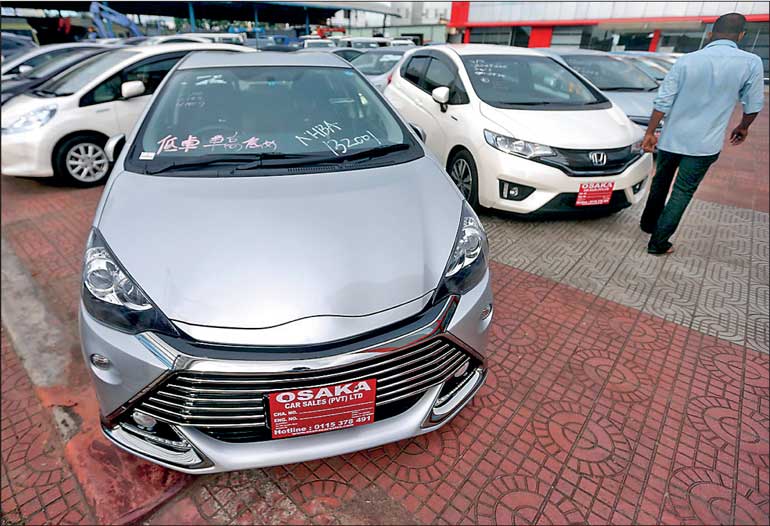
 In January, I argued in these pages that Sri Lanka's reopened vehicle market was entering a phase of correction rather than expansion. Nine months later, the data confirm that the correction has arrived, but its main driver has changed. Today's problem is less about too many vehicles and more about too few buyers who can afford them.
The boom that funded the Treasury
When imports reopened in 2025, years of pent-up demand were released almost overnight. According to the Central Bank Governor, the country spent close to $ 2 billion
on vehicle imports in 2025, well above the earlier projection of $ 1.5-1.7 billion The fiscal impact was striking. The Parliamentary Committee on Public Finance (COPF) reported vehicle-related tax collections of around Rs. 650 billion, against an initial projection of Rs. 450 billion, making vehicles the single largest driver of the year's record revenue performance.
That momentum carried into 2026. Close to $ 600 million was spent on vehicle imports in the first quarter alone, prompting the Central Bank to warn that full-year spending could reach $ 2.4 billion if the pace continued.
Policy applies the brakes
With fuel import costs rising sharply and the external account under pressure, the Government moved to cool demand. Two measures now define the market.
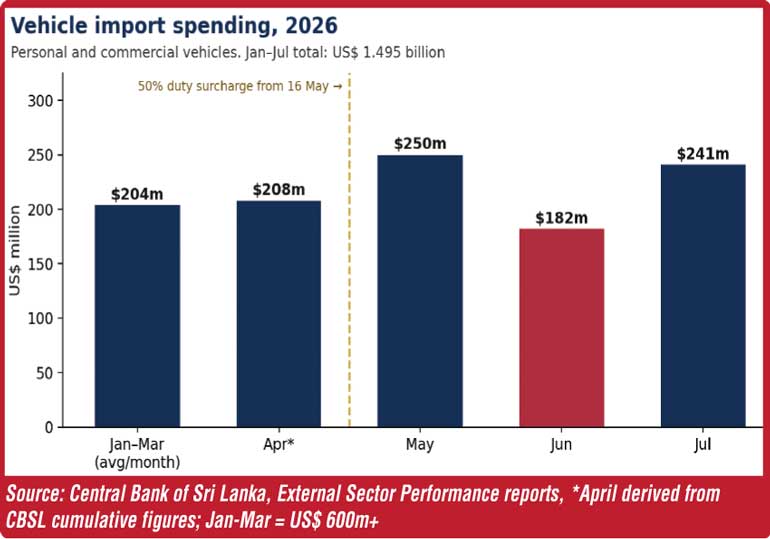
The first is a 50% surcharge on Customs Import Duty for vehicles, effective from 16 May 2026 and since extended to 31 December. Vehicles imported against Letters of Credit opened on or before 15 May are exempt.
The second is tighter loan-to-value (LTV) limits from 25 May. Maximum financing for cars, SUVs, vans and three-wheelers fell from 50% to 40%, and for commercial vehicles from 70% to 60%.
The effect was quick. Sri Lanka Customs reported that daily vehicle clearances fell from around 450 to about 350. Monthly import spending dropped 27.1% to $ 182 million in June, before rising again to $ 241 million in July as older Letters of Credit cleared, bringing January–July spending to $ 1.495 billion.
The affordability wall
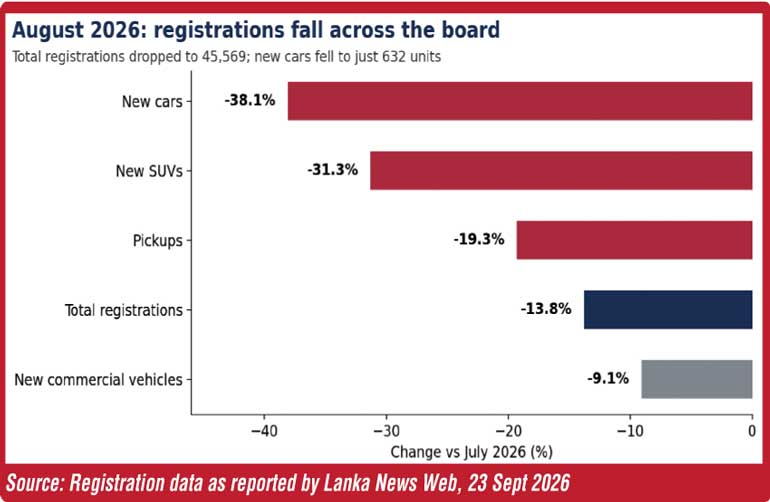
August registration data show where the pressure is landing. Total registrations fell 13.8% month-on-month to 45,569. Brand-new cars fell 38.1% to just 632 units, new SUVs fell 31.3% to 1,093, and new commercial vehicles fell 9.1% to 1,311. Pickups, the workhorse of farmers, builders and distributors, fell 19.3%.
The LTV change explains much of this. On a Rs. 10 million car, a buyer who previously needed Rs. 5 million of their own money now needs Rs. 6 million, before insurance, registration and the surcharge-driven price increase. For salaried households still carrying high debt and living costs, that is often the difference between buying now and waiting.
Buyers become economists
The market is not collapsing evenly; it is re-sorting. Hybrid models took 49% of new SUV registrations in August, up from 25% in July, while the EV share fell from 28% to 14%.
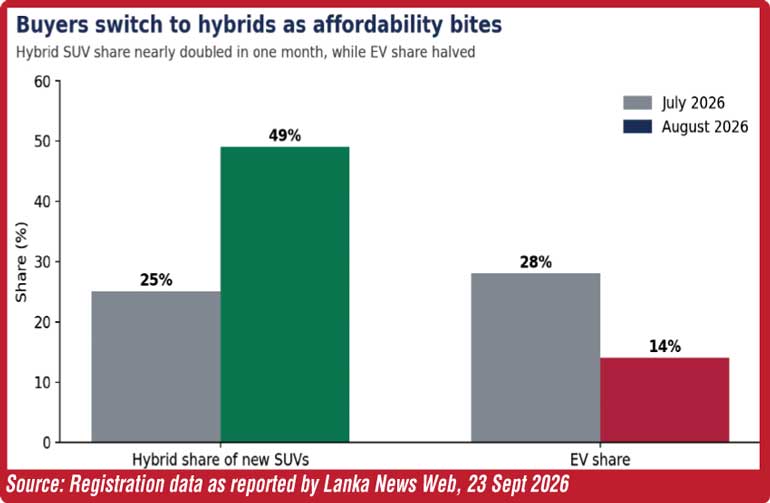
This confirms the shift I highlighted in January: buyers now judge vehicles on total cost of ownership rather than brand prestige. With fuel import spending up almost 60% year-on-year in January–July, hybrids offer a practical middle path, with lower running costs but without the higher upfront price and charging uncertainty of full EVs.
The Ditwah factor
The cyclone that struck on 28 November 2025 added a hidden layer to the market. The World Bank estimated direct damage at $ 4.1 billion, about 4% of GDP. By 11 December, insurers had received 21,306 claims, and 14,064 of them, roughly two in every three, were for motor vehicles.
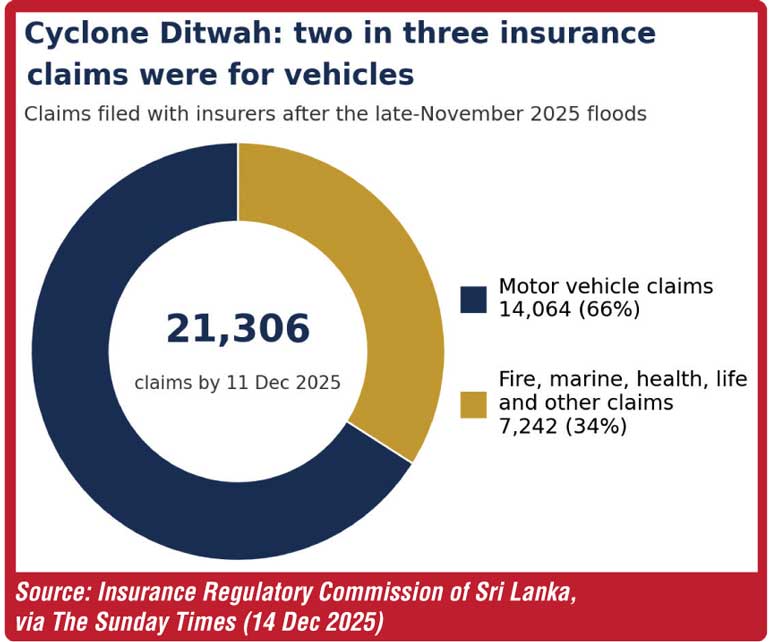
This matters in three ways. Thousands of households lost a vehicle and need a replacement just as financing has tightened. Flood-damaged vehicles that were repaired or written off may re-enter the used market without clear disclosure, creating risk for buyers. And insurers' motor portfolios have taken a heavy hit, which may eventually flow through to premiums.
The wider economy
Vehicles are not just consumer goods. Every sale supports banks, leasing companies, insurers, workshops, spare-parts dealers and the Treasury, so a prolonged slump would ripple through all of them. At the same time, unrestrained imports strain foreign reserves. Sri Lanka's merchandise trade deficit widened to $ 6.5 billion in January–July 2026, compared with $ 3.9 billion a year earlier, and the current account has now been in deficit for four consecutive months. Good policy has to balance both sides.
Solutions: from volume to value
For policymakers:
1. Publish a clear exit path for the surcharge. Announce now whether it will end, taper or continue after 31 December. Uncertainty itself freezes demand, because buyers wait for policy decisions rather than prices.
2. Make LTV smarter, not only tighter. Consider higher financing limits for fuel-efficient vehicles, for commercial vehicles used by SMEs and farmers, and for Ditwah-affected households replacing a destroyed vehicle.
3. Close valuation loopholes. Industry reports that high-end vehicles have been declared as used to access tax concessions should be examined. Consistent valuation protects both revenue and fair competition.
4. Publish monthly market data. A single official monthly release of registrations by segment and fuel type would help banks, dealers and buyers plan with confidence.
For the industry:
5. Create a flood-damage disclosure system. Insurers, the Department of Motor Traffic and dealers should flag vehicles that were written off or heavily repaired after Ditwah, so buyers know exactly what they are purchasing.
6. Offer certified pre-owned programmes and structured leasing. With higher cash down payments, trusted used vehicles and flexible leasing can keep buyers in the market.
7. Invest in after-sales service and charging networks. EV adoption stalls without confidence in service and charging, and the brands that build this now will lead the next upswing.
For buyers:
8. Compare total cost of ownership, including fuel, maintenance, insurance and resale value, not only the sticker price. Before buying a used vehicle, check its insurance and flood history.
Conclusion
Sri Lanka's vehicle market has moved from a supply shock to an affordability shock. The coming months, with the surcharge in place until year-end and credit still tight, will decide whether the market stabilises or slides into a longer contraction. The path to stability lies in predictable policy, honest data and an industry that competes on value rather than volume. If these are achieved, the vehicle sector can become a steady contributor to recovery rather than a boom-and-bust revenue windfall.
(The writer is an independent analyst.)
Data sources: Central Bank of Sri Lanka (External Sector Performance reports, 2026); Parliamentary Committee on Public Finance; Sri Lanka Customs; vehicle registration data for August 2026; Insurance Regulatory Commission of Sri Lanka; World Bank GRADE assessment of Cyclone Ditwah.



