Thursday Oct 22, 2026
Thursday Oct 22, 2026
Thursday, 11 December 2025 04:39 - - {{hitsCtrl.values.hits}}
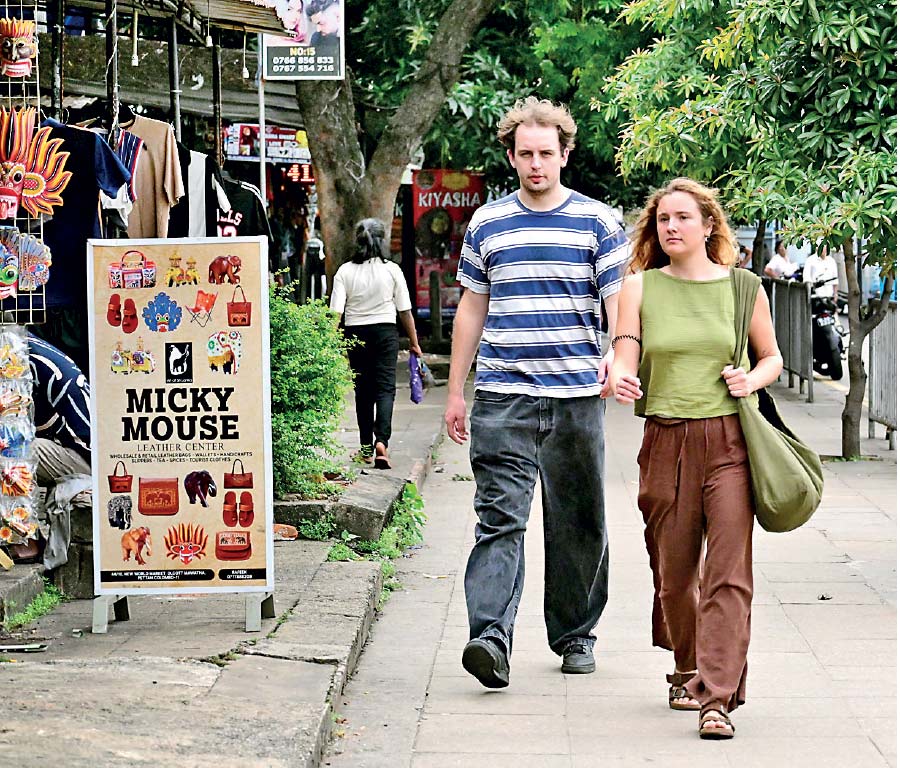
Two tourists enjoying a walk in the city yesterday - Pic by Sameera Wijesinghe
 Sri Lanka’s tourism promotion mechanisms face well-known constraints that make rapid crisis-response communication challenging. These limitations are not unique to this moment, but they underscore the importance of ensuring that a communication vacuum does not arise at a time when global travellers are searching intensely for up-to-date information. Silence risks harming new bookings. This is where the industry must act together. Hotels, guides, tour operators, industry associations, and regional groups can move with agility to ensure Sri Lanka’s story is communicated clearly, factually, and promptly
 Early global reactions to the recent cyclone suggest that the event did not create the reputational shock many feared. While deeply distressing for affected communities, the world has largely viewed it as one of a series of increasingly common climate incidents across the region.
Recent Google Trends data—one of the clearest real-time indicators of international traveller sentiment—shows that interest in Sri Lanka has not collapsed. Instead, the market is displaying the typical 10–20 day hesitation window seen worldwide after climate-related events.
Travel interest remains resilient
Searches for “hotels in Sri Lanka” held strong up to mid-November, dipped briefly after the cyclone, and then stabilised. By early December, there were even signs of a mild rebound. This indicates that travellers remain interested; they are pausing for clarity, not abandoning their plans.
Meanwhile, searches for “is Sri Lanka safe to travel” rose in the immediate aftermath but have already begun to ease. Crucially, the majority of global searches relating to Sri Lanka continue to focus on holidays, not disasters.
Although the new booking pace has dropped 30-50% we have not lost demand. Travellers simply want reassurance—and they are actively looking for it online. Demand needs to convert to bookings by providing this reassurance.
A moment for strong, coordinated messaging
Sri Lanka’s tourism promotion mechanisms face well-known constraints that make rapid crisis-response communication challenging. These limitations are not unique to this moment, but they underscore the importance of ensuring that a communication vacuum does not arise at a time when global travellers are searching intensely for up-to-date information. Silence risks harming new bookings.
This is where the industry must act together. Hotels, guides, tour operators, industry associations, and regional groups can move with agility to ensure Sri Lanka’s story is communicated clearly, factually, and promptly.
A powerful example is the newly established Hill Country Tourism Bureau, which mobilised within days of the cyclone. It has produced strong content, coordinated messaging, and showcased that the Central Highlands is open for business. Such regional leadership strengthens the national narrative and demonstrates what can be achieved through collaboration and speed.
Although the new booking pace has dropped 30-50% we have not lost demand. Travellers simply want reassurance—and they are actively looking for it online. Demand needs to convert to bookings by providing this reassurance
Over the next two to three weeks, booking pace will be softer than usual. This is expected after an event of this nature. However, with effective messaging, the January–April 2026 high season still holds strong potential. The window for influencing global sentiment is open now, and the actions taken over the next 10–14 days will significantly shape the outlook
Shaping perception in the age of AI
The next frontier in tourism communication is not traditional digital advertising—it is artificial intelligence-driven search. Increasingly, travellers rely on AI tools and LLM-powered search engines for immediate answers to questions such as “Is Sri Lanka safe?” or “Is it a good time to visit?”
These systems draw heavily from publicly available online sentiment, especially from text-rich, discussion-led platforms. To regain momentum and reverse hesitation, Sri Lanka must ensure that a clear, consistent message reaches these platforms: Sri Lanka is safe to visit, and all key tourism regions and attractions remain accessible.
Authentic, first-hand accounts from travellers currently on the island are among the most powerful tools we have. Guests who are enjoying positive, safe experiences are natural ambassadors. Encouraging them to share their stories shapes the online conversation—and, in turn, the answers AI engines provide.
Platforms with the greatest influence on AI outputs include:
Every accurate, positive post strengthens the overall narrative. In today’s digital landscape, repetition builds authority—and that authority shapes what AI platforms present as truth.
A short window for recovery
Over the next two to three weeks, booking pace will be softer than usual. This is expected after an event of this nature. However, with effective messaging, the January–April 2026 high season still holds strong potential. The window for influencing global sentiment is open now, and the actions taken over the next 10–14 days will significantly shape the outlook.
Acting together, with confidence
Sri Lanka continues to hold the world’s interest. Travellers are watching, searching, and weighing their options. They are not turning away—they are waiting for reassurance.
What they need is simple: clear updates, accurate information, and real stories from travellers who are experiencing the island safely today.
By working together—Government, private sector, regional associations, and visitors themselves—we can ensure that the online narrative reflects the reality on the ground. If we respond with clarity, consistency, and confidence, Sri Lanka’s tourism industry can emerge from this moment stronger and more resilient.
(The author is the President of Sri Lanka Tourism Alliance)




