Monday Oct 12, 2026
Monday Oct 12, 2026
Monday, 12 October 2026 02:58 - - {{hitsCtrl.values.hits}}
 What we won’t accept is a drift back toward the fragmented surcharges of the pre-2013 era, revisited under a new name, at the expense of every Sri Lankan who ultimately pays, in higher prices, for what moves through this country’s ports. It is worth defending for good, for the sake of everyone in this country, not just those who work in shipping and trade
We have been here before. A handful of intermediaries, reportedly backed by powerful players who dominate shipping and logistics in Sri Lanka, are once again pushing to reinstate separate Terminal Handling Charges (THC). It is framed as a competitiveness fix. It isn’t. It is the latest in a pattern stretching back over decades, and it deserves to be brought out into the open, not kept behind closed doors. This affects every person in this country, because it determines what you pay for the goods you buy, every day.
What is a THC, and why should you care?
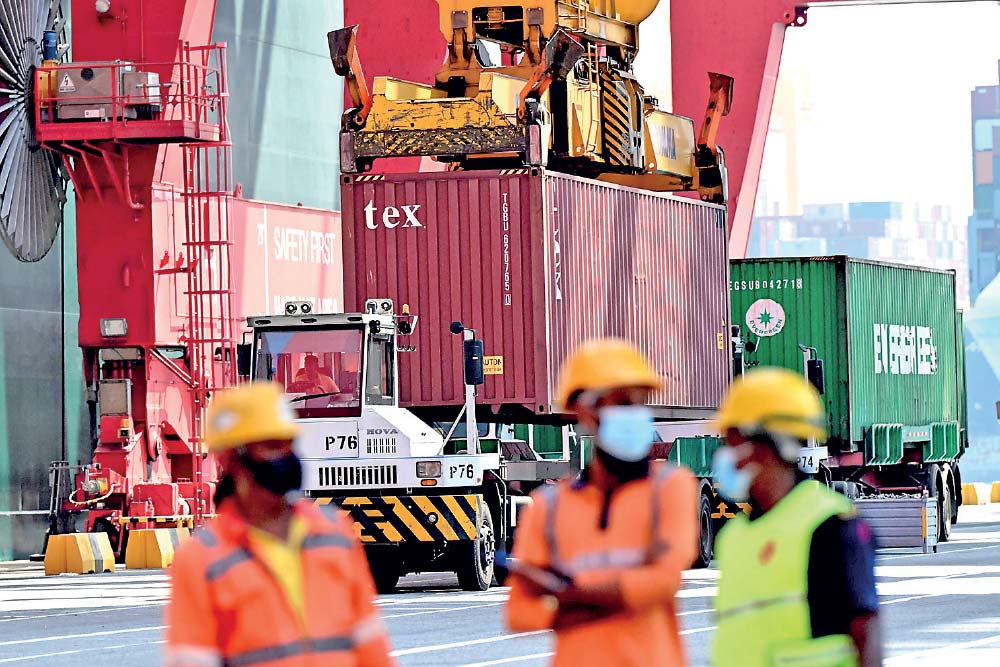
A Terminal Handling Charge is a fee for moving a shipping container through a port, lifting it on and off the vessel, and preparing it for its next leg. On paper, a small, technical shipping cost. In practice, it isn’t.
In Sri Lanka, regulations stipulate that this cost is incorporated into one all-inclusive freight charge, paid to the shipping line, by the party who has entered into a contract with the shipping line. This all-inclusive price is agreed in advance and there are no hidden extras which come out after the contract is effected. What’s being pushed for now is to introduce a separate Terminal Handling Charge (THC), which is then to be charged separately over and above the agreed all-inclusive freight charge.
That matters even if you’ve never shipped a container, because almost everything you buy, rice, medicine, cement, clothing, has passed through a port. Every charge added along that journey doesn’t disappear. It moves down the chain, from shipping line to importer, to wholesaler, to retailer, and finally to the price tag you see in the shop. A line item in a shipping contract becomes a few extra rupees on a bag of rice or a child’s school shoes, multiplied across millions of transactions a year. A history that keeps repeating itself.
This isn’t new ground. Following years of debate, the concept of the all-inclusive freight, paid by the contracting party, was established under Gazette
No. 1842/16 in December 2013, and strengthened in 2017 under Gazette No. 2041/10. For nearly a decade, container costs had to be quoted as one all-inclusive freight rate, charged only to the party actually contracting for the service.
Then, in October 2022, the Ministry of Shipping issued a Gazette
granting new tariffs at the request of local service providers, in violation of the Shipping Act. When it became clear the Minister lacked the legal power to set tariffs under the 1972 Act, the Ministry moved to acquire it through Parliament.
JAAF, together with the Sri Lanka Shippers’ Council and the Sri Lanka Association of Manufacturers and Exporters of Rubber Products, challenged this in the Supreme Court. The Court ruled that the then Minister had overreached, and that rescinding the Gazette could only be done through a two-thirds Parliamentary majority.
Even then, the pressure didn’t let up. Weeks later, the Ministry amended the Gazette and, shaped by the same service providers, also rescinded the 2017 protection. Public pressure brought it back within days: Gazette No. 2334/26, dated 31 March 2023, restored the rule and remains in force today.
Four attempts to weaken it in 2022 and 2023 alone. The pressure goes back further still. Since 2013, every change of Government has brought a fresh attempt to challenge this protection. Each time, it has held, because successive administrations understood the rule exists for the country’s benefit, not to enrich a handful of intermediaries. It’s worth asking why, if the case for change hasn’t held up in over a decade of trying, the attempt keeps returning.
What is actually being protected
There is no such term as “Terminal Handling Charge” anywhere in the Sri Lanka Ports Authority’s own tariff. The tariff says, clearly, that a vessel’s stevedoring cost must be paid directly by the shipping line to the port. That is not a cost shipping lines can roll over to exporters and importers as a separate charge. It must be embedded, with every other expense and margin, into one all-inclusive freight payment.
The Gazette has never stopped any provider from collecting money genuinely owed to them. It simply requires this to happen within an all-inclusive framework, where bargaining power, not an invented local surcharge, determines which provider a customer uses.
Before this protection took hold, importers and exporters faced nearly 50 separate charges, many variables, many borne by importers with no say in how they were set. Separate THC on imports alone rose from $ 55 in 1995 to $ 155 per ton today.
Where JAAF stands
As the body representing an industry moving the bulk of Sri Lanka’s apparel exports through Colombo, JAAF has a direct stake in this. We stand for upholding Gazette No. 2334/26 and the Supreme Court ruling behind it, in full.
This is not an open question. The Court has ruled, and successive governments have tested and upheld this protection, repeatedly, for over a decade. What JAAF carried into its recent meeting with the Ports Minister was not a request to reopen the matter, but a reminder that this Gazette protects the public as well, and should not be amended or rescinded.
What’s actually at stake
Transparent, all-inclusive THC pricing protects exporters, importers and consumers. It took a decade of repeated attempts, and a Supreme Court ruling, to secure this clarity. It shouldn’t be undone quietly, however many times the attempt returns.
What we won’t accept is a drift back toward the fragmented surcharges of the pre-2013 era, revisited under a new name, at the expense of every Sri Lankan who ultimately pays, in higher prices, for what moves through this country’s ports. It is worth defending for good, for the sake of everyone in this country, not just those who work in shipping and trade.
(The author’s comments are in his capacity representing the Joint Apparel Association Forum (JAAF).




